


Description
Tick & Trace is an AUE2601 auditing revision pack for South African second-year auditing students who want to understand the work and, just as importantly, write answers that earn marks. In 68 A4 pages it takes you from the audit process map to the auditor’s report, maps five transaction cycles control by control, and then trains you on twelve original scenario questions with full model answers.
It supports UNISA AUE2601 Auditing Theory and Practice and equivalent second-year external auditing modules in BCom Accounting, BCompt and BAcc programmes.
What this auditing revision pack does
Auditing questions rarely ask you to recite theory. They give you a scenario and ask you to identify weaknesses, recommend controls, design audit procedures, evaluate ethics threats or choose an audit opinion. Tick & Trace is built around that reality. Every topic is explained in plain language on one or two pages, then linked to the exact type of question it appears in, with a framework that shows you how to structure the answer.
Who it is for
- Students registered for UNISA AUE2601 Auditing Theory and Practice, or a second-year auditing module at another South African university
- BCom Accounting, BCompt and BAcc students preparing for assignments, tests and exams
- Students who know the theory but lose marks on scenario questions
- Repeating students who want a clear, structured revision plan
Main benefits
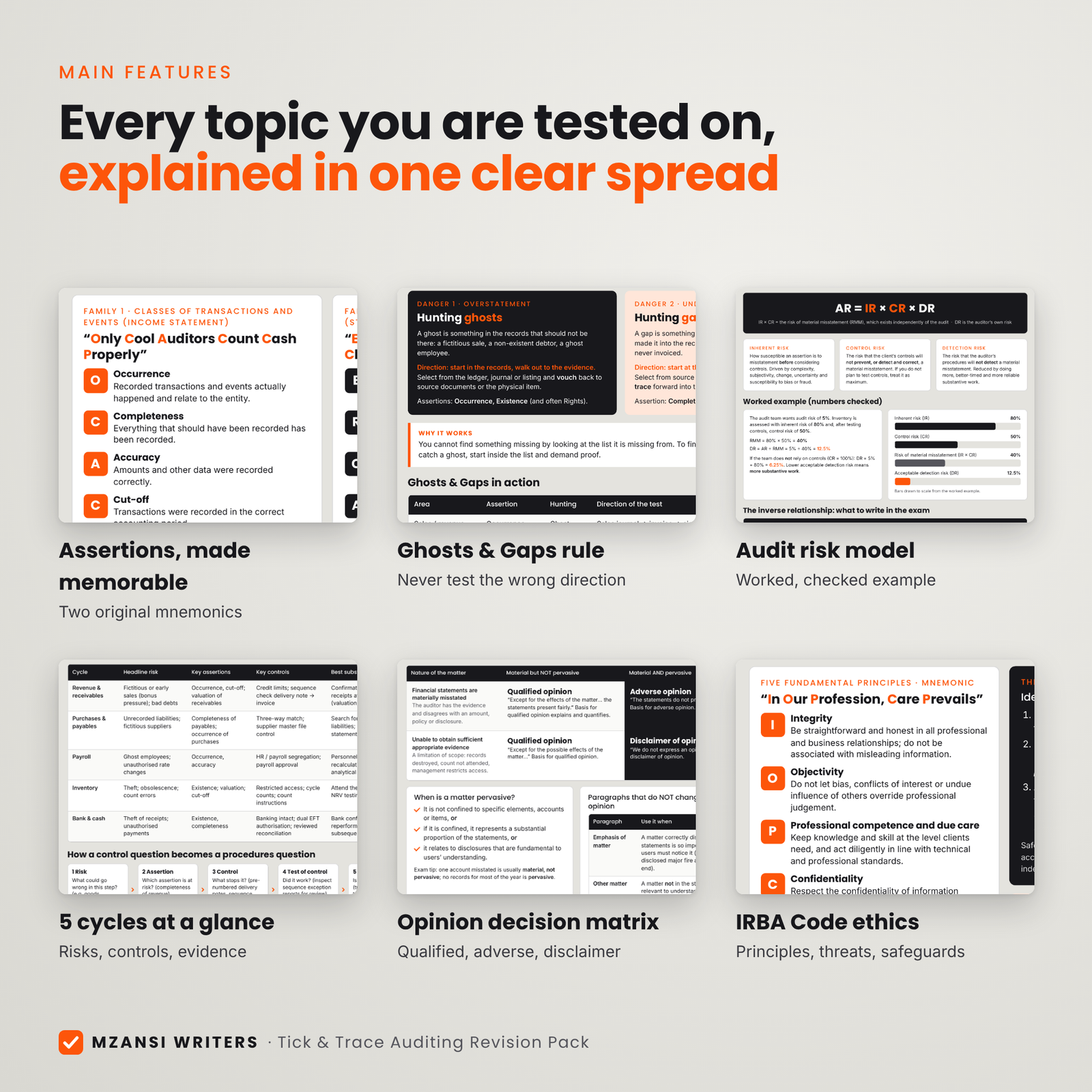
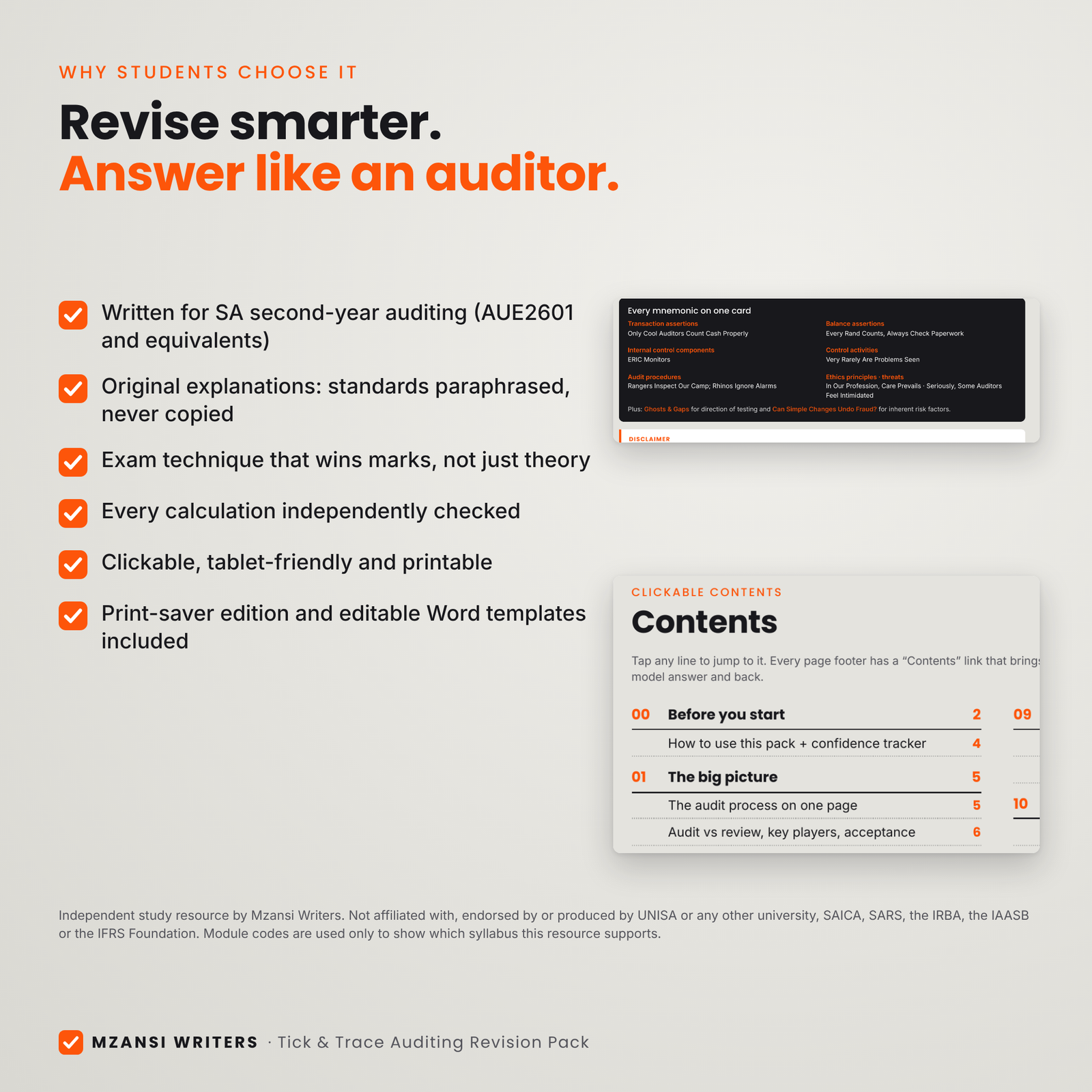
- Remember more: original mnemonics for assertions, internal control components, control activities, audit procedures, inherent risk factors and ethics, plus the Ghosts & Gaps rule that tells you which direction to test.
- Answer better: four answering frameworks (Do-What-Where-Why for procedures, Spot-Sting-Solve for control weaknesses, Principle-Threat-Test-Action for ethics, Nature-Size-Spread-Say for audit reports) and side-by-side weak versus full-mark answers.
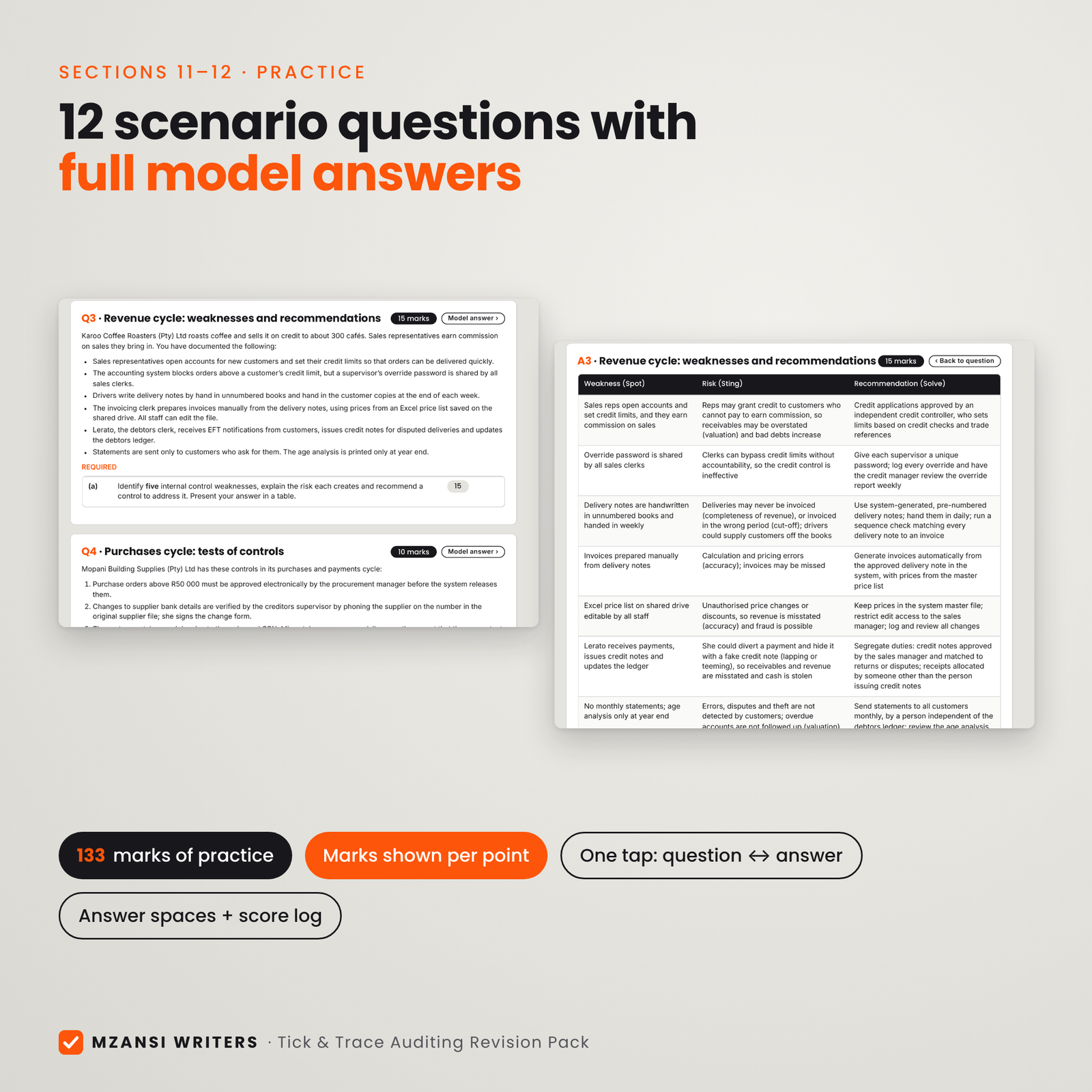
- Practise properly: twelve exam-style scenarios worth 133 marks, with model answers that show where each mark is earned.
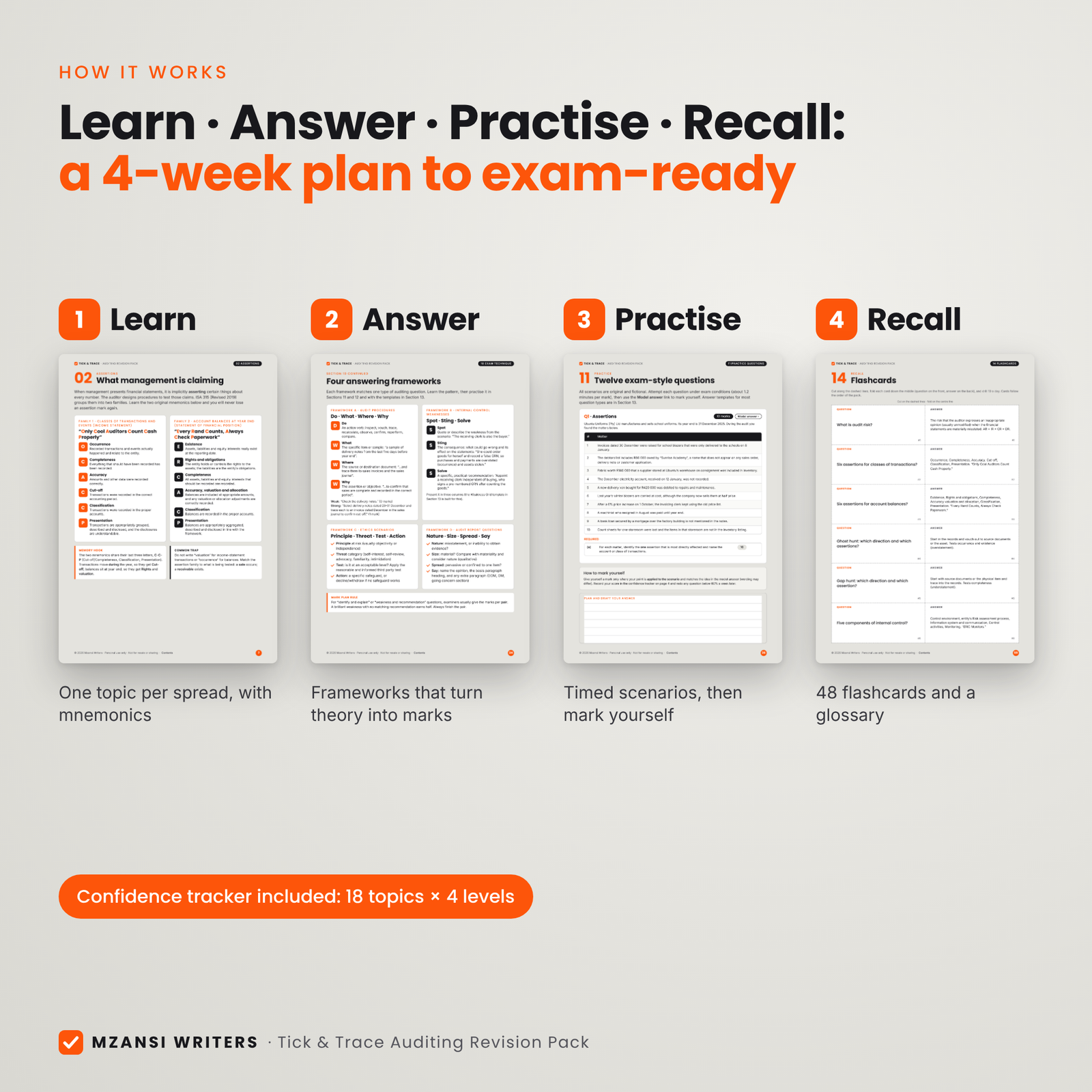
- Revise faster: a 4-week plan, a confidence tracker and 48 flashcards for daily recall.
Features and topics covered
Auditing theory, explained in your own language
- The audit process on one page, audit versus review engagements, the people involved and engagement acceptance
- Assertions for classes of transactions and account balances, with worked direction-of-testing examples
- The audit risk model and materiality, with calculations checked before publication
- Internal control components, control activities, general IT and application controls, and how auditors evaluate controls
- Tests of controls versus substantive procedures, and choosing the audit approach
- Audit evidence: sufficient and appropriate evidence, the seven procedures, analytical procedures, sampling, confirmations and using experts
Five transaction cycles, control by control
Revenue and receivables, purchases and payables, payroll, inventory (including attending the inventory count) and bank and cash. Each cycle shows the process flow, key documents, what can go wrong, the control that prevents it, the test of control and the substantive procedures for each assertion.
Completion, reporting and ethics
- Subsequent events, going concern, written representations and evaluating misstatements
- The structure of the auditor’s report and a decision matrix for qualified, adverse and disclaimer opinions, emphasis of matter and key audit matters
- Professional ethics basics from the IRBA Code in plain language: fundamental principles, the conceptual framework, the five threats, independence, confidentiality and reportable irregularities
Auditing standards and the IRBA Code are paraphrased in our own words with their reference numbers. No standard text, tutorial letter or past paper is reproduced.
What is included
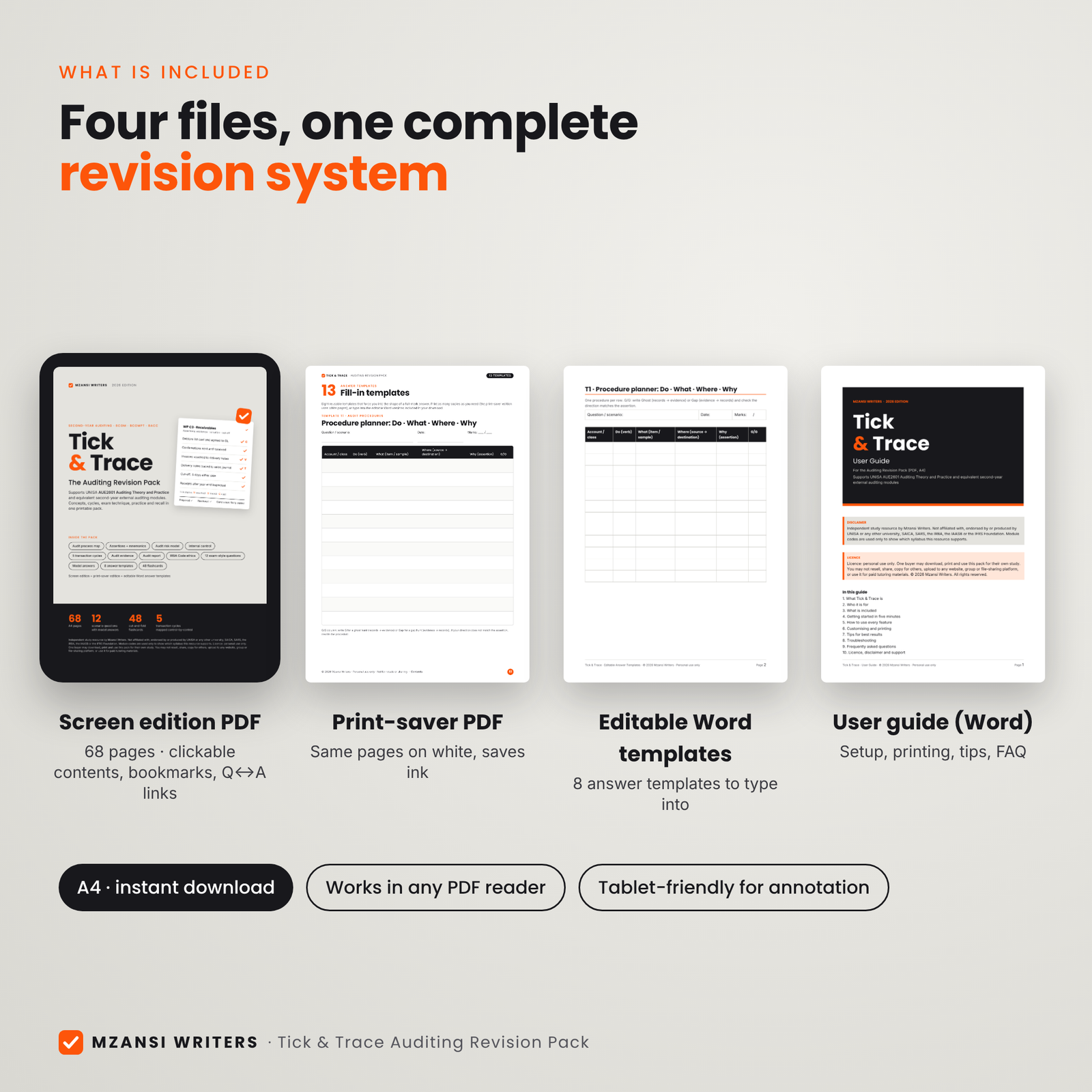
- Screen edition PDF (68 A4 pages): chalk-grey pages with clickable contents, bookmarks, a Contents link in every page footer and one-tap links between each question and its model answer
- Print-saver edition PDF: the same pages on white, with identical page numbers, to save ink
- Editable answer templates (Word .docx): the eight templates ready to type into
- User guide (Word .docx): getting started, printing, every feature, troubleshooting and FAQ
How it works
- Learn one topic per spread, using the mnemonics and tables.
- Answer with the frameworks in the exam technique section.
- Practise the twelve timed scenario questions, then mark yourself against the model answers and log your score.
- Recall daily with the flashcards, and track your progress on the confidence tracker.
File formats and software requirements
PDF files open in any PDF reader, including Adobe Acrobat Reader, Microsoft Edge, Chrome, Apple Preview and tablet apps such as GoodNotes, Notability and Xodo. The Word templates and user guide are .docx files that open in Microsoft Word, LibreOffice Writer or Google Docs. Page size is A4.
Customisation
Print only the pages you need, annotate the PDF on a tablet, or type into the Word templates and add rows as you go. Template money columns are labelled “Amount”, so you can work in rand or any other currency.
Digital download
This is a digital product. No physical item is posted. You can download your files immediately after payment.
Use cases
- Revising for the AUE2601 exam in the four weeks before the exam date
- Preparing for an assignment on internal control weaknesses or audit procedures
- Drilling assertions, threats and opinions with flashcards on the taxi or during lunch breaks
- Running a study session with your own copy and the practice score log
Frequently asked questions
Is this the official UNISA AUE2601 study guide?
No. It is an independent study resource by Mzansi Writers that supports the module. Always use your current tutorial letters and prescribed textbook as the final word.
Are the questions copied from past papers?
No. All twelve scenarios, model answers, examples and mnemonics are original.
Does it include model answers with marks?
Yes. Every question has a full model answer with the marks shown next to each point.
Can I print it?
Yes. Use the print-saver edition on A4 paper. The flashcards are designed to be cut and folded.
Will it help if I study at another university?
Yes. It follows the international auditing standards and South African requirements taught in second-year external auditing modules.
Can I share the files with friends?
No. The licence is for one buyer’s personal use only. No resale, sharing or uploading.
Licence and disclaimer
Personal use only. You may not resell, share, copy for others or upload the files to any website, group or file-sharing platform.
Independent study resource by Mzansi Writers. Not affiliated with, endorsed by or produced by UNISA or any other university, SAICA, SARS, the IRBA, the IAASB or the IFRS Foundation. Module codes are used only to show which syllabus this resource supports.


Reviews
There are no reviews yet.