


Description
Accounting exam technique guide and answer templates for BCom students
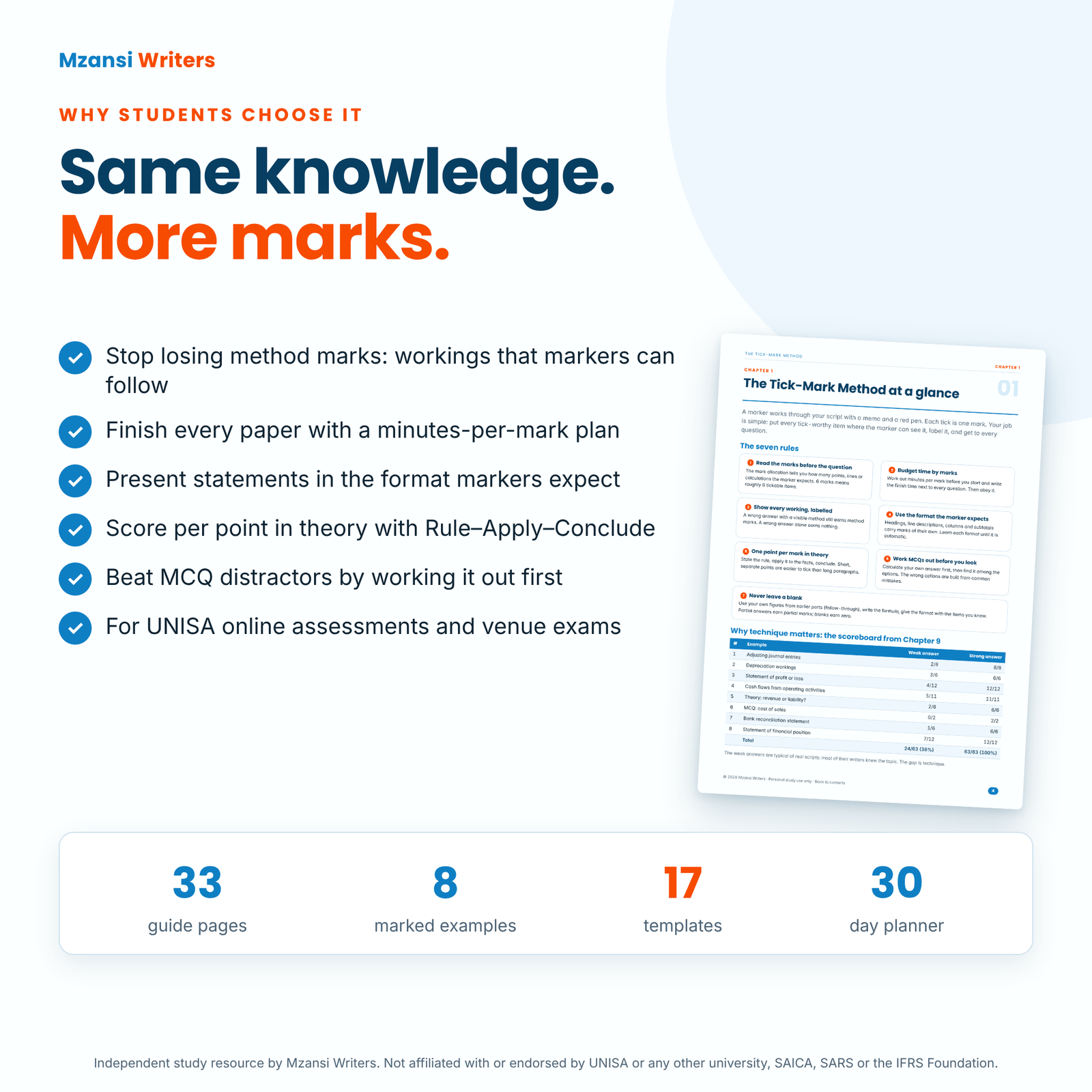
The Tick-Mark Method is an accounting exam technique kit for South African BCom Accounting, BCompt and BAcc students. Most students who fail or scrape through an accounting paper do not lack knowledge. They lose marks because the marker cannot see their method, cannot follow their workings, or never reaches the last question because time ran out. This kit shows you exactly how accounting answers are marked and gives you the printable layouts to practise on until good technique is automatic.
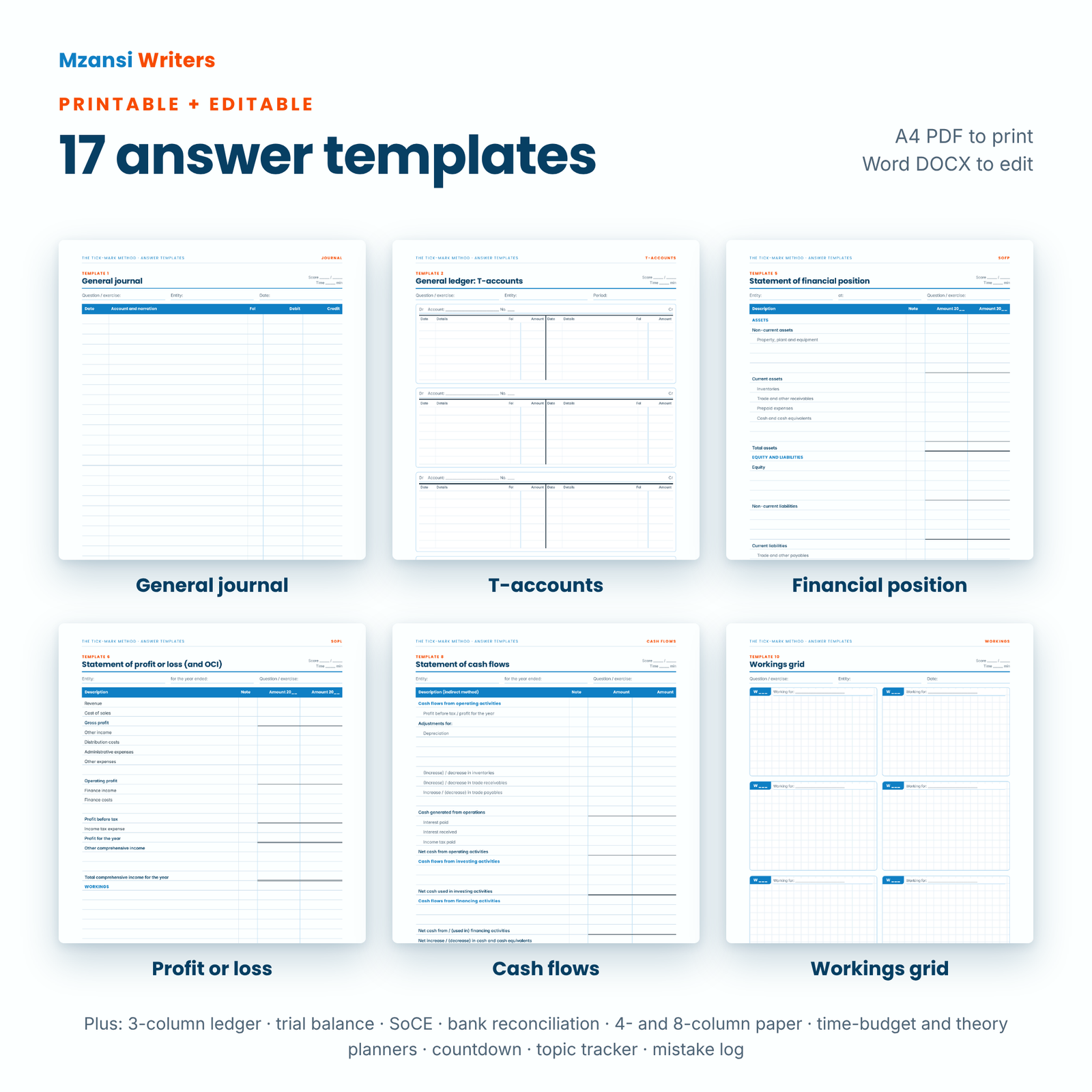
You get a 33-page A4 guide with clickable contents, 17 printable answer templates in PDF, the same templates as an editable Word document, and a DOCX user guide.
Who it is for
- First- to third-year BCom Accounting, BCompt and BAcc students at any South African university
- Distance students, including UNISA students, who write timed online quizzes, MCQ papers or upload-type exams
- Students writing venue exams who keep losing presentation, method and theory marks
- Repeat students who know the work but run out of time or score lower than expected
What the guide covers
How marks are allocated
Learn the difference between method, accuracy, presentation and follow-through marks, how a marker reads your script, and how to decode a mark allocation such as “(8 marks)” into the number of items the memo expects. The “tick test” shows you how to check your own practice answers like a marker.
Time-per-mark planning
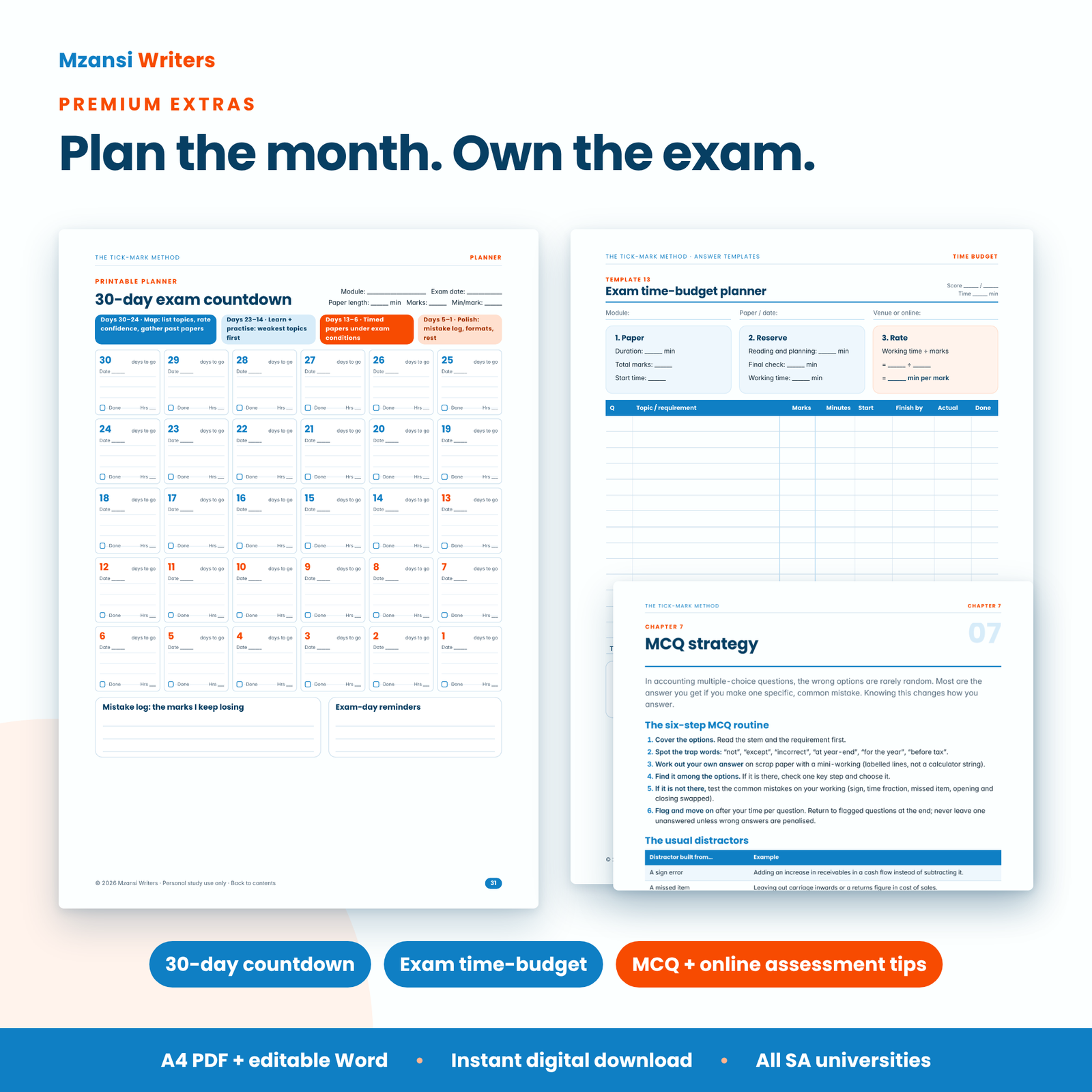
A minutes-per-mark table for 90- to 180-minute papers and a fully worked 3-hour time budget with finish times, plus a 15-minute reading routine and the move-on rule that stops one question eating your whole paper.
Workings, statements and theory
Eight rules for workings that earn method marks, the W-reference system, three-part statement headings, skeletons for the SoFP, SoPL, SoCE and statement of cash flows, and a working-capital sign table. For theory, a command-word table (define, explain, discuss, evaluate, recommend) and the Rule–Apply–Conclude structure for “discuss” questions.
MCQ and online assessment strategy
A six-step MCQ routine, the six types of distractor examiners build from common mistakes, and practical habits for online quizzes, upload-type answers and venue answer sheets.
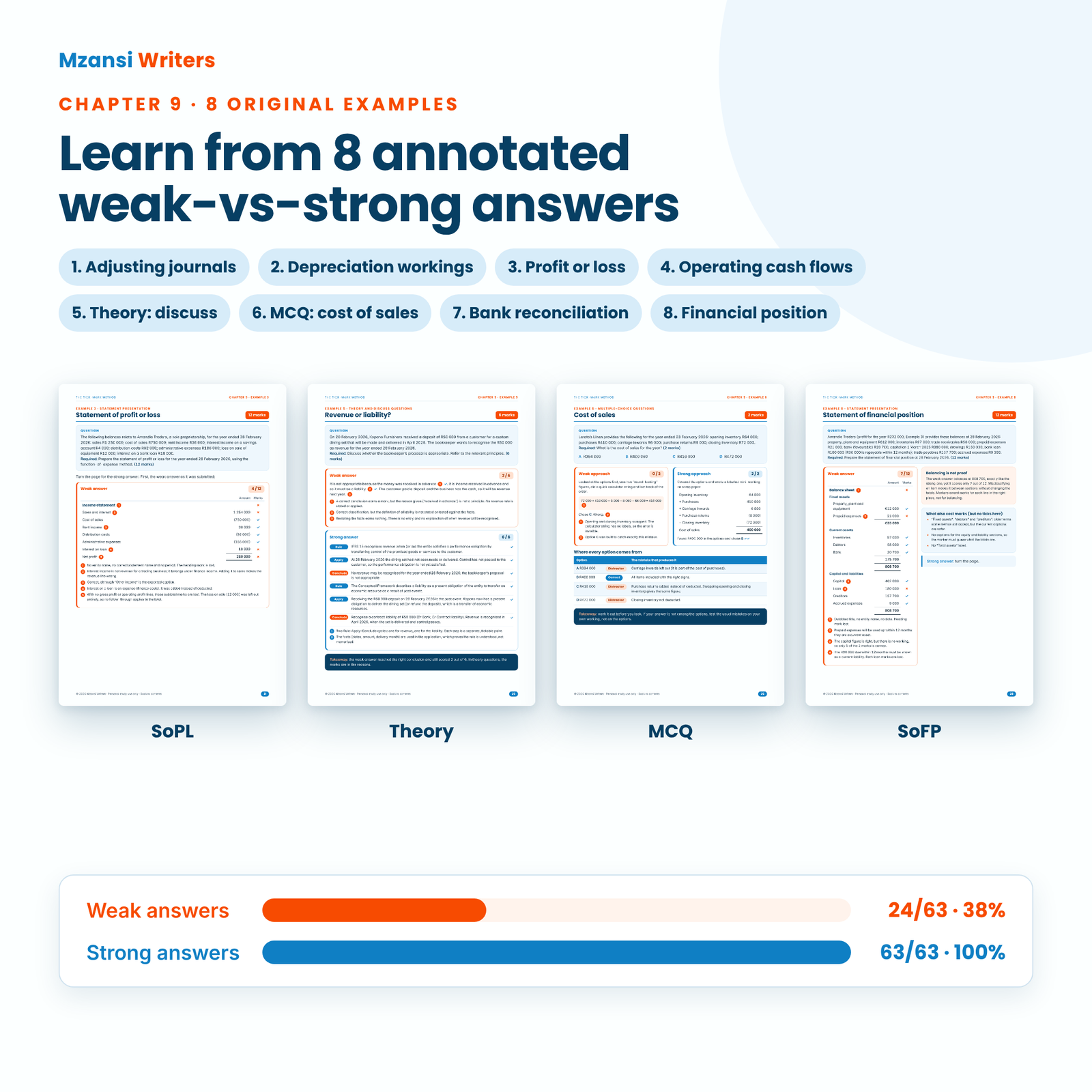
Eight annotated weak-vs-strong answers
Original exam-style questions on adjusting journals, depreciation workings, the statement of profit or loss, operating cash flows, a revenue-versus-liability theory question, an MCQ on cost of sales, a bank reconciliation and the statement of financial position. Each is answered twice and marked tick by tick, with orange notes showing exactly why marks were lost. Across the eight questions the weak answers score 24 out of 63; the strong answers score 63 out of 63. Every figure was recalculated by script: journals balance, statements add up and linked figures agree between examples.
What is included
- Exam technique guide (PDF, A4, 33 pages): 10 chapters, 23 common mark-losing mistakes with fixes, exam-day routine, self-marking checklist, 30-day exam countdown planner and topic tracker
- Printable answer templates (PDF, A4, 18 pages): general journal, general ledger T-accounts, three-column ledger, trial balance, statement of financial position, statement of profit or loss, statement of changes in equity, statement of cash flows, bank reconciliation, workings grid, 4-column and 8-column paper, exam time-budget planner, theory answer planner, 30-day countdown, topic tracker and mistake log
- Editable answer templates (Word DOCX): the same 17 templates as editable tables, one per page
- User guide (Word DOCX): getting started, how to use each part, customisation, troubleshooting and FAQ
How it works
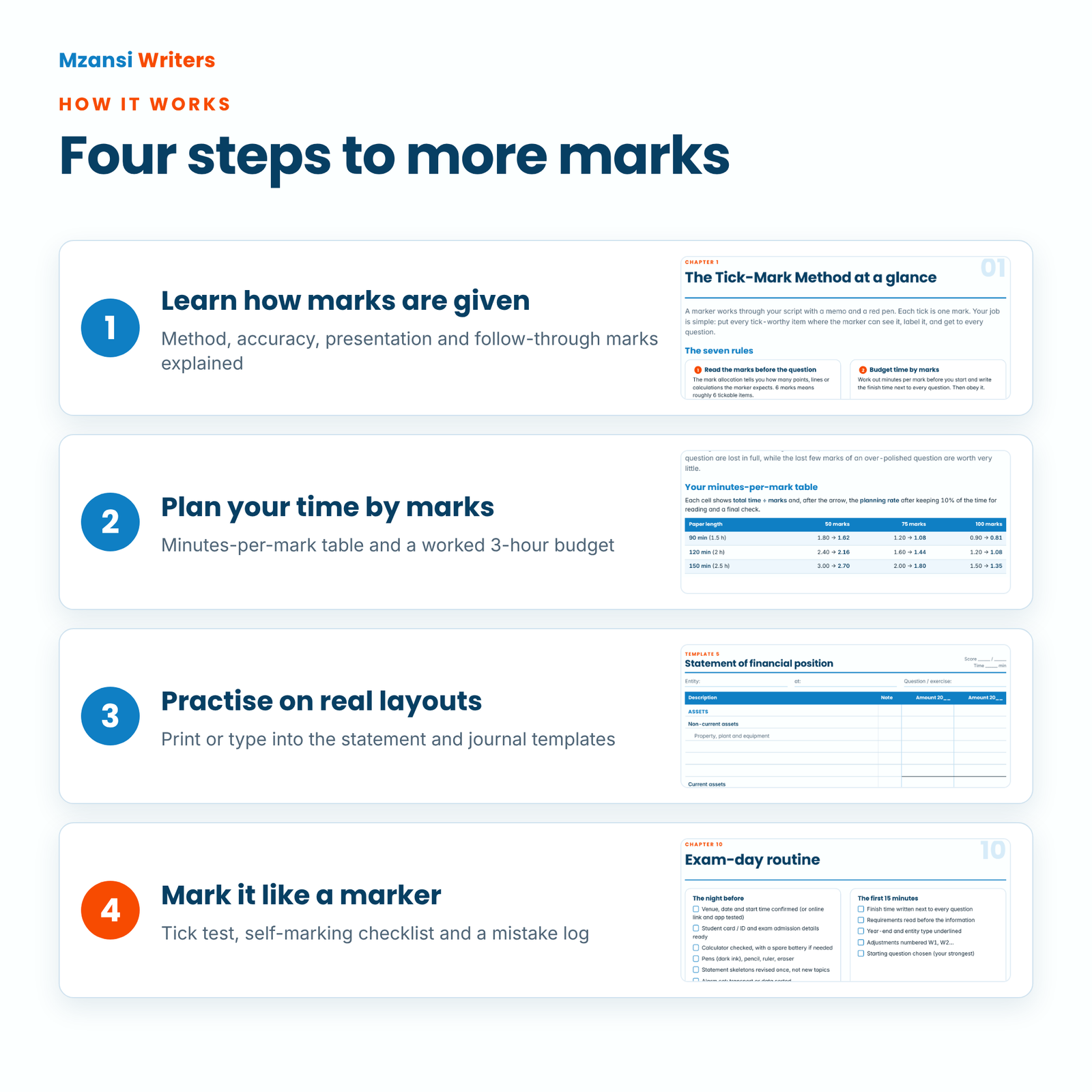
- Read Chapters 1 to 8 (about 90 minutes) to learn how marks are given and collected.
- Study the eight weak-vs-strong examples. Try each question first, then compare.
- Print the templates and answer past-paper questions on them, timed with your minutes-per-mark rate.
- Mark yourself with the tick test and the self-marking checklist, and record every lost mark in the mistake log.
File formats and software requirements
- PDF files open in any PDF reader, including free readers and web browsers. The contents pages and template index are clickable, and both PDFs have bookmarks.
- The DOCX files are standard Word-format documents, tested in LibreOffice Writer. Use Microsoft Word or another DOCX editor to edit them.
- All pages are A4. Print at 100% (“actual size”) for the intended row heights.
- Fonts: Poppins and Inter (SIL Open Font Licence), embedded in the PDFs.
Customisation
In the editable DOCX you can add or delete rows, rename captions, type your own column headings (for example SoCE equity components or 8-column analysis headings) and add your module code to the header. Amount columns are neutral, so you can work in rand or any other currency.
Digital download
This is a digital product. No physical item is posted. Your four files are available to download straight after payment. Print as many copies of the templates as you need for your own studies.
Use cases
- Building a 30-day revision plan before your financial accounting exam
- Practising past-paper questions on proper statement and journal layouts
- Getting ready for a UNISA online MCQ quiz or upload-type exam
- Fixing recurring mistakes after a disappointing test or assignment mark
FAQ
Does this cover my university or module?
It teaches answer-writing technique that applies to accounting assessments at any South African university. It is not tied to one module code, and you should always follow your module’s prescribed formats.
Is it useful for UNISA online exams?
Yes. A chapter covers online MCQ and upload-type assessments in general terms. Always read the current online-exam rules your institution publishes, because they change between exam periods.
Are the examples copied from past papers or textbooks?
No. All entities, questions, figures and explanations are original and were written for this product.
Do I need Excel?
No. You need a PDF reader, and optionally a DOCX editor if you want to type into the templates.
Does it include tax or VAT rates?
No. The examples deliberately avoid tax and VAT rates, so the content stays correct when rates change.
Can I print the templates more than once?
Yes. Print them as often as you need for your own studies.
Can I share it with my study group?
No. The licence covers the buyer’s personal use only. Each student needs their own copy.
Licence and disclaimer
Licence: personal study use by the original buyer only. You may not resell, share, distribute or upload the files (for example to Stuvia, Scribd, shared drives or WhatsApp groups) or claim them as your own.
Independent study resource by Mzansi Writers. Not affiliated with, endorsed by or produced by UNISA or any other university, SAICA, SARS or the IFRS Foundation. University and module names are used only to show which assessments this resource supports.


Reviews
There are no reviews yet.