

Description
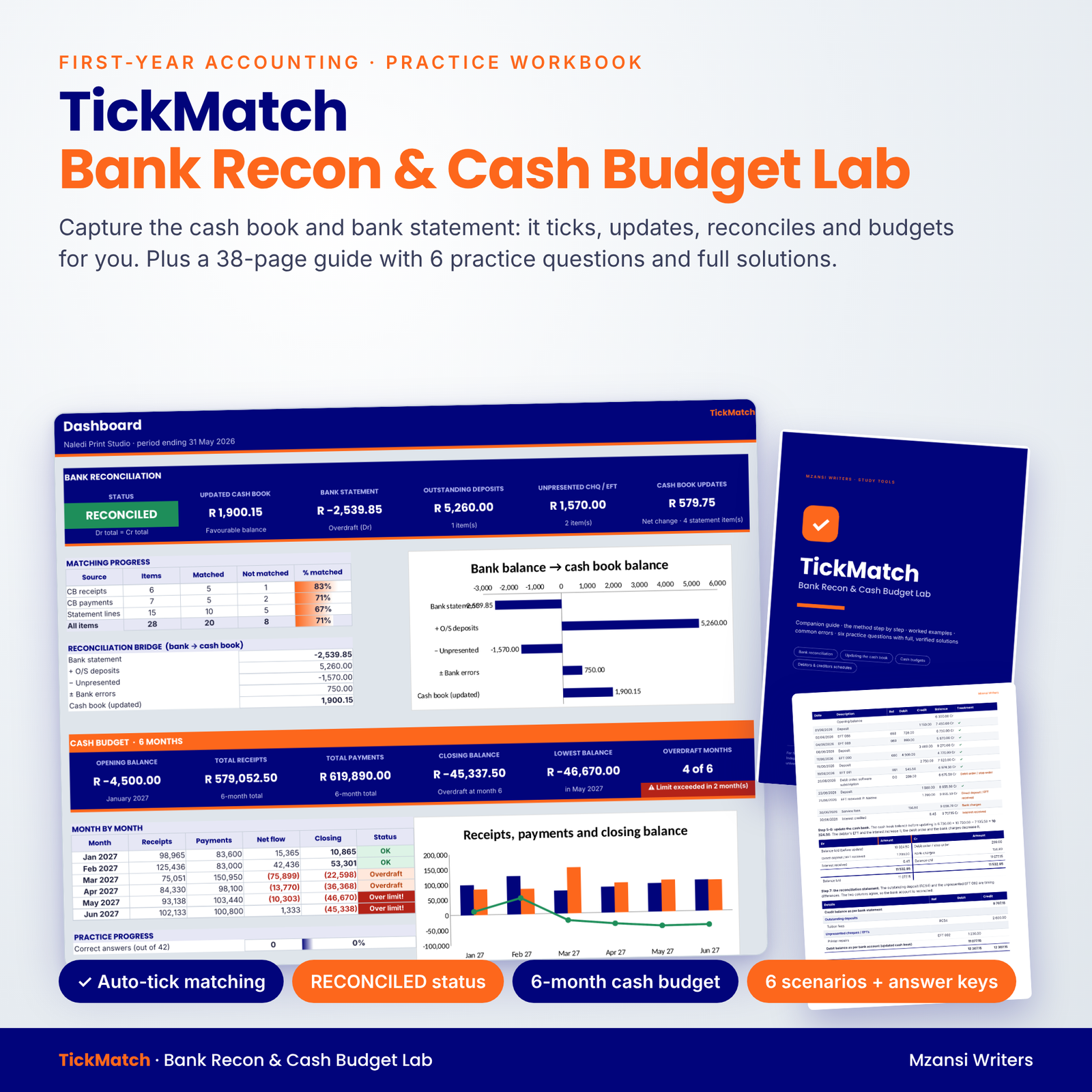
TickMatch Bank Recon & Cash Budget Lab is a bank reconciliation and cash budget practice workbook for first-year accounting students. Type in the cash book and the bank statement, and the workbook ticks off the matching items, lists the outstanding deposits and unpresented cheques/EFTs, updates the cash book for bank charges, interest, dishonoured cheques and direct deposits, and prepares the bank reconciliation statement with a clear RECONCILED status. A second module turns sales, purchases and collection patterns into a six-month cash budget with overdraft warnings and charts.
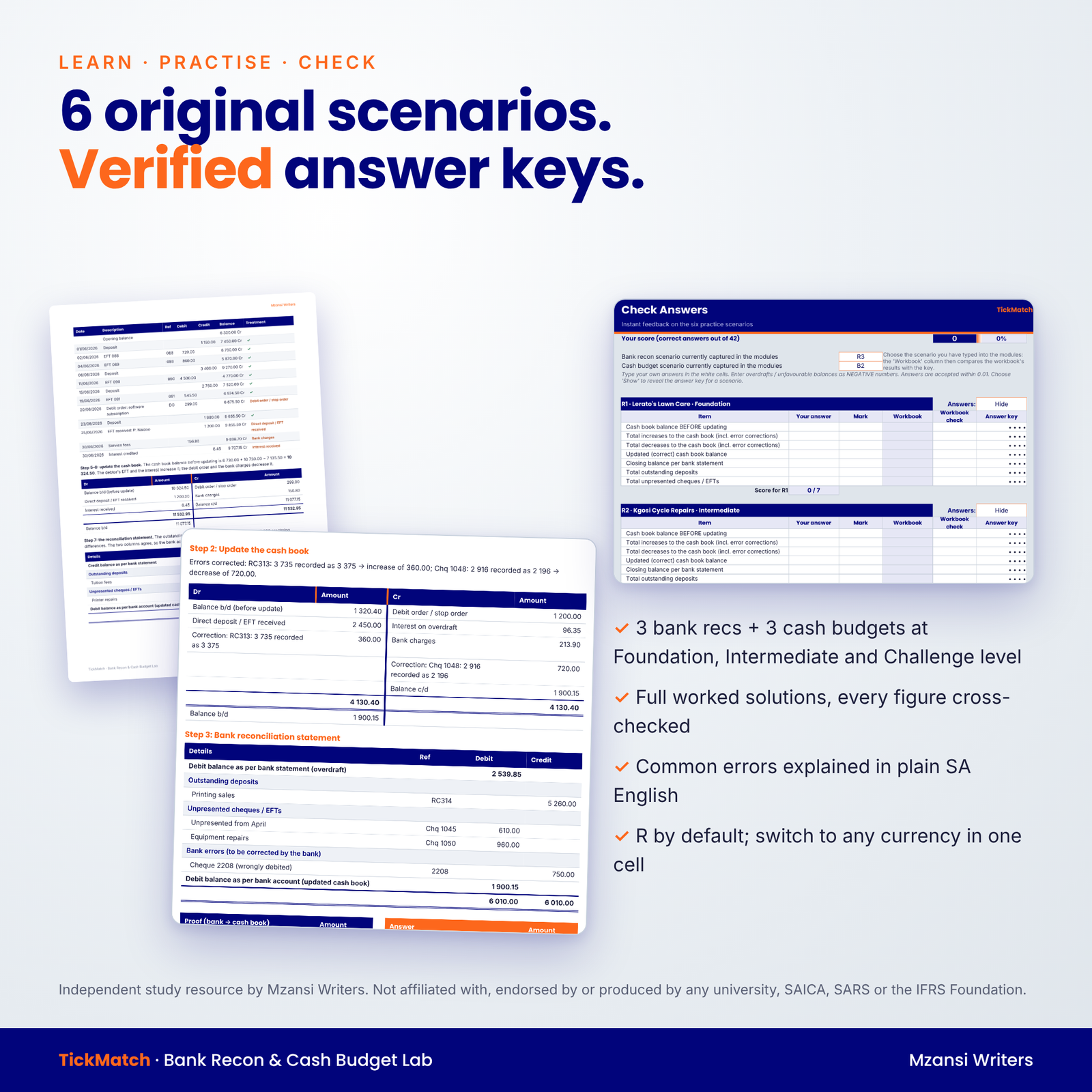
It comes with a 38-page A4 companion guide that teaches the method step by step, shows the mistakes that cost marks, and gives six original practice questions with complete, verified solutions.
What the bank reconciliation workbook does
- Automatic matching: each receipt is matched with a bank statement credit and each payment with a debit. Equal amounts are paired in order, and a Tick column lets you override a match when you find an error.
- Outstanding items listed for you: outstanding deposits and unpresented cheques/EFTs appear on the reconciliation statement automatically, including items carried forward from last month.
- Cash book update: unmatched statement items are grouped by category (bank charges, interest, debit orders, R/D cheques, direct deposits) and you can add error corrections. The updated Bank account is drawn as a T-account.
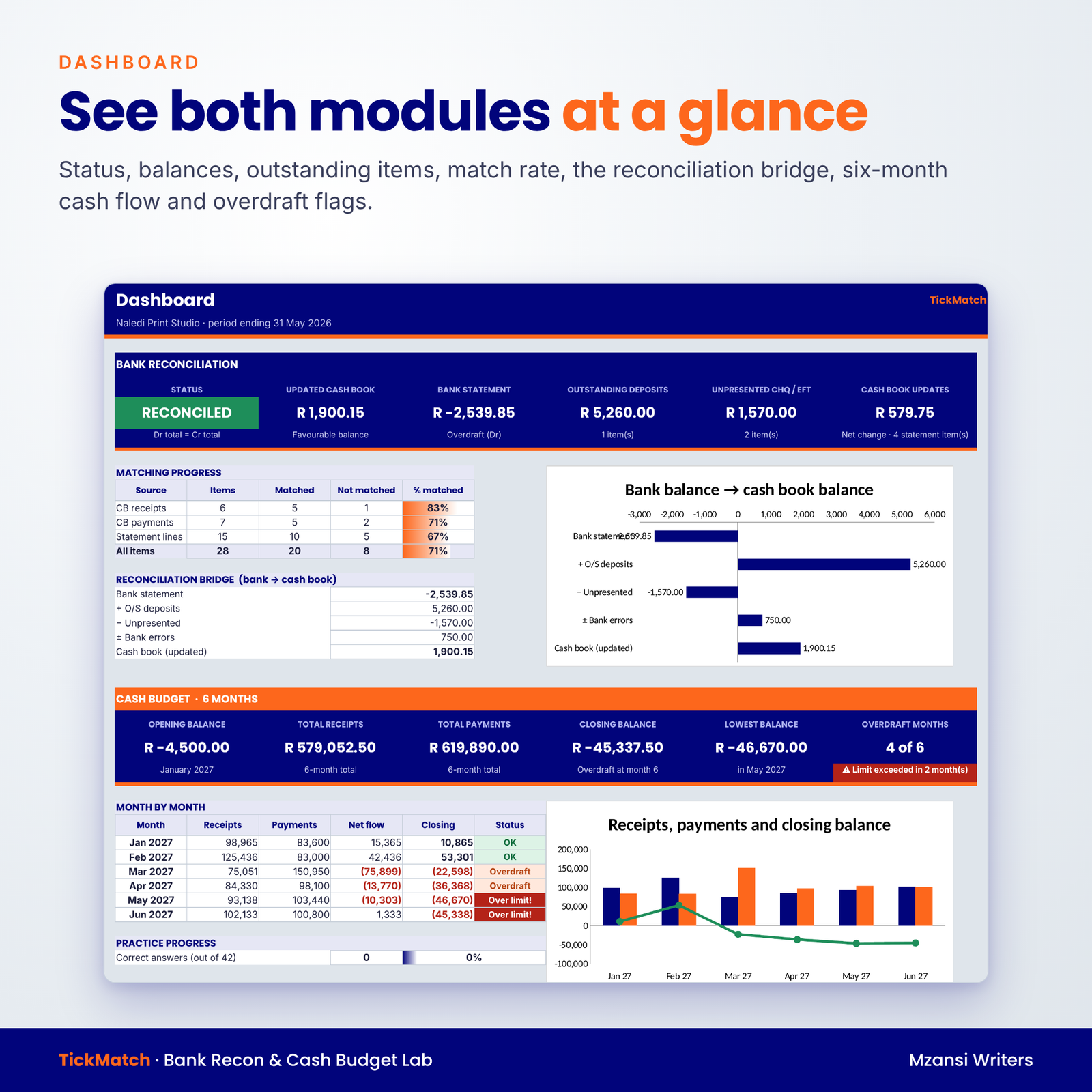
- Bank reconciliation statement: the South African Debit/Credit layout, a proof box (bank balance to cash book balance) and a banner that says RECONCILED or shows the exact difference.
- Difference Detective: when it does not balance, hints point to transpositions (divisible by 9), items on the wrong side, missing items and sign errors.
- Statement check: type the printed closing balance and the workbook confirms that you captured every line.
The cash budget module
- Six consecutive months with month headings that follow your chosen start month.
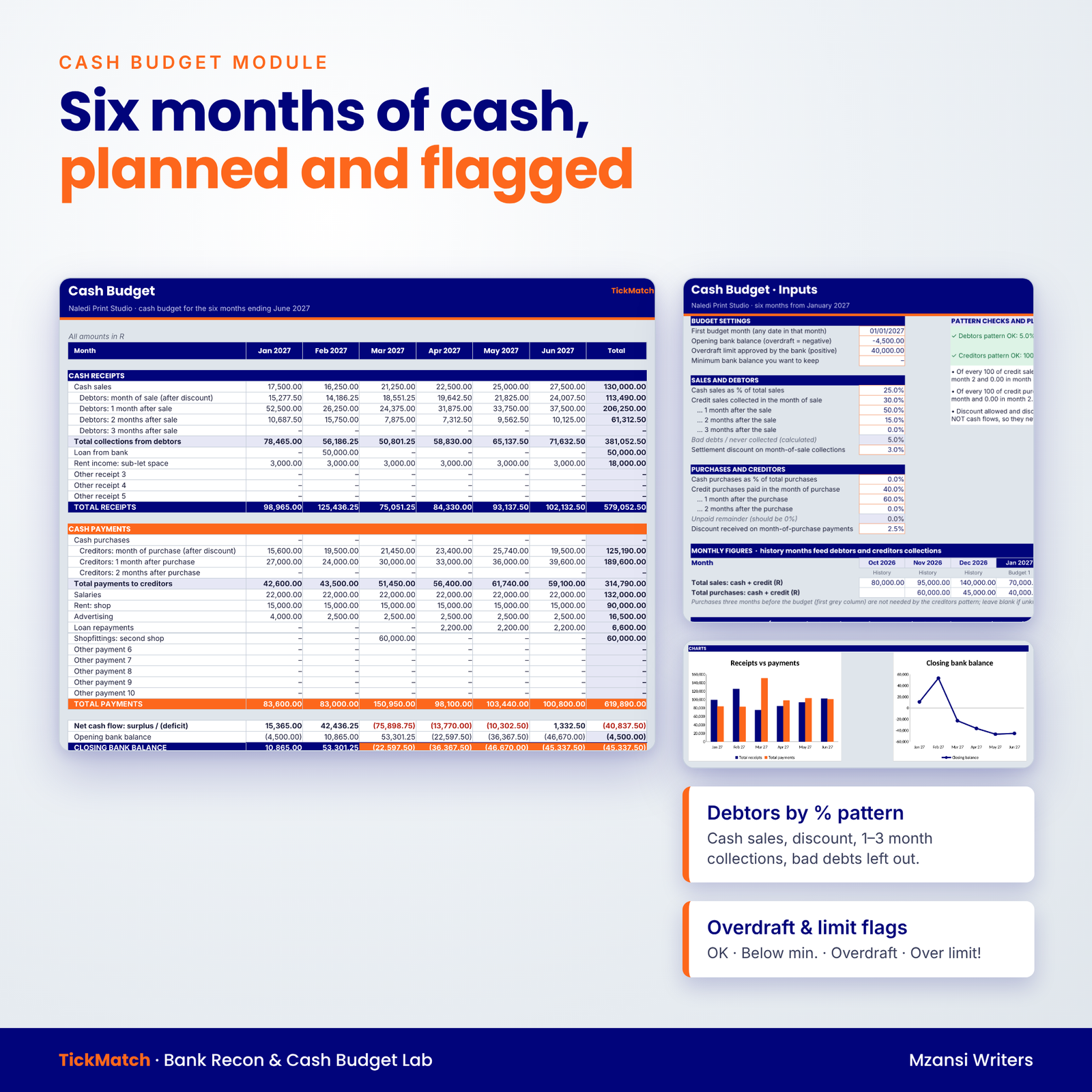
- Collections from debtors by percentage pattern (month of sale and up to three months later), with settlement discount and bad debts handled correctly.
- Payments to creditors by pattern, with discount received, plus cash sales and cash purchases.
- Five rows for other receipts and ten rows for other payments such as salaries, rent, loans and assets.
- Opening and closing balances, unused overdraft facility and a status line for every month: OK, Below min., Overdraft or Over limit!
- Native charts for receipts vs payments and the closing bank balance.
- Pattern checks that warn you if the percentages do not add up, explained in plain language.
Who it is for
First-year BCom, BCompt and BAcc students in South Africa studying financial or management accounting, students repeating a module, and tutors who want a clear way to demonstrate bank reconciliations and cash budgets. It suits any course that uses the cash book, bank statement and cash budget format taught in first year.
Main benefits
- See the logic of a bank reconciliation instead of memorising rules: every item is classified and placed for you.
- Get instant feedback on six practice scenarios at Foundation, Intermediate and Challenge level.
- Check your own homework: capture a textbook question and see whether your answer reconciles.
- Learn to read a cash budget like a manager, with overdraft and minimum-balance flags.
What is included
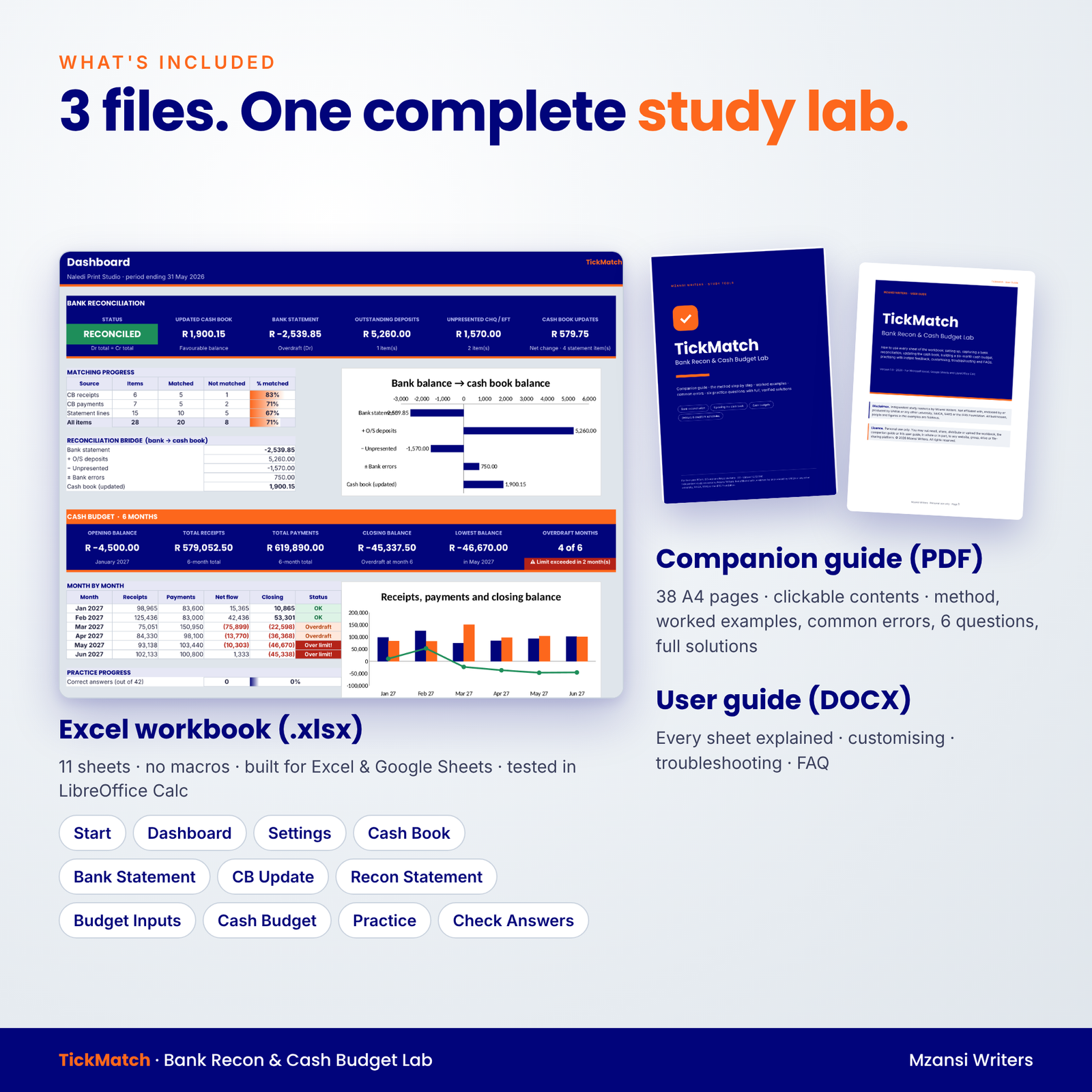
- TickMatch-Bank-Recon-Cash-Budget-Lab.xlsx: 11 sheets: Start, Dashboard, Settings, Cash Book, Bank Statement, CB Update, Recon Statement, Budget Inputs, Cash Budget, Practice and Check Answers.
- TickMatch-Companion-Guide.pdf: 38 A4 pages with a clickable contents page: the seven-step bank reconciliation method, a cash budget method, two worked examples, 20 common errors, six practice questions and full solutions.
- TickMatch-User-Guide.docx: how to use every sheet, customise the workbook, troubleshoot problems and answers to common questions.
How the bank reconciliation and cash budget practice works
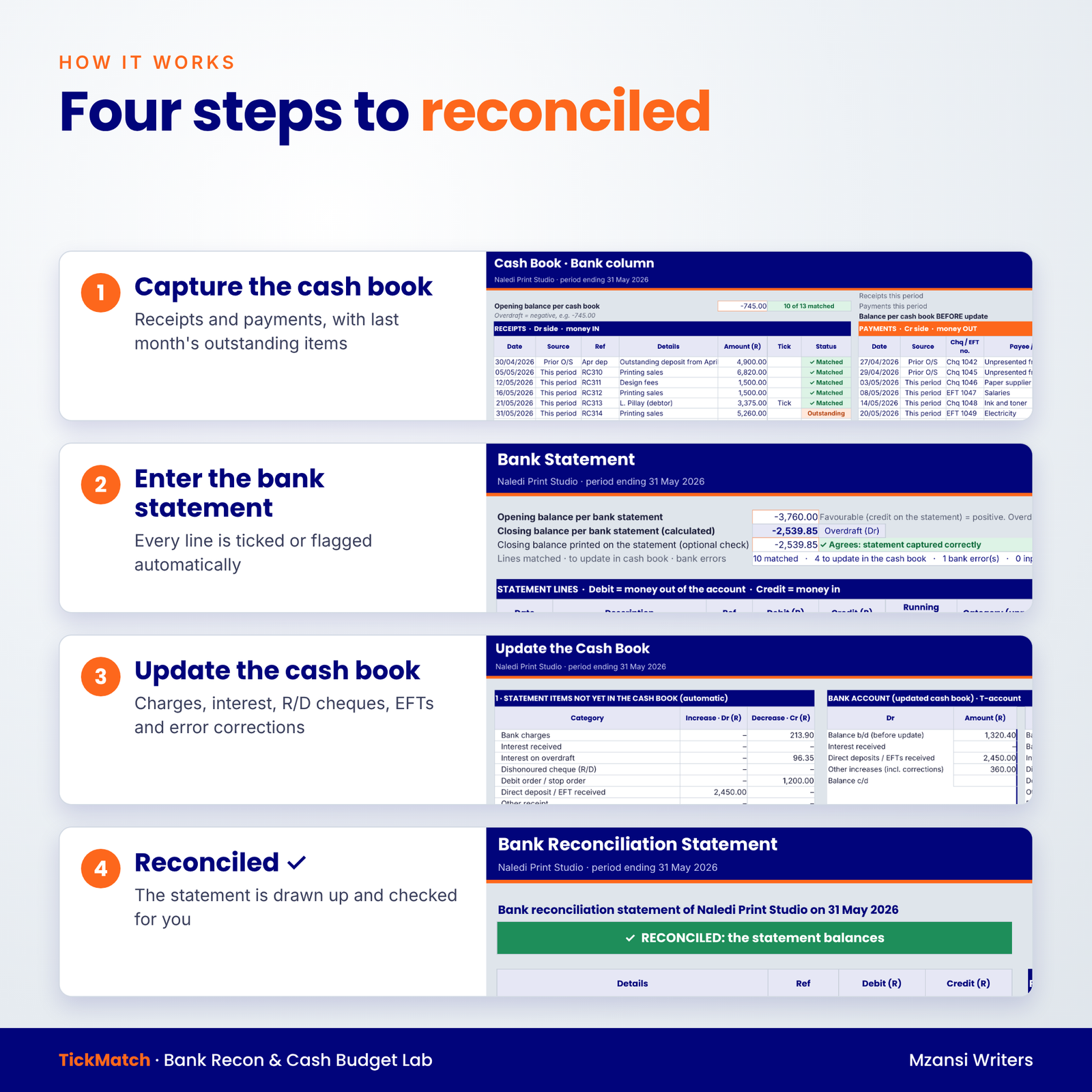
- Choose your currency and type the business name and date on Settings.
- Capture the cash book receipts and payments and the bank statement lines.
- Choose a category for each statement item that is not in the cash book and enter any error corrections.
- Read the reconciliation statement and the dashboard. For the budget, enter the patterns, sales and purchases and read the six-month budget.
- Type your practice answers on Check Answers and get a ✓ or ✗ for each one. Reveal the answer key when you are ready.
Use cases
- Preparing for a test on bank reconciliations, with a fresh scenario every time you practise.
- Checking a tutorial question: if your workbook says RECONCILED, your classification is right.
- Revising cash budgets before exams, especially collection schedules with discounts and bad debts.
- Tutors demonstrating the effect of a dishonoured cheque or an overdraft in class.
File formats and software requirements
Excel-format .xlsx; tested in LibreOffice Calc; built with standard functions for Microsoft Excel and Google Sheets. No macros, add-ins or internet connection needed. The guide is an A4 PDF that opens in any PDF reader and prints well; the user guide is a Word (.docx) file.
Customisation
Choose any currency symbol in one Settings cell (R by default) and every money heading and dashboard tile updates. Titles read the business name and dates automatically. Formula cells are locked to protect them, but sheets are protected without a password, so you can change the layout if you need to.
Digital download
This is a digital product. After payment you download three files immediately. Nothing is posted.
FAQ
Does it work in Google Sheets and Excel?
It is built with standard functions for Microsoft Excel and Google Sheets and was tested in LibreOffice Calc. It uses no macros.
Which bank reconciliation format does it use?
The South African two-column Debit/Credit statement, plus a proof box in the shorter bank-to-cash-book format.
Are the answers correct?
Every answer key and worked example was calculated with an independent model and cross-checked against the workbook’s own results.
Does it handle overdrafts and dishonoured cheques?
Yes. Overdrafts are entered as negative balances, and R/D cheques, interest on overdraft, debit orders, direct deposits, cash book errors and bank errors are all covered.
Can I use my own textbook questions?
Yes. The modules are blank in the buyer copy. Capture any question with up to 40 receipts, 60 payments and 100 statement lines.
Is it linked to a specific university?
No. It follows the standard first-year method and is not tied to any one module or lecturer.
Can I share it with my study group?
No. The licence is for personal use only.
Licence and disclaimer
Personal use only: no resale, sharing or uploading of the files, in whole or in part. Independent study resource by Mzansi Writers. Not affiliated with, endorsed by or produced by UNISA or any other university, SAICA, SARS or the IFRS Foundation. All businesses and figures in the examples are fictitious.


Reviews
There are no reviews yet.