




Description
IFRS cheat sheets that make the standards stick
Standard Sorted is a set of IFRS cheat sheets for South African BCom Accounting, BCompt and BAcc students in second and third year. It turns 18 of the most-examined IFRS and IAS standards into clean, one-page revision sheets written in plain student English, so you can see the whole standard at a glance, learn it faster and walk into tests knowing where the marks are.
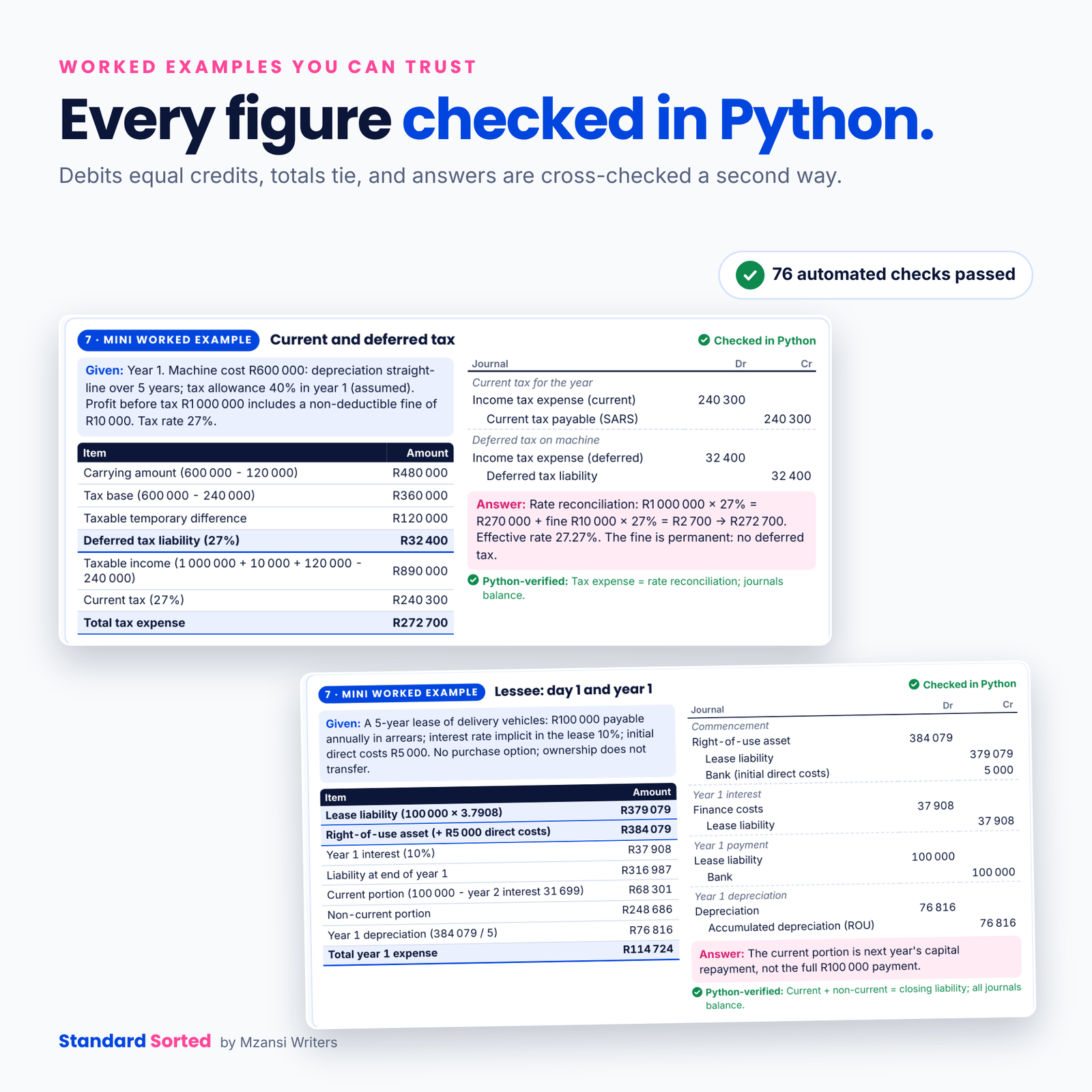
Every sheet follows the same seven-block layout, so you never waste time hunting for the rule you need. Every worked example was calculated and checked in Python: journals balance, tables add up and answers are cross-checked a second way.
Who it is for
- Students taking FAC2601 (Financial Accounting for Companies) or FAC3701 (General Financial Reporting) at UNISA.
- Second- and third-year financial accounting students at UJ, UP, Wits, UCT, Stellenbosch and other universities studying the same standards.
- Students repeating a module who need a fast, structured way to revise.
- Anyone who wants the move from IAS 1 to IFRS 18 explained simply.
What is on every IFRS / IAS sheet
- Scope: what the standard covers and which items belong to another standard.
- Recognition: when the item goes onto the financial statements.
- Measurement: initial and subsequent measurement, models and key rules.
- Key journals: the debit and credit entries for the main events (IAS 7 gives reconstruction formulas).
- Disclosure checklist: tick-boxes that double as a skeleton for notes questions.
- Common exam traps: the mistakes that cost students marks.
- Mini worked example: an original scenario with a calculation table, journals and the answer.
Standards covered
Conceptual Framework (2018), IAS 1, IAS 2, IAS 7, IAS 8, IAS 10, IAS 12 (basics), IAS 16, IAS 20, IAS 23, IAS 36, IAS 37, IAS 38, IAS 40, IFRS 9 (basics), IFRS 13, IFRS 15 and IFRS 16.
Main benefits
- Faster revision: one page per standard means you can review a whole study unit in an evening.
- Fewer lost marks: the exam-trap boxes and disclosure checklists target the errors markers see most.
- Numbers you can trust: 19 worked examples and 76 automated checks, including debits = credits on every journal.
- Up to date: reflects the IFRS Accounting Standards as at November 2026, including IFRS 18 and the 2024-2026 amendments that affect students. Examples use the SA company tax rate of 27% (SARS, 2026/27).
What is included
- A4 print edition (PDF, 29 pages): cover, how-to page, clickable contents, amendments radar 2024-2027, IFRS 18 at a glance, decision flowchart, 18 standard sheets, 2-page journal-entry index, exam technique with formula bank and abbreviations, and a blank “build your own sheet” template.
- Tablet edition (PDF, 53 landscape pages): the same content in larger print, each standard over two pages, with a tap-to-jump sidebar on every page.
- User guide (DOCX): getting started, how to use every feature, printing tips, troubleshooting and FAQ.
Extra study tools
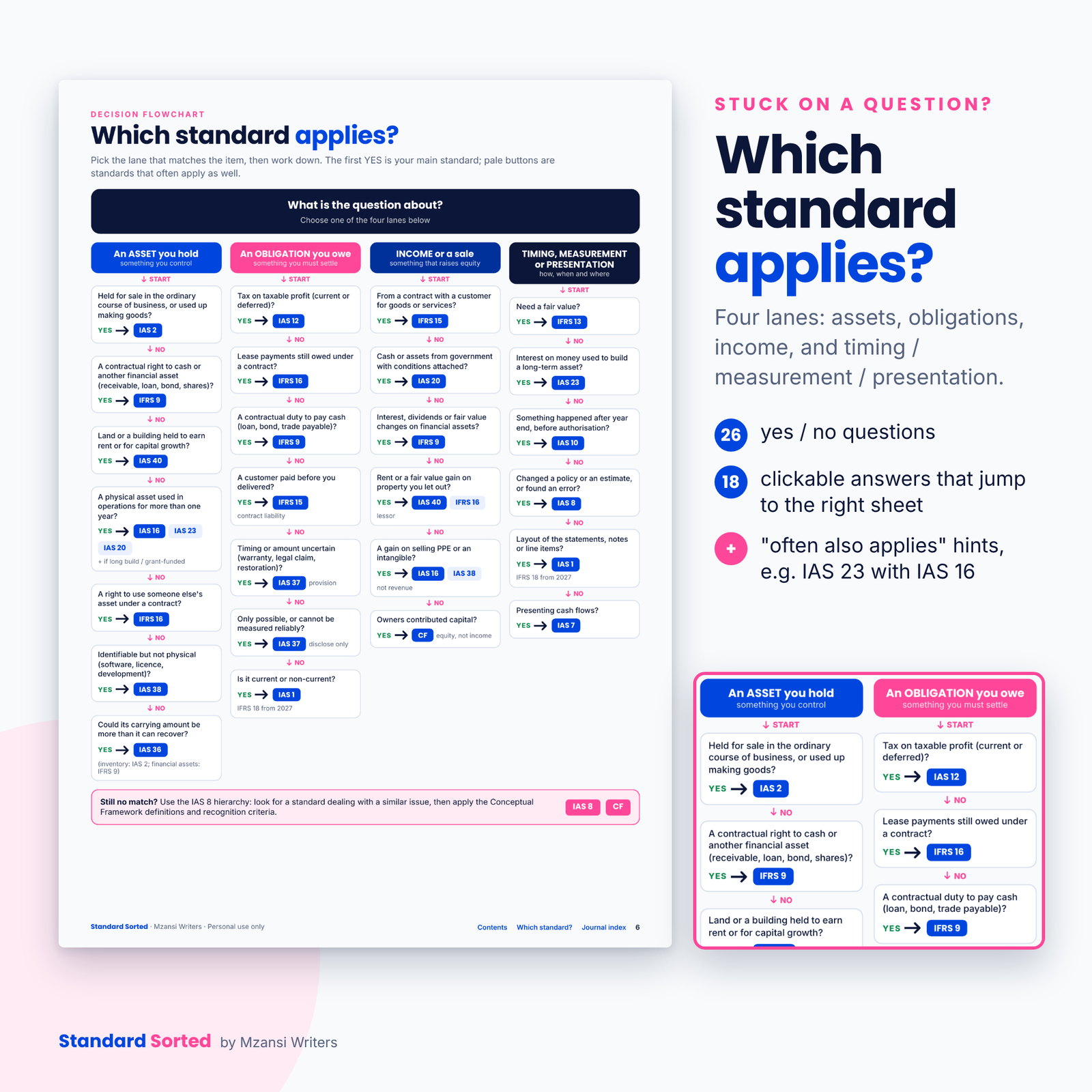
- “Which standard applies?” flowchart: 26 yes/no questions in four lanes (assets, obligations, income, and timing / measurement / presentation). Every answer links to the right sheet.
- Journal-entry index: 57 key journals grouped by topic and sorted A-Z, each linked to its sheet.
- Amendments radar: 13 recent and coming changes with effective dates, such as IFRS 18, the 2026 IFRS 9 classification amendments, the IAS 1 covenant rules and the IAS 37 project still in progress.
- Formula bank: 12 formulas used in the examples, from annuity present values to deferred tax and amortised cost.
How it works
- Open the A4 edition and read the one-page “How to use” guide.
- Use the contents page or the flowchart to jump to the standard you are studying.
- Learn the sheet, cover it and recall blocks 1-4 from memory.
- Rework the mini example without looking, then check the traps before your test.
File formats and software requirements
- Two PDF files (A4 portrait and 4:3 landscape tablet edition) with embedded fonts, PDF bookmarks and internal links. Open them in any PDF reader on a computer, tablet or phone.
- One DOCX user guide that opens in Microsoft Word, LibreOffice Writer or Google Docs.
- No special software, login or internet connection is needed after download.
Customisation
Print only the sheets you need, print in colour or greyscale, or import the tablet PDF into a PDF note-taking app to write on the pages. The blank “build your own sheet” page uses the same seven blocks, so you can add standards your module includes (for example IFRS 5 or IAS 21) in the same format.
Digital download
This is a digital product: no physical item is shipped. Your files are available to download straight after payment. Amounts in examples are in Rand (R); the principles apply in any currency.
Use cases
- The night before a FAC3701 assignment on IAS 37 or IFRS 15, revise the sheet and check your journals against the index.
- In exam preparation, use the flowchart on each past-paper question to name the standard in seconds.
- When notes questions come up, use the disclosure checklist as your answer skeleton.
- On the bus or between lectures, flip through the tablet edition on your device.
FAQ
Does it cover IFRS 18?
Yes. There is a dedicated IFRS 18 page with a worked example, and the IAS 1, IAS 7 and IAS 8 sheets explain what changes from 1 January 2027. Always use the version your tutorial letter says is examinable.
Is it enough to pass FAC2601 or FAC3701 on its own?
No summary replaces your prescribed material and practice. These sheets give you structure, fast recall and checked examples to support your study.
Are the worked examples copied from textbooks or past papers?
No. All explanations, examples and traps are original and written in our own words.
Which tax rate is used?
The SA company income tax rate of 27% for years of assessment ending 1 April 2026 to 31 March 2027, as published by SARS.
Can I use it on a tablet?
Yes. The tablet edition is a landscape PDF with larger text and a sidebar that links to every section.
Can I share it with my study group?
No. The licence is for one person; each student needs their own copy.
Licence and disclaimer
Personal use only: no resale, sharing or uploading of the files or any part of them. Independent study resource by Mzansi Writers. Not affiliated with, endorsed by or produced by UNISA or any other university, SAICA, SARS or the IFRS Foundation. Module codes are used only to show which syllabus this resource supports.


Reviews
There are no reviews yet.