



Description
CrimeLens is a complete set of criminology study notes for South African university students in first and second year. It covers theories of crime, the South African criminal justice system, victimology, crime in South Africa and crime prevention in plain language, then gives you 60 MCQs and two full practice papers with memos so you can test yourself before the exam.
What these criminology study notes do for you
Criminology looks simple until the exam asks you to apply Merton to a case study or critically evaluate labelling theory. CrimeLens is built around how marks are actually given. Every unit explains the work clearly, shows you how to use it in an answer, and then checks that you can do it.
You get 128 A4 pages of original notes, written for South African students, with South African law, court cases and crime examples throughout. No padding and no copied textbook text.
Who it is for
- First-year and second-year criminology students at South African universities, distance or contact.
- Students in law, policing, social work, psychology, forensic investigation and safety programmes who take criminology modules.
- Students repeating a module who want a clear, structured way to revise.
What is covered
Theories of crime
The classical school (Beccaria, Bentham), deterrence, rational choice and routine activity theory; biological and psychological positivism (Lombroso, Ferri, Sheldon, twin and adoption studies, Freud, Bowlby, Eysenck, psychopathy); Durkheim, Merton and Agnew; the Chicago School and social disorganisation; subcultural theories; differential association and social learning; neutralisation and drift; control theories (Reckless, Hirschi, Gottfredson and Hirschi); labelling, conflict, Marxist and critical theory; left and right realism; feminist criminology; life-course theories; and African and Southern perspectives, including ubuntu and restorative justice. A one-page comparison table pulls all of them together.
The South African criminal justice system
Packer’s crime control and due process models, the flow of a case from report to reintegration, section 35 rights and the 48-hour rule, bail schedules, the police, the NPA, the court hierarchy, sentencing and minimum sentences, corrections and parole, the Child Justice Act (including the minimum age of 12), and restorative justice. Landmark cases such as S v Makwanyane, S v Zinn, S v Malgas and Carmichele are explained in plain terms.
Victimology
Mendelsohn, von Hentig, Wolfgang and Schafer; lifestyle-exposure theory; repeat victimisation; the ideal victim; the impact of crime; secondary victimisation; the Victims’ Charter and its seven rights; the Domestic Violence Act, the Sexual Offences Act and the 2021 GBV Acts; Thuthuzela Care Centres and victim support.
Crime in South Africa and crime prevention
The historical context, the drivers of violent crime, GBVF, gangs, organised crime, corruption, cybercrime and more, with four applied case studies and an example bank linking every theory to a South African illustration. Crime prevention covers primary, secondary and tertiary levels, Clarke’s situational techniques, displacement, CPTED, community policing and national policy.
Features
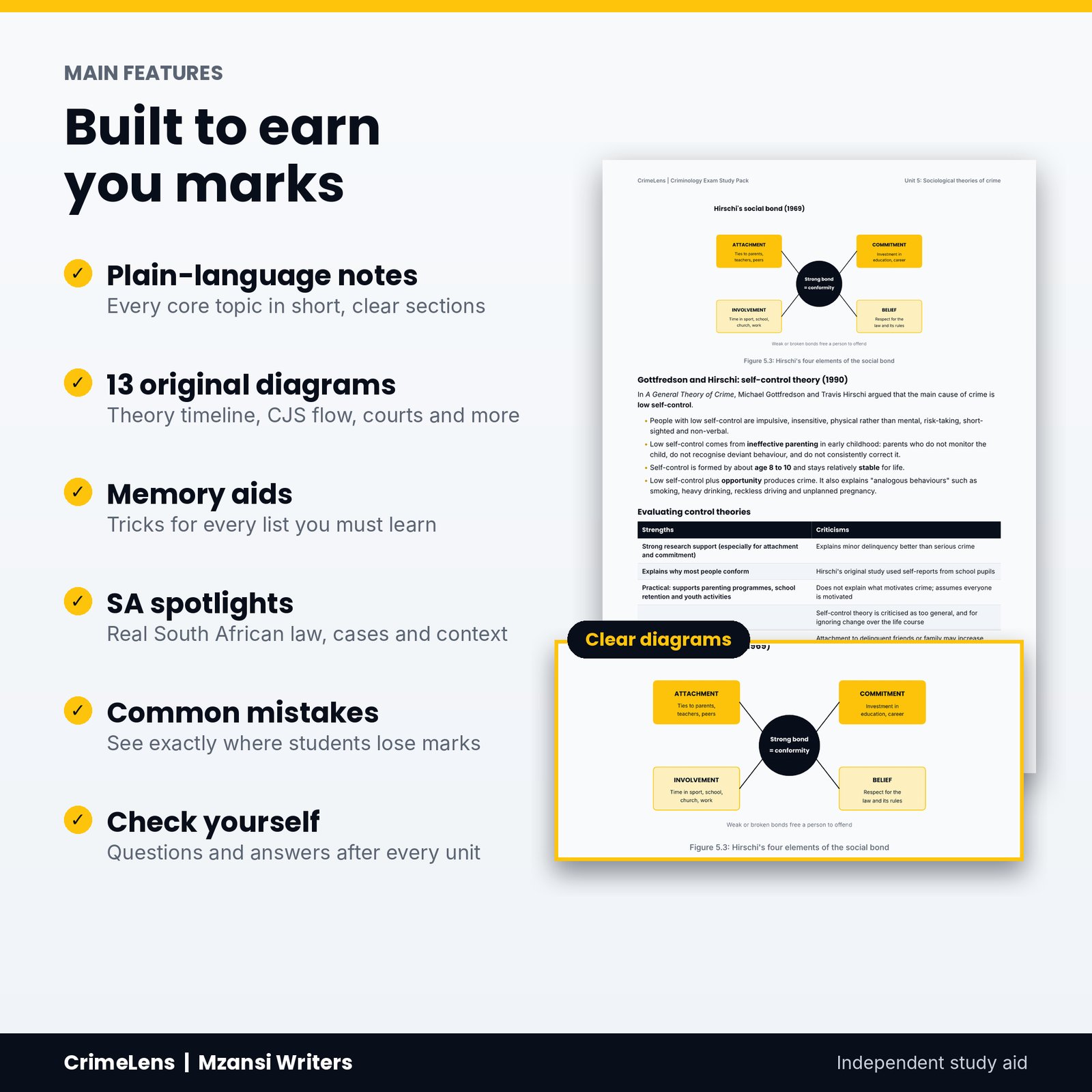
- 12 units of plain-language notes with definitions you can use in answers
- 13 original diagrams, including a theory timeline, a criminal case flow chart and the court hierarchy
- Memory aids for every list you need to learn
- Exam tips, common mistakes and South African spotlight boxes
- “Check yourself” questions with answers at the end of every unit
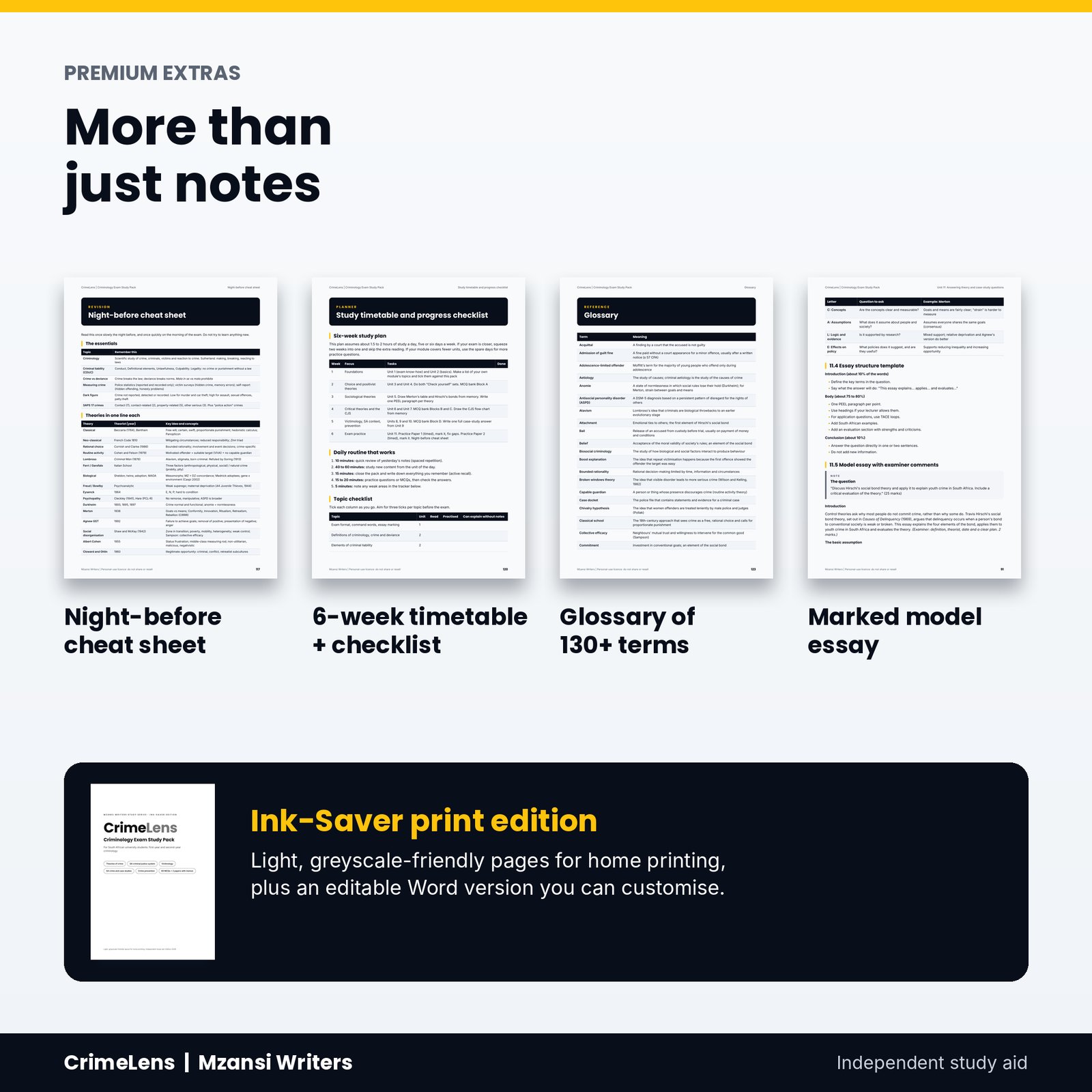
- Answering skills: PEEL, TACE and SCALE methods plus a marked model essay
- 60-question MCQ bank with an answer key and a reason for every answer
- Two full 100-mark practice papers with detailed memos and mark allocations
- Night-before cheat sheet, six-week study timetable, topic checklist and score tracker
- Glossary of more than 130 terms
What is included
- CrimeLens Study Pack (PDF): 128 A4 pages in colour, with clickable contents and bookmarks.
- Ink-Saver Edition (PDF): the same content on light, greyscale-friendly pages for printing.
- Editable Word version (DOCX): real heading styles and an automatic contents page, so you can add notes or cut units you do not need.
- User Guide (DOCX): getting started, how to use each part, troubleshooting, FAQ and licence terms.
How it works
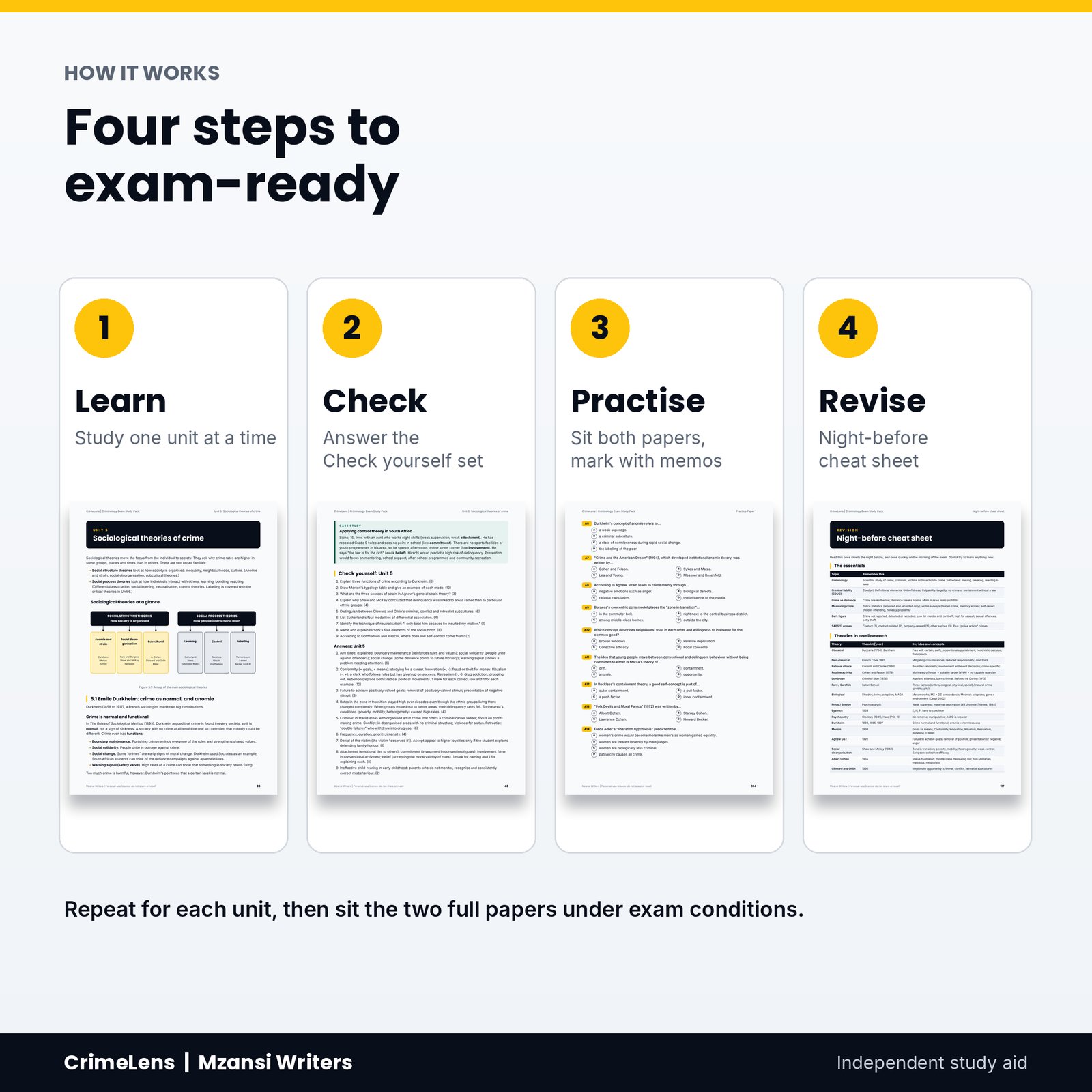
- Read Unit 1 to see how criminology exams are set and marked.
- Match the units to your own module outline using the topic checklist.
- Study one unit at a time and do the “Check yourself” questions.
- Drill the MCQ bank, then sit both practice papers under exam conditions and mark them with the memos.
- Use the cheat sheet the night before the exam.
File formats and software
PDF files open in any PDF reader, including Adobe Acrobat Reader, Microsoft Edge, Google Chrome and the built-in readers on Android and iPhone. The DOCX files open in Microsoft Word, Google Docs or LibreOffice Writer. All pages are A4.
Customising: edit the Word version freely for your own study. Add your lecturer’s examples, highlight key points or delete units your module does not cover, then update the contents page with one click.
Digital download
This is a digital product. Nothing is posted. Your download links appear straight after payment and are also sent by email. Download and save the files to your device as soon as you can.
Use cases
- Preparing for a semester test or final criminology exam.
- Planning an assignment on a theory, the criminal justice system or victims’ rights.
- Catching up after missing lectures, or revising for a supplementary exam.
- Quick daily MCQ drills before online quizzes.
- Practising case-study answers that apply theory to South African situations.
Frequently asked questions
Do these criminology study notes match my university module?
They cover the content taught in most first-year and second-year criminology modules in South Africa. Use the topic checklist to map the pack to your own module outline, and follow your lecturer where the two differ.
Is this for UNISA students?
It suits distance and contact students at any South African university. It is an independent study aid and is not linked to UNISA or any other institution.
Are the practice papers real past papers?
No. They are original papers written in the style of university criminology exams, with full memos and mark allocations.
Is the law up to date?
The pack reflects the position in 2026, including the Child Justice Amendment Act and the 2021 GBV Acts. Crime statistics are given as rounded trends; use the latest SAPS release for exact figures.
Can I print it?
Yes. Use the Ink-Saver PDF for printing at home or on campus.
Can I use it on my phone?
Yes. The colour PDF reads well on a phone or tablet, and the contents links take you straight to any section.
Can I share it with my study group?
No. The licence is for one person’s personal study. Each group member needs their own copy.
Licence and important notice
Personal-use licence: you may store the files on your own devices and print copies for yourself. You may not share, upload, resell or copy the content into any other product.
CrimeLens is an independent study aid by Mzansi Writers. It is not affiliated with, endorsed by or approved by UNISA or any other university, the Department of Higher Education and Training, the South African Police Service, the Department of Justice and Constitutional Development, the National Prosecuting Authority or the Department of Correctional Services. Names are used only to describe the subject. It is not legal advice.



Reviews
There are no reviews yet.