




Description
Q-Point N3 is a complete set of Industrial Electronics N3 study notes for TVET college students writing the NATED Engineering Studies exam. It explains every topic in plain language, shows you how marks are earned, and gives you enough exam-style practice to walk into the exam room knowing what to expect. The name comes from the transistor Q-point, the operating point on the load line. This pack helps you find yours.
What this Industrial Electronics N3 exam pack does
Many students lose marks in Industrial Electronics N3 not because the work is impossible, but because they do not know how the paper is set out or how calculation marks are split. Q-Point N3 starts with a clear guide to the exam: the Section A and Section B layout, typical marks per topic, command words, the rounding rule, the formula sheet and an exam-day plan. Then it takes you through the whole syllabus one module at a time.
Each module has a short list of what you must be able to do, notes written in short paragraphs, tables that compare devices side by side, worked examples with every step shown, memory aids, exam tips, common-mistake warnings and practice questions with full answers.
Who it is for
- TVET college students registered for Industrial Electronics N3 (April, August or November exams)
- Students repeating the subject who want a structured way to revise
- Part-time and distance students who study without regular classes
- Apprentices completing N3 alongside workplace training
Topics covered
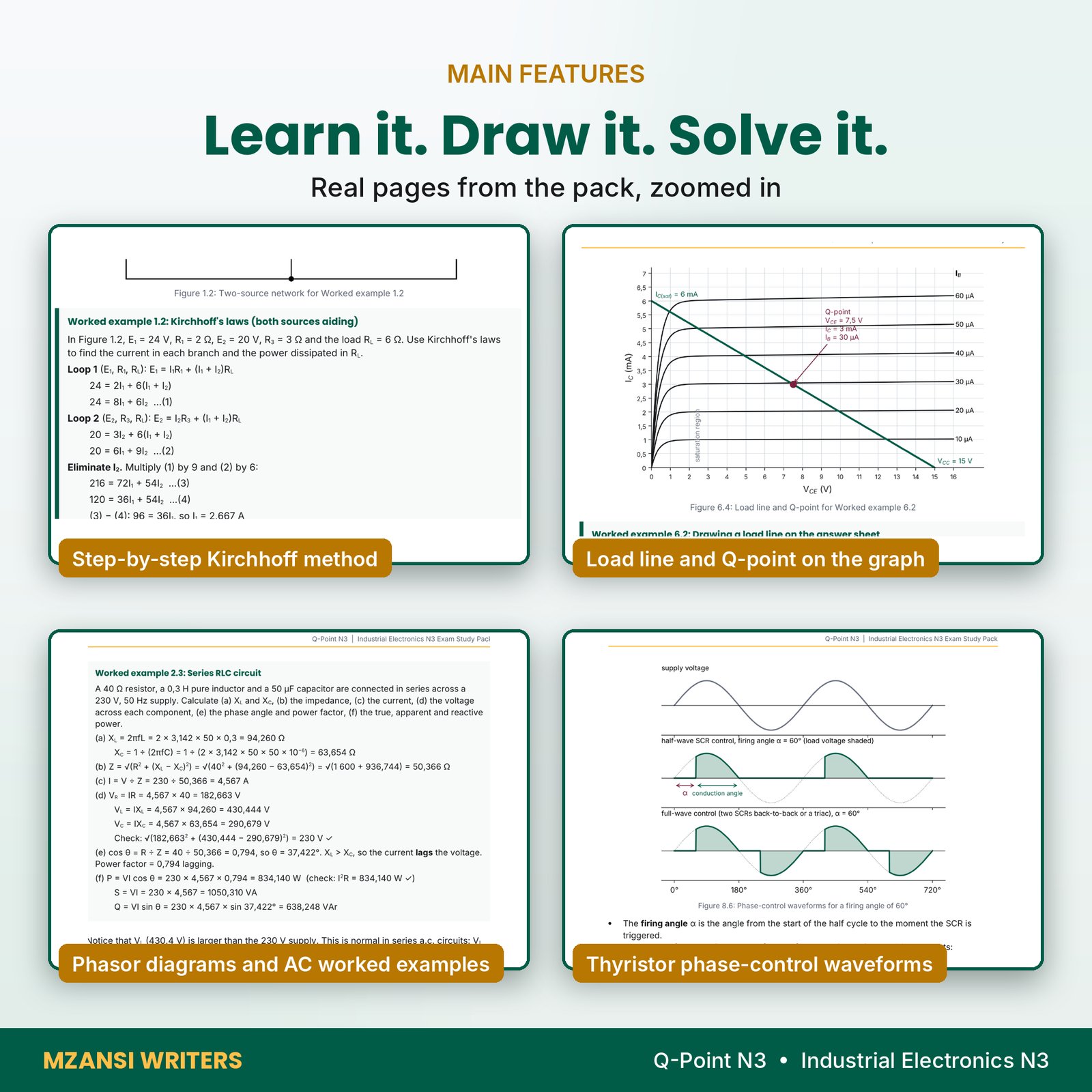
- Direct-current theory: Ohm’s law, series-parallel networks, Kirchhoff’s laws with a step-by-step two-loop method, negative currents, the Wheatstone bridge
- Alternating-current theory: sine-wave values, phasors, reactance, series and parallel RLC circuits, the power triangle, series and parallel (tank) resonance
- Semiconductor theory: ions, bonds, energy bands, Fermi level, N-type and P-type material, drift and diffusion current, the PN junction and breakdown
- Diodes and diode circuits: data-sheet ratings, zener, LED, photodiode, varactor, Schottky and tunnel diodes, clippers, clampers and voltage doublers
- Power supplies: half-wave, centre-tap and bridge rectifiers, filters, ripple and regulators
- Transistors, amplifiers and FETs: configurations, characteristics, drawing a load line on the answer sheet, biasing, amplifier classes, push-pull, coupling, negative feedback, Darlington pairs, JFETs and MOSFETs with IEC symbols
- Operational amplifiers: inverting, non-inverting, follower, summing, integrator, differentiator and comparator circuits with waveforms
- Thyristors and power control: SCR, two-transistor model, triggering, commutation, control methods, phase control, triac, diac, snubbers and optocouplers
- Measuring instruments: accuracy, precision, resolution, errors, digital voltmeter types, frequency counter and the oscilloscope
- Transducers and control: potentiometer, strain gauge, thermistor, RTD, LDR, LVDT, capacitive, piezoelectric, thermocouple and photovoltaic transducers, open and closed-loop control
Features
- More than 90 diagrams, graphs and block diagrams drawn specially for this pack, in the labelled style markers want to see
- Worked examples with every step: formula, substitution and answer with units, using the decimal comma and three decimal places like the real paper
- Every calculation checked twice so you can trust the answers you compare against
- Practice questions and answers at the end of every module
- Two original 100-mark practice papers in the current format (Section A objective questions, Section B long questions) with a formula sheet and a load-line answer sheet
- Mark-by-mark memos where every tick is one mark, so you can mark yourself honestly
- Night-before cheat sheet of formulas and must-know facts
- Eight-week study timetable, progress checklist and score tracker
- Glossary of more than 90 terms
What is included
- Study pack, full colour PDF (135 A4 pages) with a clickable contents page and bookmarks
- Study pack, editable Word DOCX with real heading styles and an automatic table of contents
- Ink-saver PDF edition for low-cost printing at home or at a print shop
- User guide (DOCX) with getting-started steps, study tips, troubleshooting and FAQ
How it works
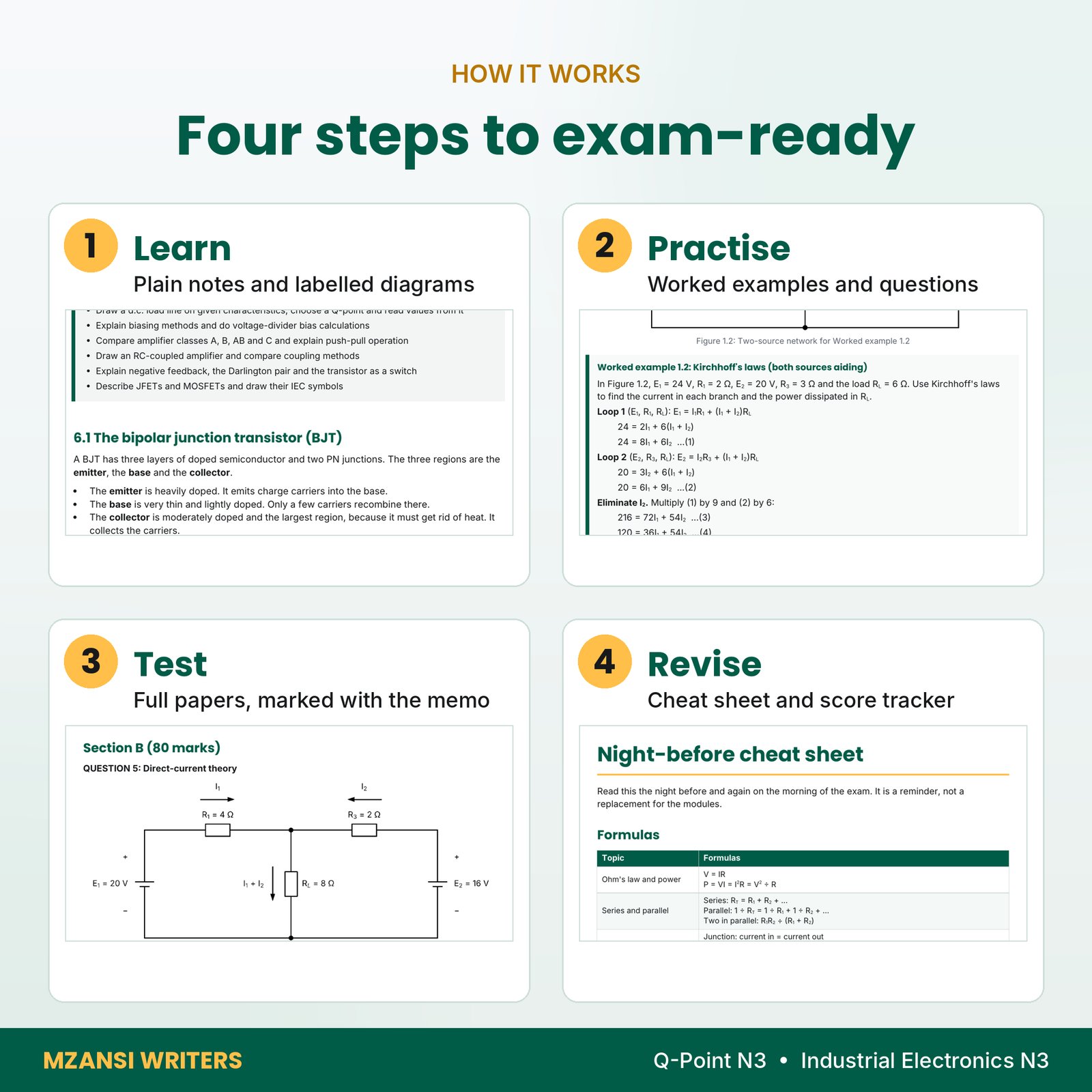
- Learn: read one module at a time and draw each diagram from memory.
- Practise: cover the worked examples and try them, then do the module questions.
- Test: write Practice Paper 1 under exam conditions and mark it with the memo.
- Revise: fix weak modules using the score tracker, write Paper 2, then use the cheat sheet before the exam.
File formats and software
PDF files open in any PDF reader on a phone, tablet or computer (for example Adobe Acrobat Reader, your web browser or Google Drive). The DOCX files open in Microsoft Word, Google Docs or LibreOffice Writer. The pack uses the free Google fonts Inter and Poppins; if they are not installed, your software uses a similar font.
Customising
Use the DOCX to add your own notes, highlight key facts, change heading colours with the built-in styles and print only the pages you need.
Digital download
This is a digital product. No physical item is posted. After payment your download links appear on the order confirmation page and in your account, and they are also sent by email.
Use cases
- Revising for the April, August or November N3 exam
- Catching up after missing classes or before a class test
- Practising the load-line, Kirchhoff and AC calculations that carry many marks
- Learning to draw rectifier, op-amp, SCR and block diagrams neatly
- Last-minute revision with the cheat sheet on exam morning
Frequently asked questions
Is this the official DHET Industrial Electronics N3 study guide?
No. It is an independent study aid by Mzansi Writers and is not affiliated with, endorsed by or approved by DHET, any TVET college or any examining body.
Are the practice papers past papers?
No. They are original papers written in the style and format of recent N3 papers, each with a full marking memo.
Does it cover the whole syllabus?
Yes. All ten topic areas tested in the Industrial Electronics N3 exam are covered.
Can I study on my phone?
Yes. The PDF works on any phone or tablet, and the contents page is clickable.
Can I print it?
Yes, for your own use. Use the ink-saver PDF to save ink, printed on A4 at actual size.
Why are decimals written with a comma?
South African exam papers use the decimal comma, so the pack matches the paper you will write.
Can I share it with classmates?
No. The licence is for personal use only. Sharing, reselling or uploading the files is not allowed.
Mzansi Writers is an independent study aid publisher. This product is not affiliated with, endorsed by or approved by the Department of Higher Education and Training (DHET), any TVET college, Umalusi or any examining body. Names are used only to describe the examination. Personal-use licence: no sharing, copying for others or resale.




Reviews
There are no reviews yet.