





Description
SocioLens SA is a complete set of sociology exam notes for South African university students. In 130 A4 pages it takes you from the sociological imagination to Marx, Weber and Durkheim, modern theory, research methods, inequality, family, education, religion, urbanisation and the social issues that shape South Africa today. Every chapter is written in plain language, applied to South African life and built around the way sociology papers are actually marked.
Sociology exam notes that turn reading into marks
Most students do not struggle because sociology is hard. They struggle because the readings are long, the theories blur together and nobody explains what a marker wants in a 25-mark essay. SocioLens SA fixes that. Each idea is explained simply first, then given the exact terms, thinkers and examples you need to write a strong answer.
The notes cover the topics that appear again and again in first-year and second-year sociology modules at South African universities and distance-learning institutions. Use them next to your own study guide and module outline.
Who it is for
- First-year sociology students at any South African university.
- Second-year students who need a firm grip on theory, research methods and inequality.
- Students repeating a module or preparing for a supplementary exam.
- Social work, education, nursing, law, psychology, development studies and public administration students taking sociology as a service module.
What is included
The study pack (19 chapters)
- Start Here: how SA sociology exams work, mark splits, a command words table, an essay marking rubric, PEEL paragraphs and Harvard referencing basics.
- Thinking sociologically: the sociological imagination, structure and agency, social facts, verstehen, and the history of sociology in South Africa.
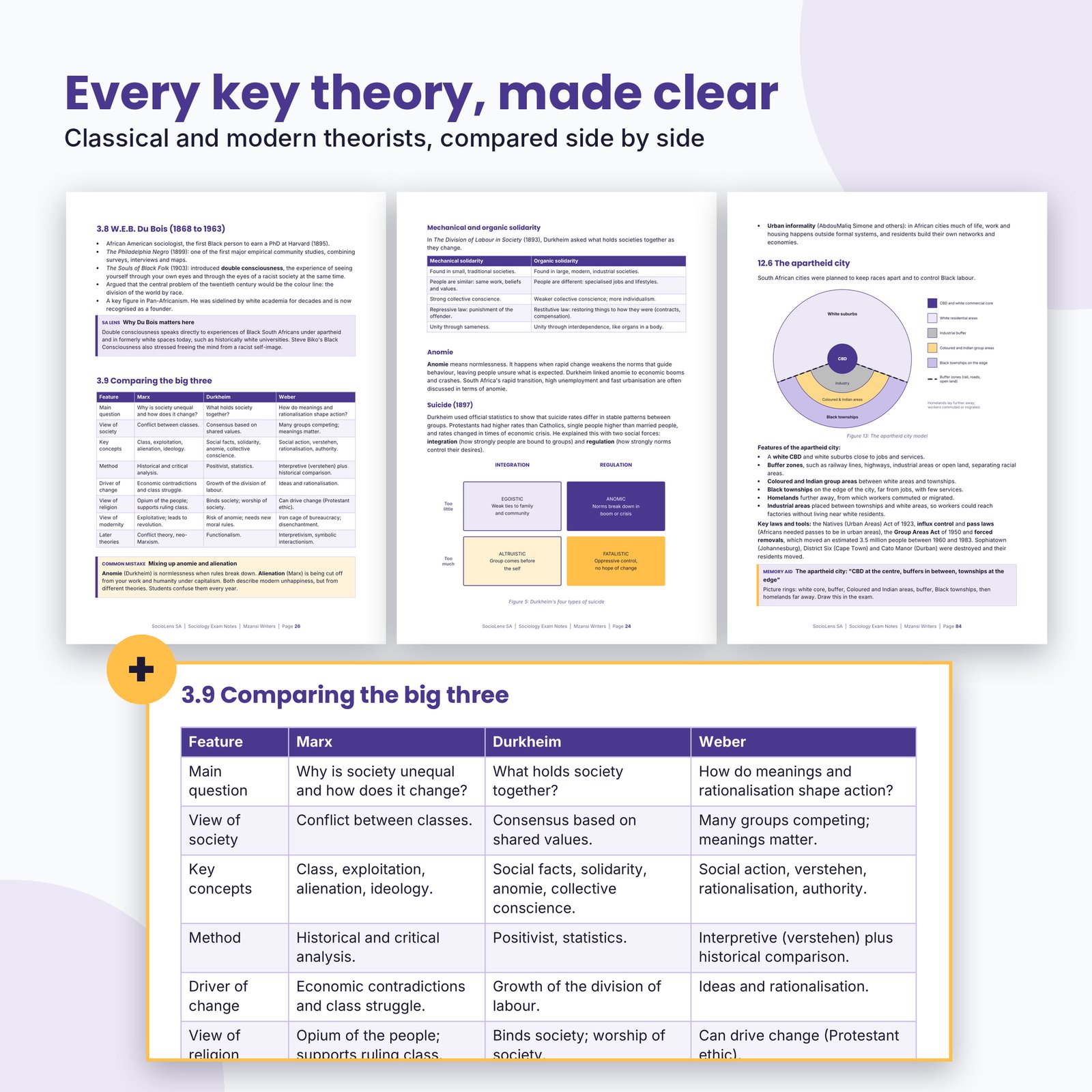
- Classical theorists: Comte, Spencer, Martineau, Marx, Weber, Durkheim, Simmel and Du Bois, with a side-by-side comparison table.
- Modern and contemporary theory: functionalism, conflict theory, Gramsci, symbolic interactionism, Goffman, feminist theories and intersectionality, Bourdieu, Giddens, Foucault, Habermas, Beck, Bauman, Ritzer, and decolonial thinkers including Fanon, Biko, Mafeje, Connell and Ndlovu-Gatsheni.
- Research methods: paradigms, the research process, surveys, interviews, ethnography, sampling, reliability and validity, research ethics and POPIA, plus eight worked calculations (mean, median, mode, unemployment rates, rates per 100,000, sampling fractions, percentage change and the Gini coefficient), all checked.
- Culture, socialisation and deviance: norms, values, agents of socialisation, identity, Merton’s strain theory, labelling, control theory and crime in South Africa.
- Inequality: class, race, gender, poverty lines, social grants, apartheid laws and development theories.
- Institutions: family and migrant labour, education from Bantu Education to #FeesMustFall, religion and the secularisation debate, the apartheid and post-apartheid city, work, globalisation and health.
- SA social issues: youth unemployment, GBVF, crime, substance abuse, HIV, xenophobia, state capture, land reform, service delivery protests, climate justice and the digital divide, each with a ready-made essay plan.
Practice and revision tools
- Two full 100-mark practice papers (40 MCQs, 12 short questions and 8 essay questions).
- Memos with mark allocations, an essay rubric and model answer outlines.
- Check yourself questions at the end of every chapter, all answered.
- A night-before cheat sheet with key thinkers, memory aids, dated SA statistics and key dates.
- A six-week study timetable, a progress checklist and a practice score tracker.
- A 210-term glossary and 13 clear diagrams you can redraw in the exam.
Features that make it different
- Built for South Africa: SA Lens boxes apply every theory to local life, from Marikana to the apartheid city.
- Current facts: statistics checked against Census 2022, Stats SA’s labour force survey for Q2 2026 and other official sources, always with the year.
- Memory aids for every list you must learn by heart.
- Common mistake boxes that flag the errors that cost marks every year.
- Exam focus boxes that show how each topic is usually asked.
- Original content: written from scratch in clear, plain English, with original practice questions.
How it works
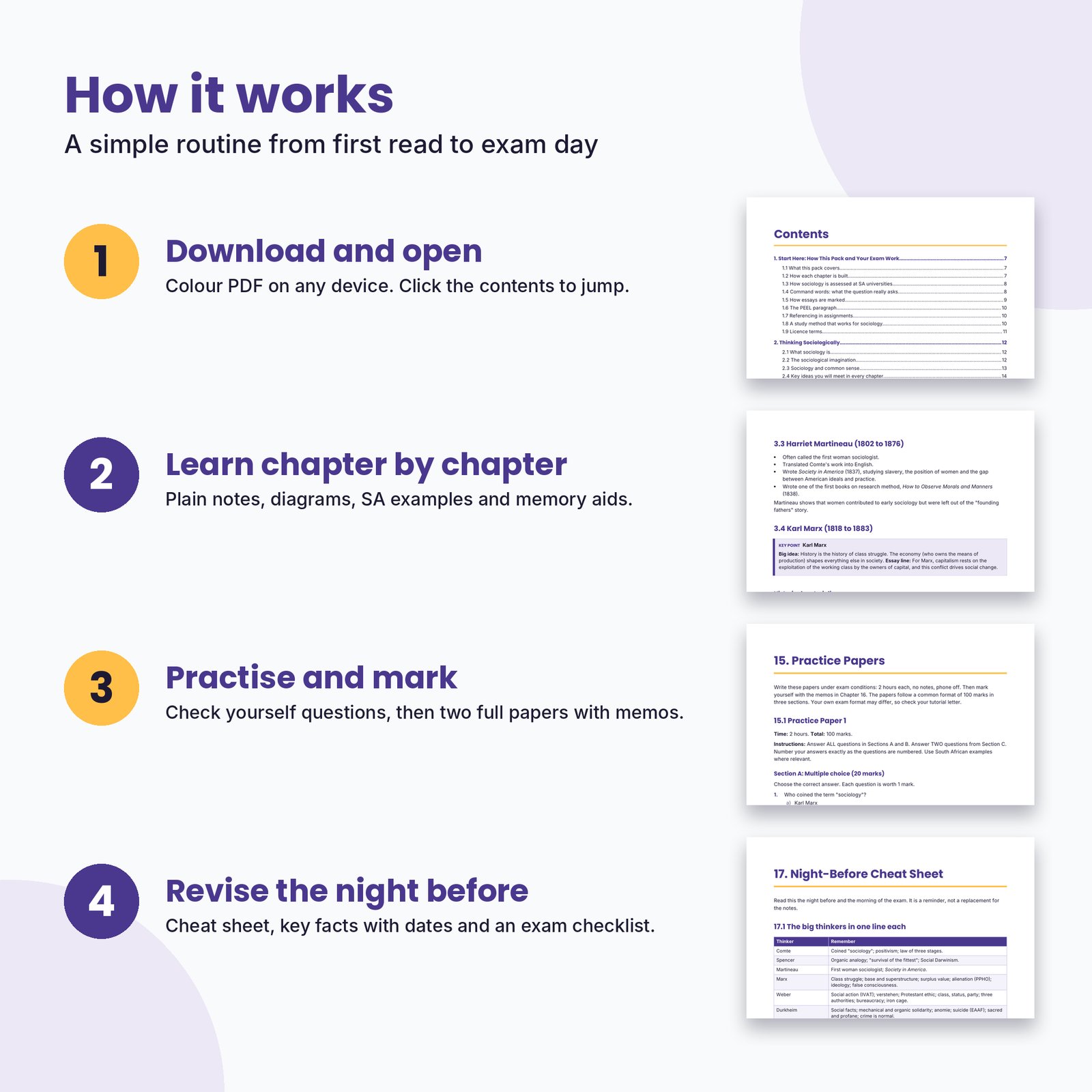
- Download your files straight after checkout.
- Open the colour PDF on your laptop, tablet or phone and click any line in the contents to jump there.
- Work through one chapter at a time, then answer the Check yourself questions.
- Write both practice papers under exam conditions and mark them with the memos.
- Read the cheat sheet the night before your exam.
File formats and software
- Study pack, colour PDF (A4, 130 pages, clickable contents and bookmarks, fonts embedded).
- Ink-saver PDF (A4, light greyscale-friendly design for home or campus printing).
- Editable Word DOCX with real heading styles and an automatic table of contents.
- User guide DOCX explaining how to use every part.
You need any PDF reader to open the PDFs. To edit the DOCX, use Microsoft Word, Google Docs, LibreOffice Writer or WPS Office. Nothing else to install.
Customise it
The Word version uses built-in heading styles, so you can add your lecturer’s notes, remove topics that are not on your outline, change fonts and colours in one step and refresh the contents page. Print as many copies as you need for your own study.
Digital download
This is a digital product. No physical item will be shipped. Your files are available to download from your account and order email immediately after payment.
Use cases
- Preparing for a first-year sociology exam in June or November.
- Planning an assignment on inequality, family or education and needing the theory straight.
- Catching up after missing lectures or falling behind on readings.
- Revising research methods and calculations before a test.
- Studying on the go on your phone, then printing the ink-saver version for the final week.
Frequently asked questions
Will these sociology notes match my university module?
They cover the core topics shared by introductory and intermediate sociology modules in South Africa. Use the progress checklist to match them to your own outline.
Are these past exam papers?
No. The two practice papers and all questions are original, written in the style of a typical university sociology exam.
Is this a textbook summary?
No. All content is original and written in plain language. It explains the same core theories and debates with its own examples.
Can I use it on my phone?
Yes. The PDF opens in any phone PDF reader, and the contents links and bookmarks work there too.
Can I print it?
Yes. The ink-saver PDF is designed for printing in greyscale on A4.
Can I share it with my study group?
No. The licence covers one buyer for personal study. Each student needs their own copy.
Are the statistics current?
Yes, as of 2026. Figures were checked against official sources and every statistic includes its year and source.
Important information
Mzansi Writers is an independent study aid. SocioLens SA is not affiliated with, endorsed by or approved by any university, college, examining body or the Department of Higher Education and Training (DHET). Institution names are used only to describe who the notes are for. Licensed for one buyer’s personal study only: no sharing, copying, uploading or resale.


Reviews
There are no reviews yet.