



Description
FirstByte IT 101 is a complete set of first-year IT exam notes for South African university students. It covers Python programming, data structures, systems analysis and design, databases and SQL, networks and information systems theory in one study pack. Every Python example was run and every SQL query was tested, so the output you see on the page is real.
If your module is called Introduction to Information Systems, Programming 1, Development Software 1, Informatics 1 or Business Information Systems, this pack was written for you. It explains the work in plain language, shows you how markers allocate marks, and gives you plenty of practice before the exam.
What the first-year IT exam notes cover
The pack has 18 topic chapters across 167 A4 pages, mapped to the topics that appear in most first-year IT and Information Systems modules in South Africa:
- Exam technique: paper structure, command words (define, explain, discuss, trace), mark allocation and time management.
- Information systems theory: data vs information, IS components, TPS, MIS, DSS, ESS, ERP, CRM, SCM, e-commerce, Porter’s five forces, generic strategies and the value chain.
- Hardware, software and data: the CPU and machine cycle, memory, operating systems, cloud computing (IaaS, PaaS, SaaS), binary, hexadecimal and data units.
- Python programming: variables, operators, input and output, f-strings, selection, loops, functions, recursion, strings, lists, tuples, dictionaries and sets.
- Data structures and algorithms: stacks, queues, linear and binary search, bubble, selection and insertion sort, and Big-O.
- Files, testing and OOP: text and CSV files, exceptions, test data, assert, classes, objects, inheritance and UML class diagrams.
- Systems analysis and design: the SDLC, waterfall, prototyping, RAD and Scrum, TELOS feasibility, requirements, fact-finding, DFDs, use cases, decision tables and trees, changeover and maintenance.
- Databases and SQL: keys and integrity, crow’s foot ERDs, resolving many-to-many relationships, normalisation to 3NF, and SQL from CREATE TABLE to GROUP BY, joins and subqueries.
- Networks: LAN and WAN, topologies, devices, media, OSI and TCP/IP, ports, IP addressing, subnet masks, DNS, DHCP and transfer time calculations.
- Security, ethics and law: the CIA triad, malware, encryption, backups, PAPA, POPIA, ECTA, the Cybercrimes Act and PAIA, plus AI, big data, BI, IoT and 4IR.
Features that help you score marks
Tested code you can trust
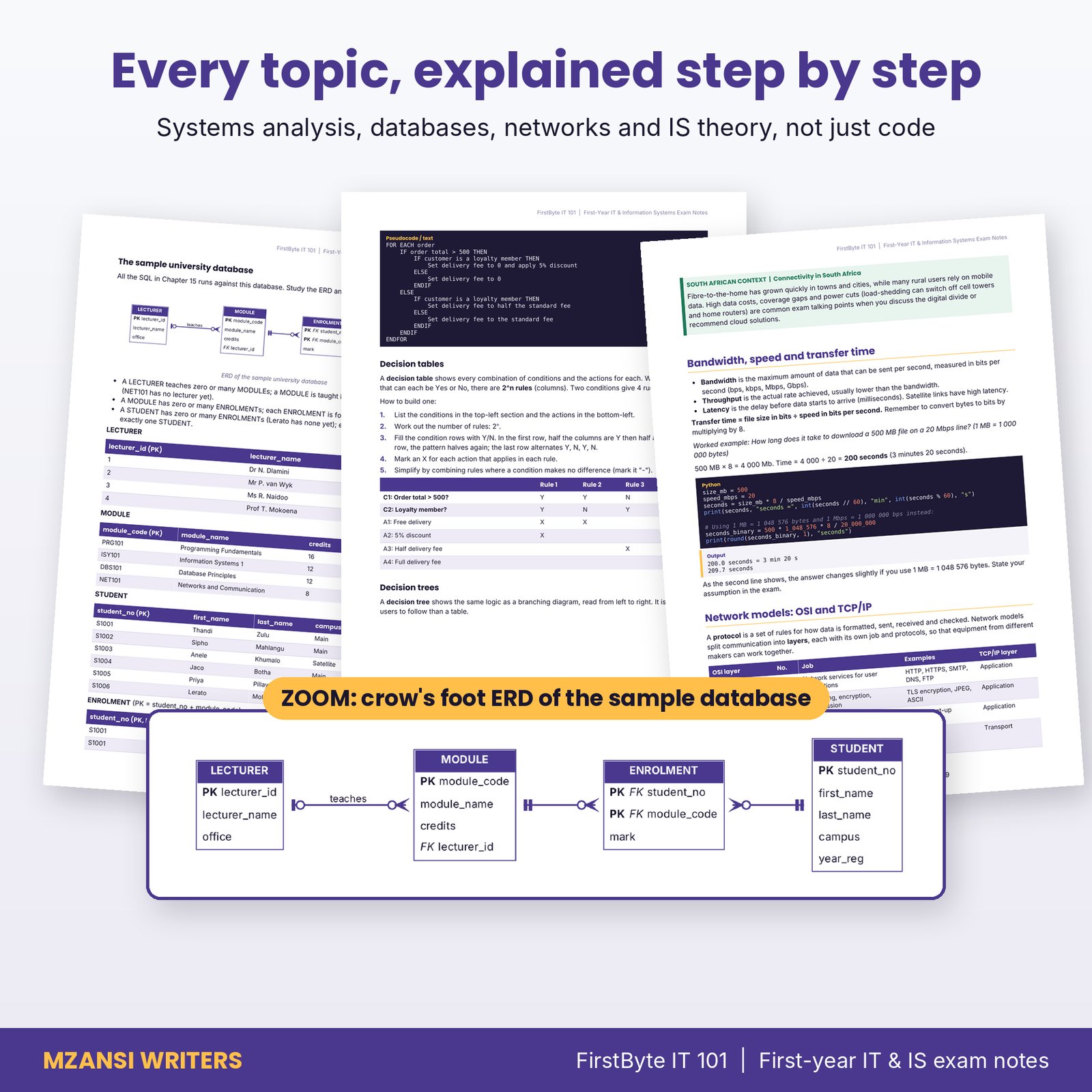
Each Python example sits in a colour-coded code box with its real output underneath. Programs that ask for input show a sample run. All SQL runs against one small university database, so you can follow every result table and rebuild it yourself.
Exam alerts, memory aids and common mistakes
Coloured boxes flag how each topic is usually examined, short tricks for remembering lists, and the errors that cost students marks every year, such as printing instead of returning or writing = NULL in SQL.
Diagrams drawn to exam standard
26 clear diagrams include a context diagram and level-0 DFD, crow’s foot ERDs, a use case diagram, flowcharts, a decision tree, network topologies, the SDLC and Scrum cycles, and a UML class diagram.
Practice that feels like the real thing
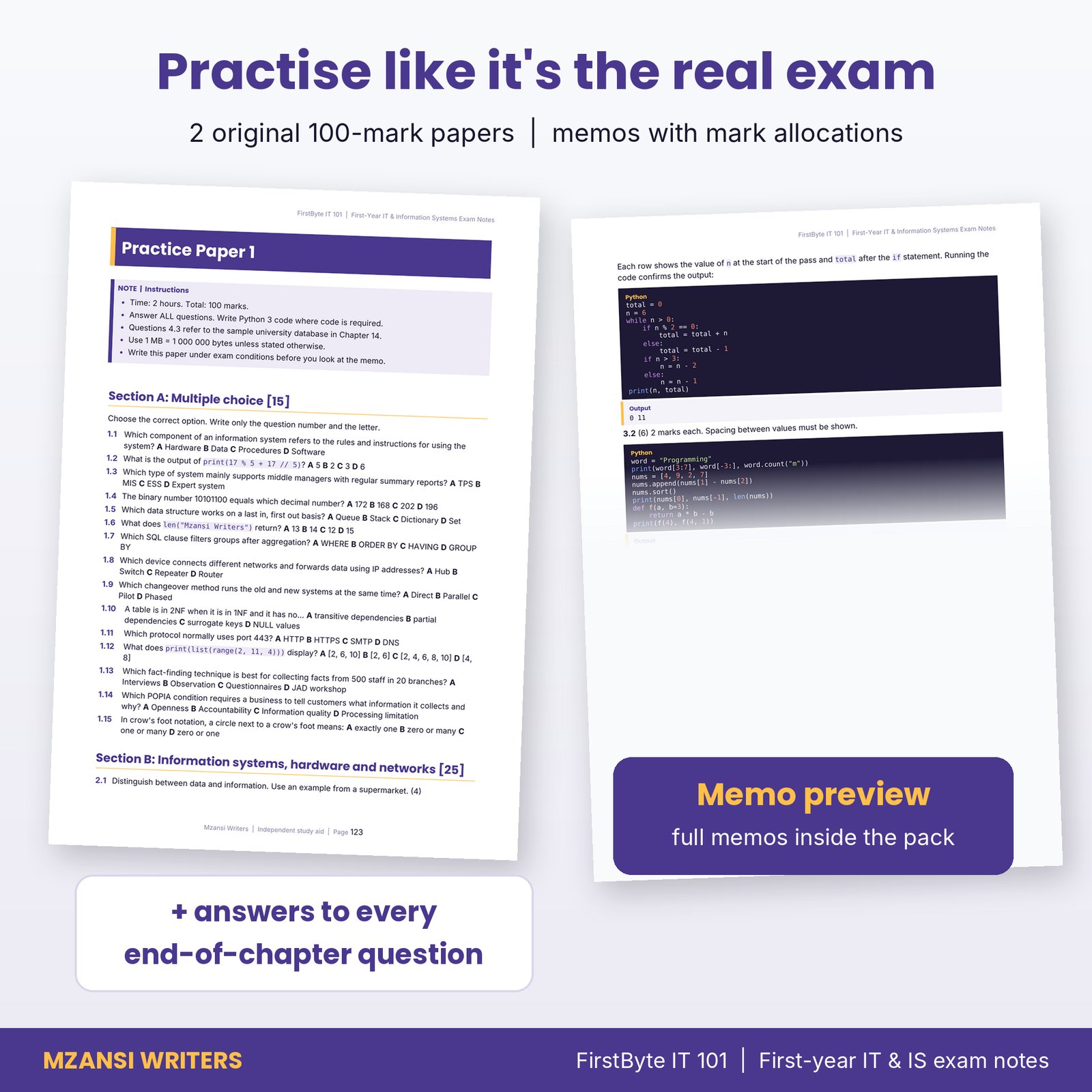
Every chapter ends with practice questions and mark values. Model answers for all of them are at the back. Two original 100-mark practice papers come with full memos that show where each mark is earned.
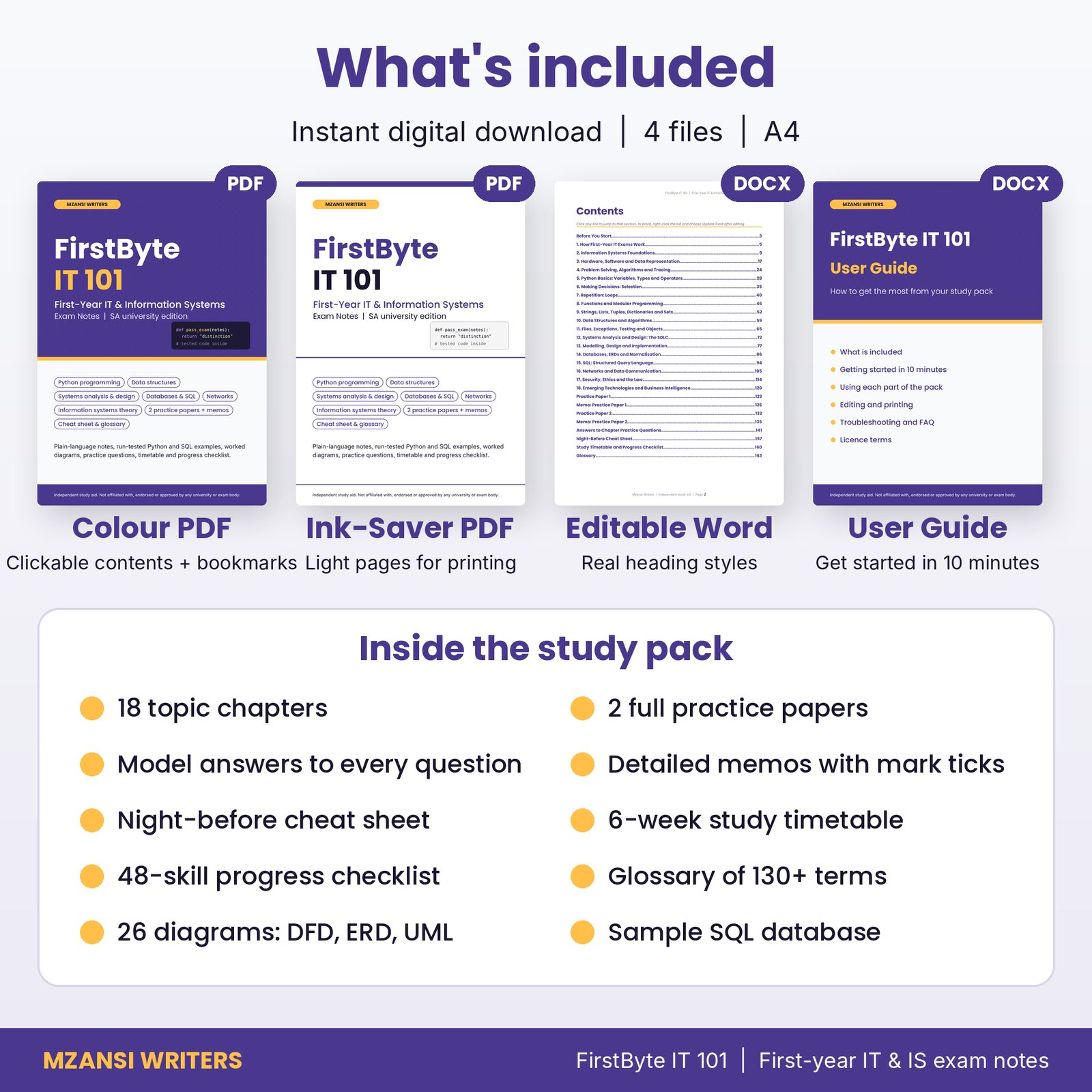
What is included
- Study pack in colour PDF with a clickable contents page and full PDF bookmarks
- Ink-Saver PDF edition with light, greyscale-friendly pages for printing
- Editable Word (DOCX) study pack with real heading styles and an automatic contents page
- User guide (DOCX) with getting started steps, troubleshooting and FAQs
- Night-before cheat sheet, six-week study timetable, 48-skill progress checklist, practice paper score tracker and a glossary of more than 130 terms
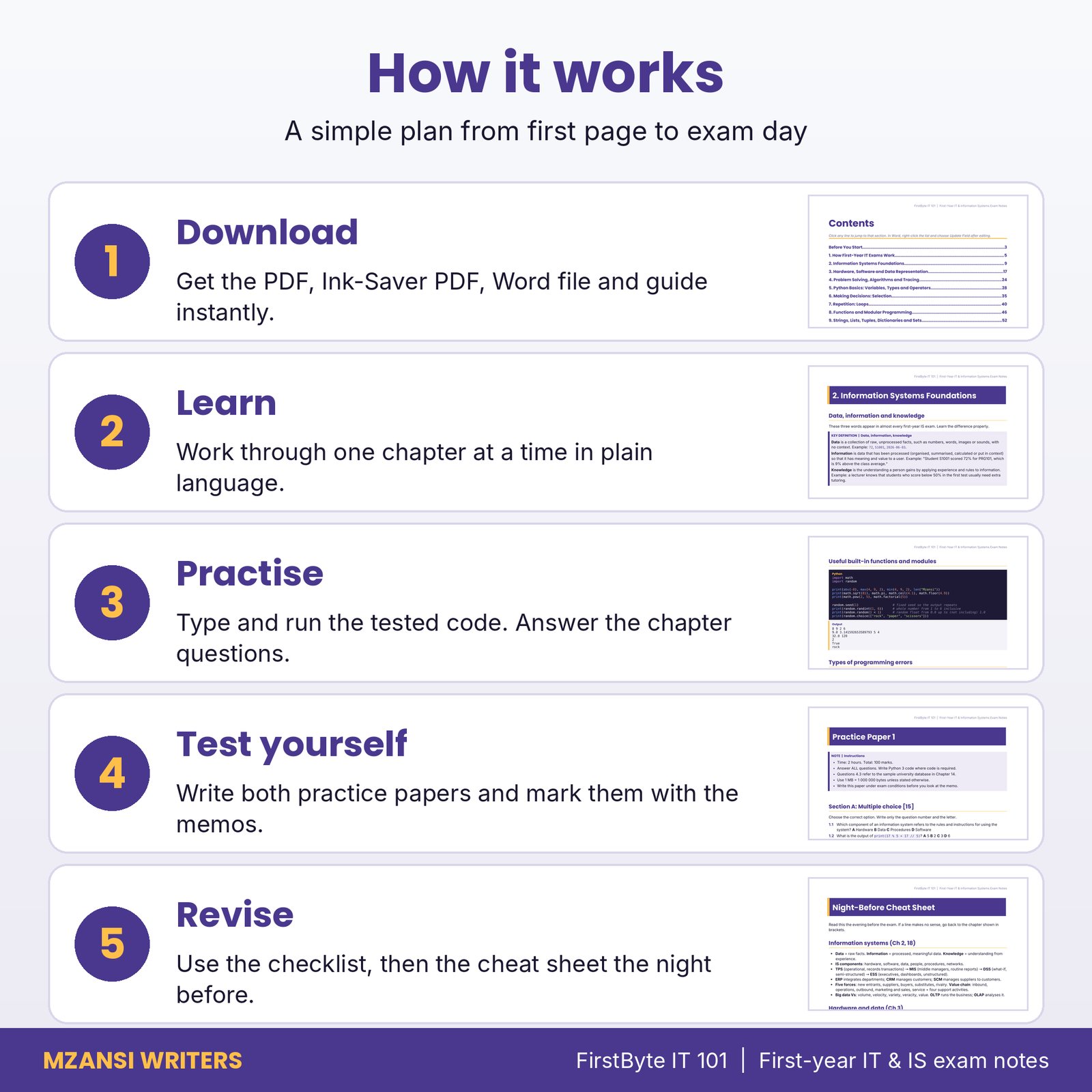
How it works
- Buy and download the four files straight away from your account.
- Read Chapter 1 to learn how first-year IT exams are set and marked.
- Work through one chapter at a time. Type and run the code yourself.
- Answer the chapter questions, then check the model answers.
- Write both practice papers under exam conditions and mark them with the memos.
- Use the checklist to find weak spots, and read the cheat sheet the night before.
File formats and software needed
You get two PDF files and two DOCX files, all A4. Open the PDFs in any PDF reader on a laptop, tablet or phone. Open the DOCX files in Microsoft Word, Google Docs or LibreOffice Writer. To run the code yourself, install free Python 3 (version 3.8 or later; 3.10 or later for the match example).
Customise it
The Word version uses built-in heading styles, so you can change fonts and colours in a few clicks, add your own notes under any heading, and type straight into the timetable and checklist. Update the contents page with one right-click after editing.
Digital download
This is a digital product. No physical item is shipped. Your download links appear right after payment and stay in your account, so you can download again on any device.
Who uses it
- A first-year BCom Information Systems student preparing for a semester test on DFDs, ERDs and SQL.
- A Diploma in IT student who struggles with loops and trace tables before the programming exam.
- A student repeating Programming 1 who wants structured practice with memos.
- An extended-programme student who needs plain-language explanations of networks and number systems.
- A student who studies on a phone during the commute and prints the Ink-Saver edition for exam week.
Frequently asked questions
Does it match my university’s module?
It covers the topics that appear in most South African first-year IT and IS modules. The topic map in Chapter 1 shows which chapters match your outline. Always check your own study guide for what is examinable.
My module uses Java, C# or C++. Will this help?
Yes. The theory, algorithms, tracing, systems analysis, databases, SQL and networks apply to any language, and a syntax comparison table helps you translate the Python examples.
Are the practice papers past papers?
No. They are original papers written to match the level and style of first-year exams, with full memos.
Can I print it?
Yes. Use the Ink-Saver PDF, which is designed to print clearly in greyscale on A4.
Do I need to install Python?
No, you can study from the notes alone. Running the code yourself is recommended, and Python 3 is free.
Can I share it with my study group?
No. The licence covers one student’s personal use. Each student needs their own copy.
Licence and independence
Personal use licence for one student. You may print and edit your copy for your own study, but you may not resell, share, upload or distribute it. Mzansi Writers is an independent study aid publisher. This product is not affiliated with, endorsed by or approved by any university, university of technology, private college, DHET, the CHE, the Python Software Foundation or any software vendor. Product and institution names belong to their owners and are used only to describe the subject.



Reviews
There are no reviews yet.