Description
FAC1501 study pack: learn it, practise it, check it
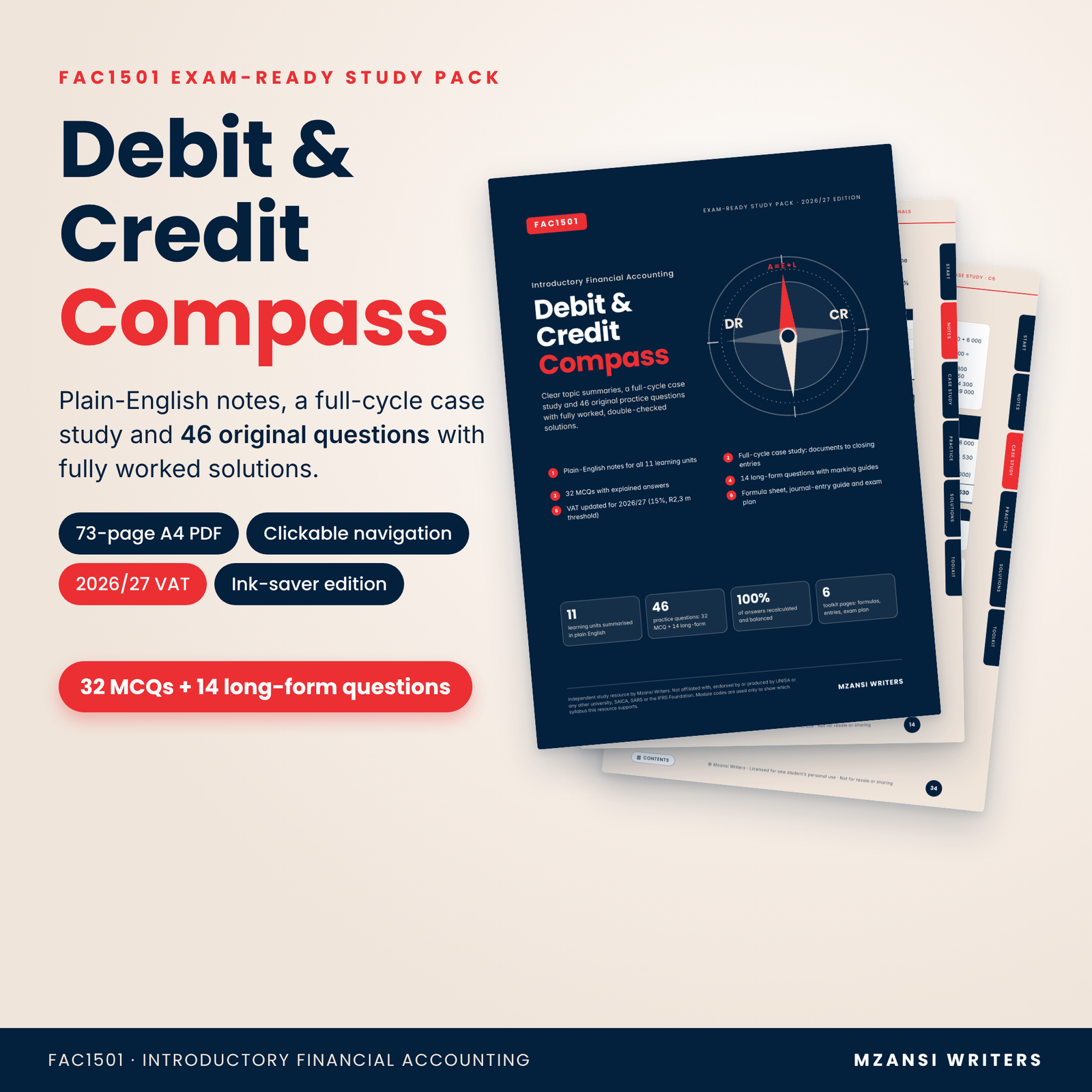
Debit & Credit Compass is an exam-ready FAC1501 study pack for Introductory Financial Accounting. It turns the whole syllabus into one clear route: read a short, plain-English summary, see the rule worked in a real example, practise with original questions, then check every step against a fully worked solution. It is designed for South African students who want to understand financial accounting, not just memorise memos.
Every explanation, business and question in the pack is original. Every figure in every worked example and solution was recalculated and checked: debits equal credits, journals cross-cast, statements balance and totals agree.
Who this FAC1501 summary and practice pack is for
- UNISA students registered for FAC1501 (topics checked against the public module page in November 2026)
- First-year BCom Accounting, BCompt and BAcc students at UJ, UP, NWU, Wits, UKZN, UFS and other institutions covering the same work
- Students repeating the module who need structured practice with full workings
- Anyone who finds debits and credits confusing and wants a step-by-step method
What’s included
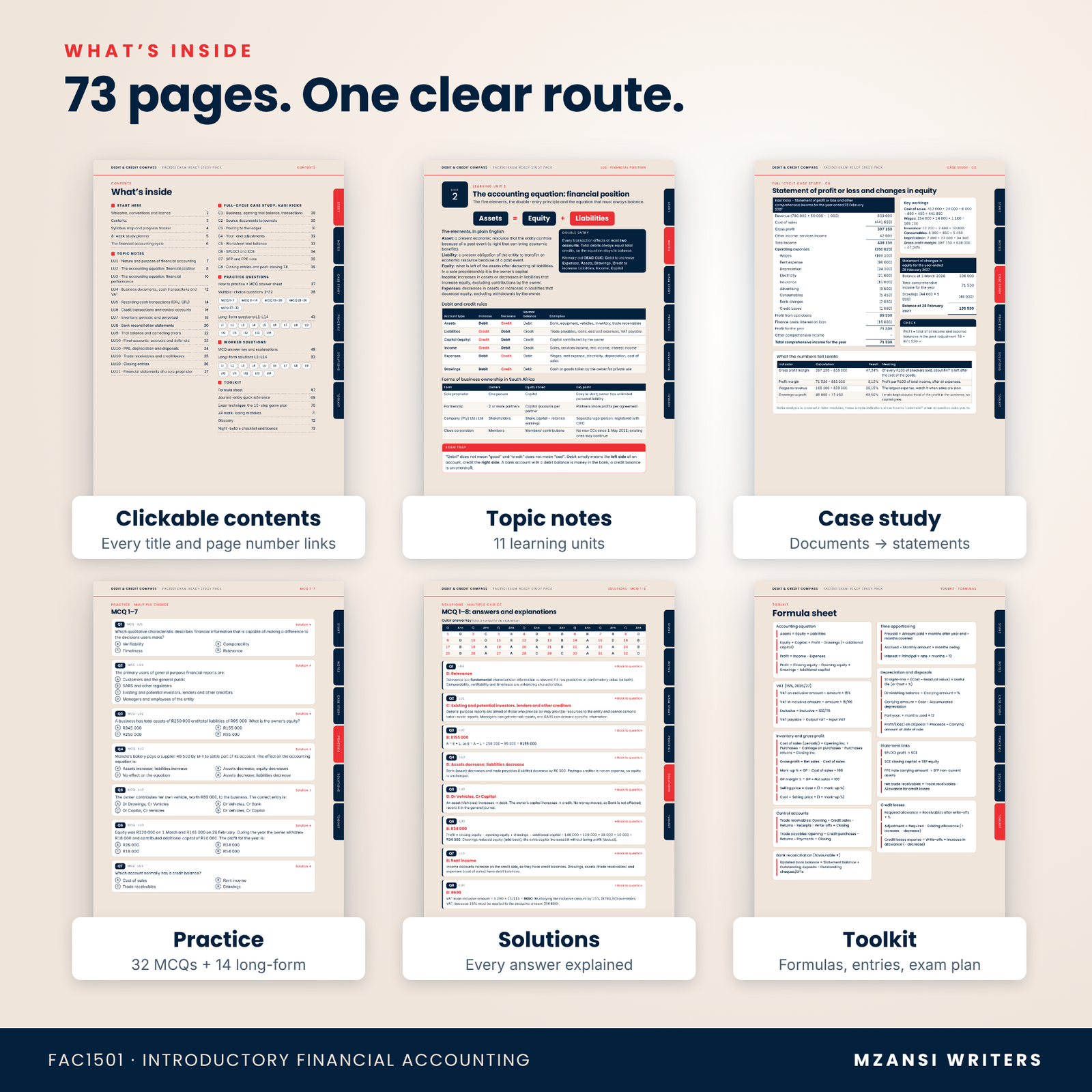
- Debit & Credit Compass – FAC1501 Study Pack (PDF, 73 A4 pages) with the full colour design
- Ink-Saver Print Edition (PDF, 73 pages): the same pages on a white background for cheaper printing
- User guide (DOCX): how to use every feature, printing tips, troubleshooting and FAQs
Inside the pack
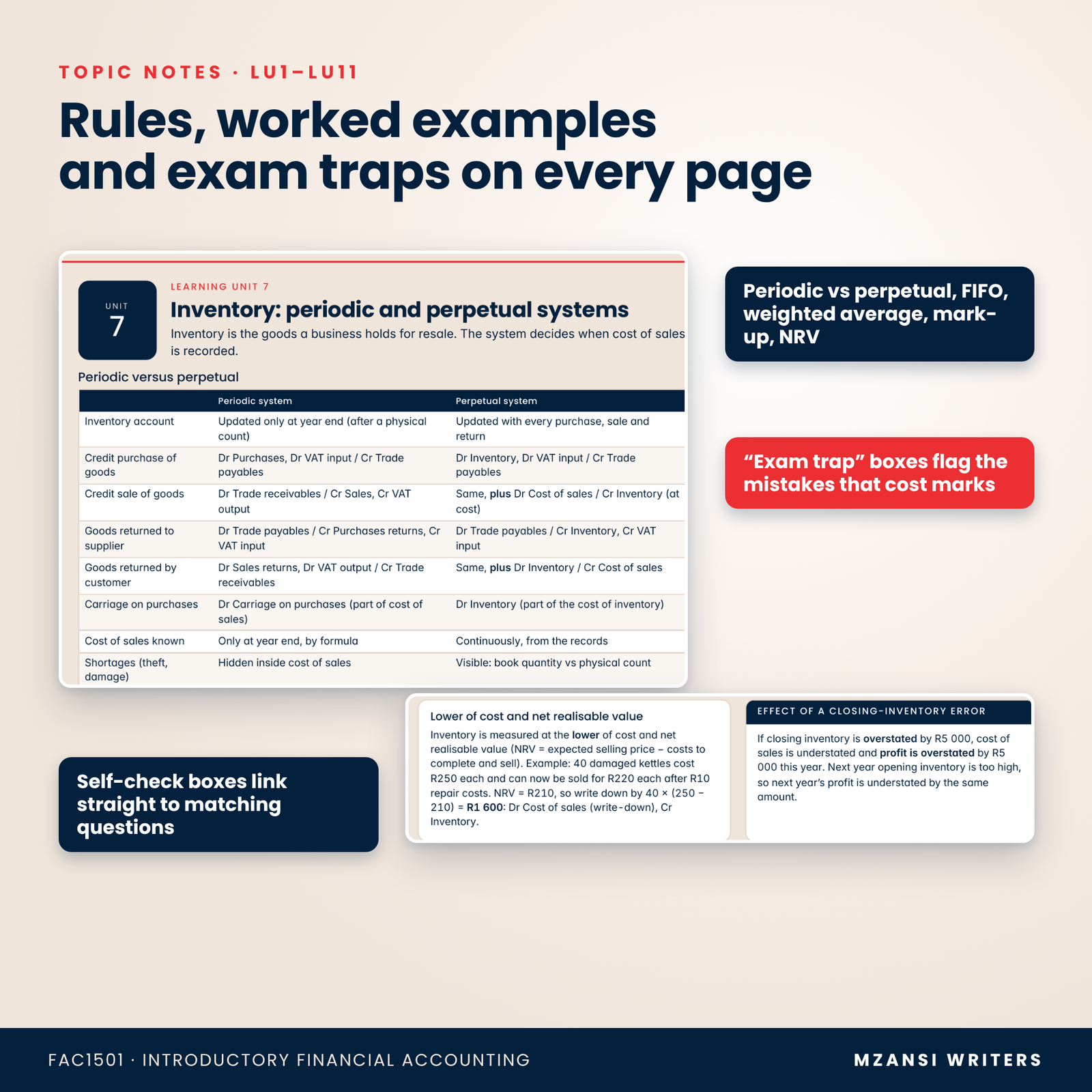
- Topic notes for all 11 learning units: the nature and purpose of financial accounting; the accounting equation (financial position and performance); business documents, cash transactions and VAT; the cash receipts and cash payments journals; credit transactions and control accounts; periodic and perpetual inventory, FIFO and weighted average; bank reconciliation statements; the trial balance and correcting errors; adjustments, PPE and depreciation, disposals, credit losses and closing entries; and the financial statements of a sole proprietor.
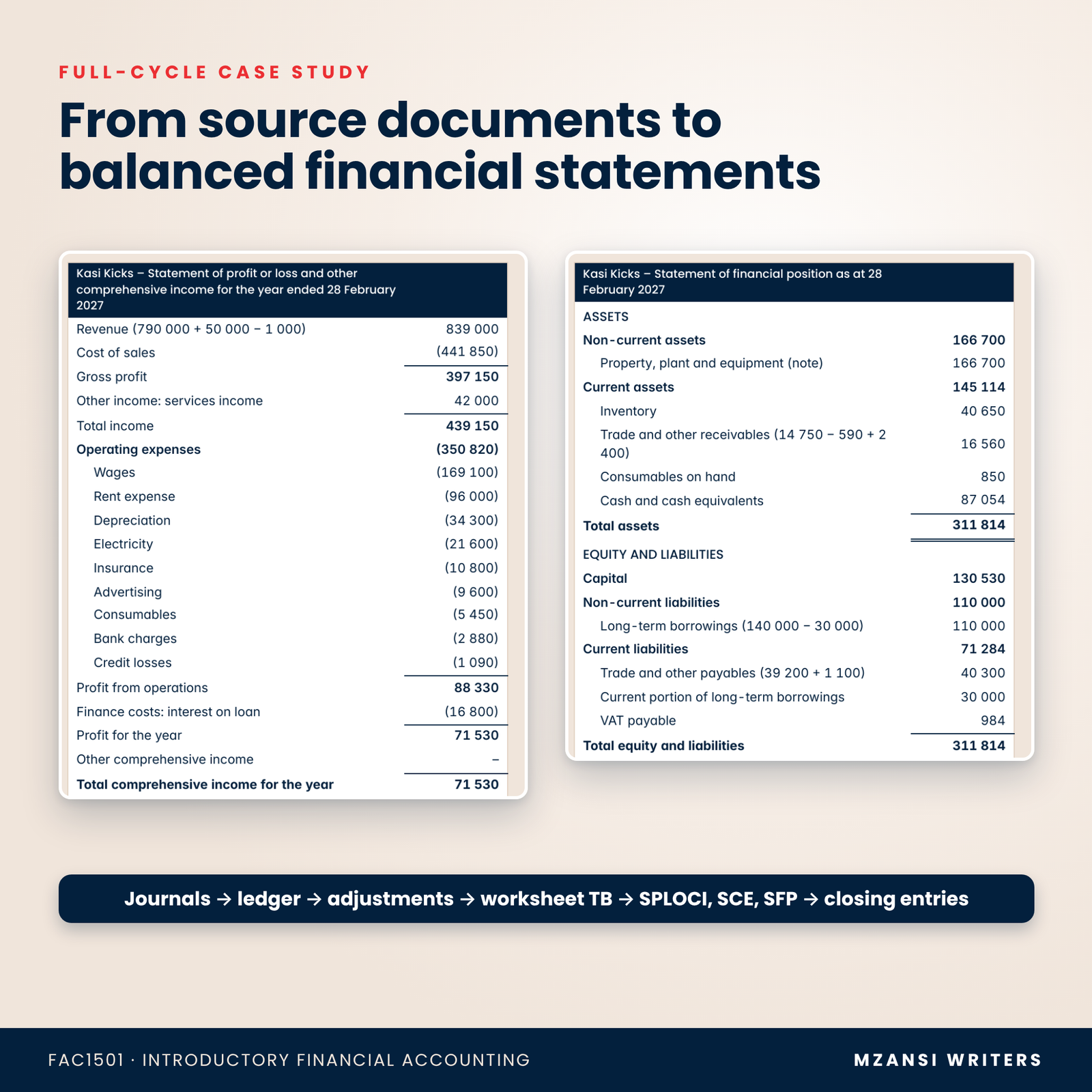
- Full-cycle case study: follow a Soweto sneaker store from its opening trial balance through February’s source documents, journals, ledger, year-end adjustments and a worksheet trial balance to a complete statement of profit or loss and other comprehensive income, statement of changes in equity, statement of financial position, PPE note and closing entries.
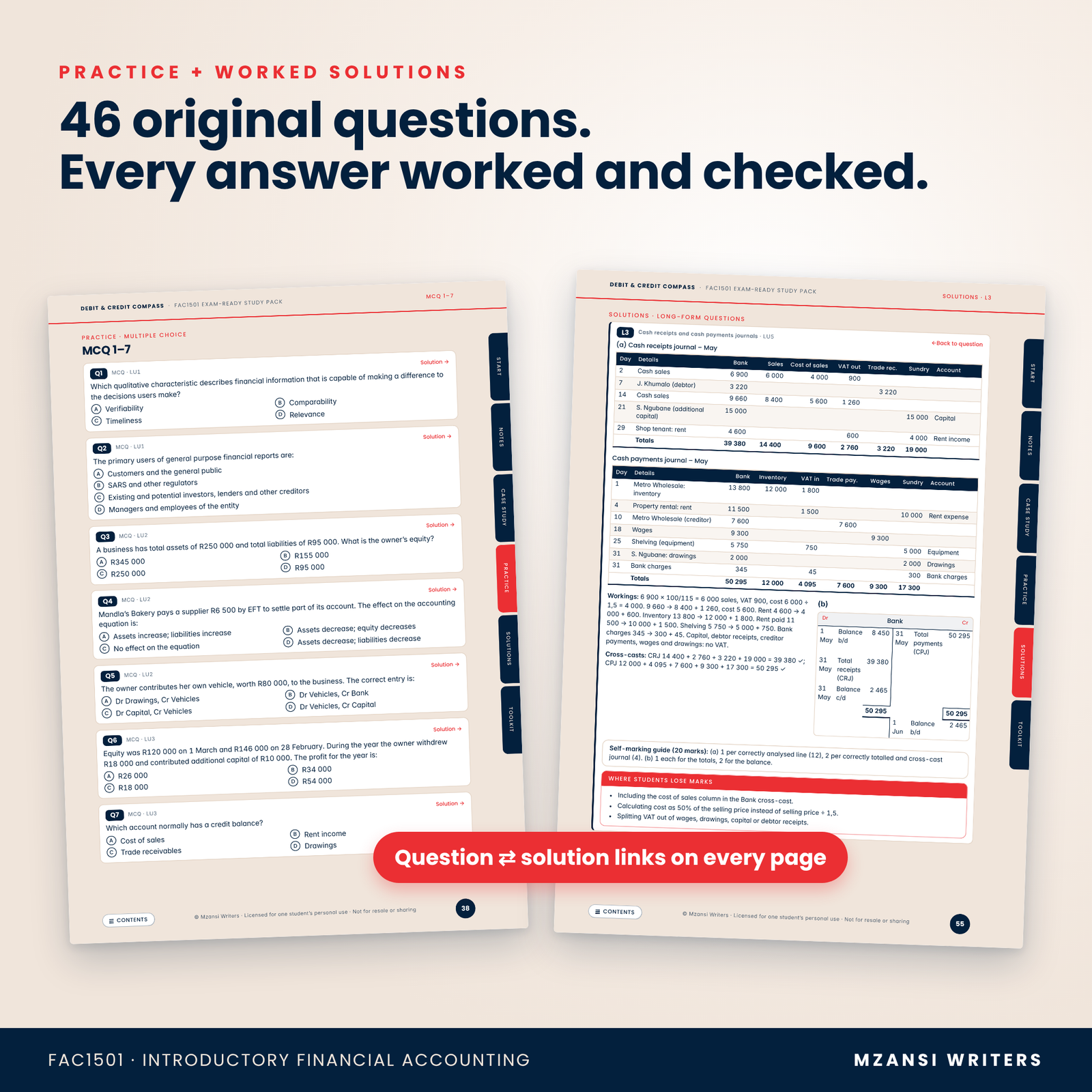
- 46 practice questions: 32 multiple-choice questions and 14 long-form questions worth 208 marks, including VAT, CRJ and CPJ, debtors and creditors reconciliations, inventory, bank reconciliation with an overdraft, suspense accounts, adjustments, depreciation and disposals, credit losses, financial statements and closing entries.
- Worked solutions: a quick answer key, an explanation for every MCQ (including why the wrong options are wrong), full workings for every long-form question, self-marking guides, exam variations and “Where students lose marks” boxes.
- Toolkit: formula sheet, two-page journal-entry quick reference, exam technique game plan with a time budget, 24 mark-losing mistakes, and a glossary of current IFRS terms alongside the older names you still see in past papers.
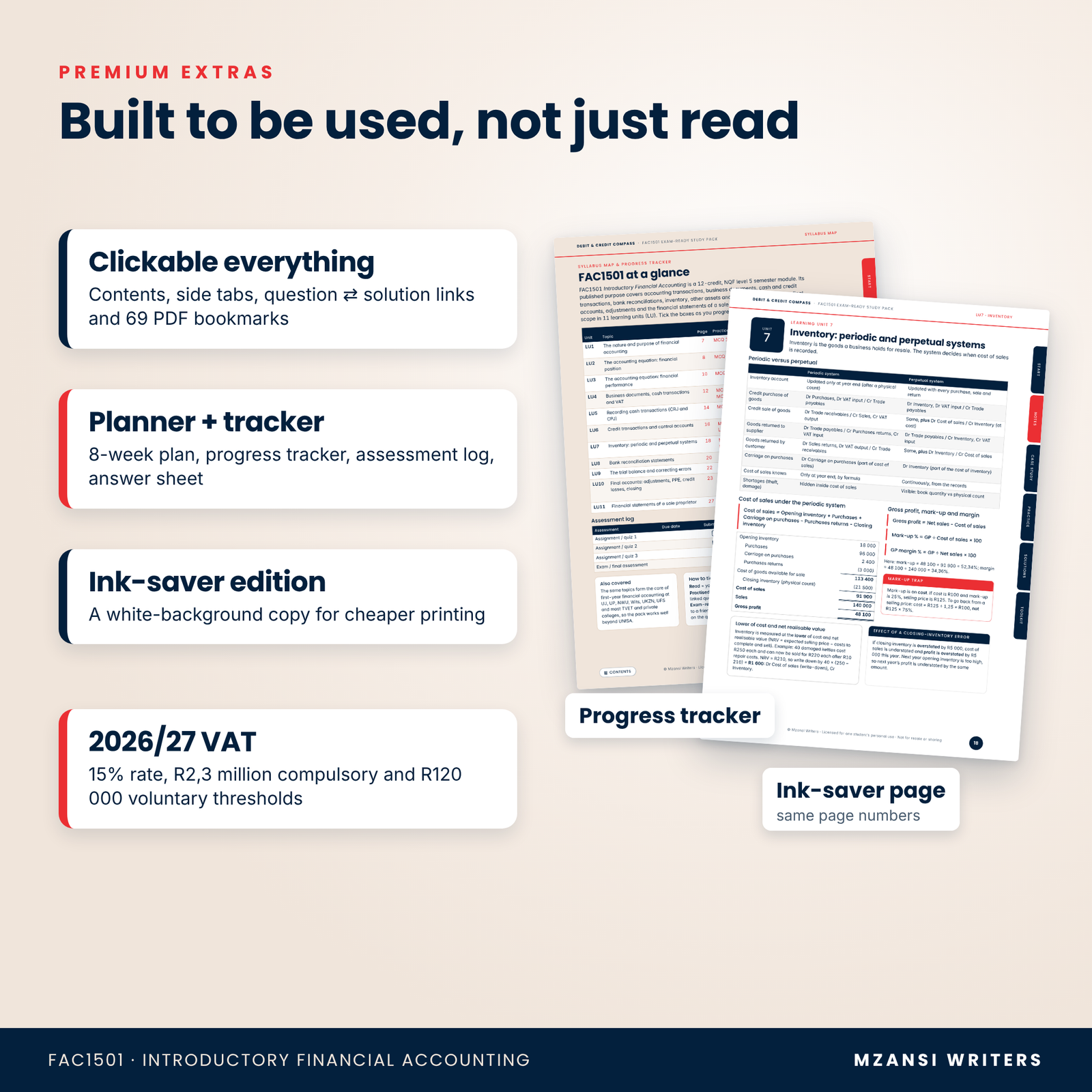
- Planning tools: syllabus map with progress tracker, assessment log, 8-week study planner, last-7-days plan, MCQ answer sheet and a night-before checklist.
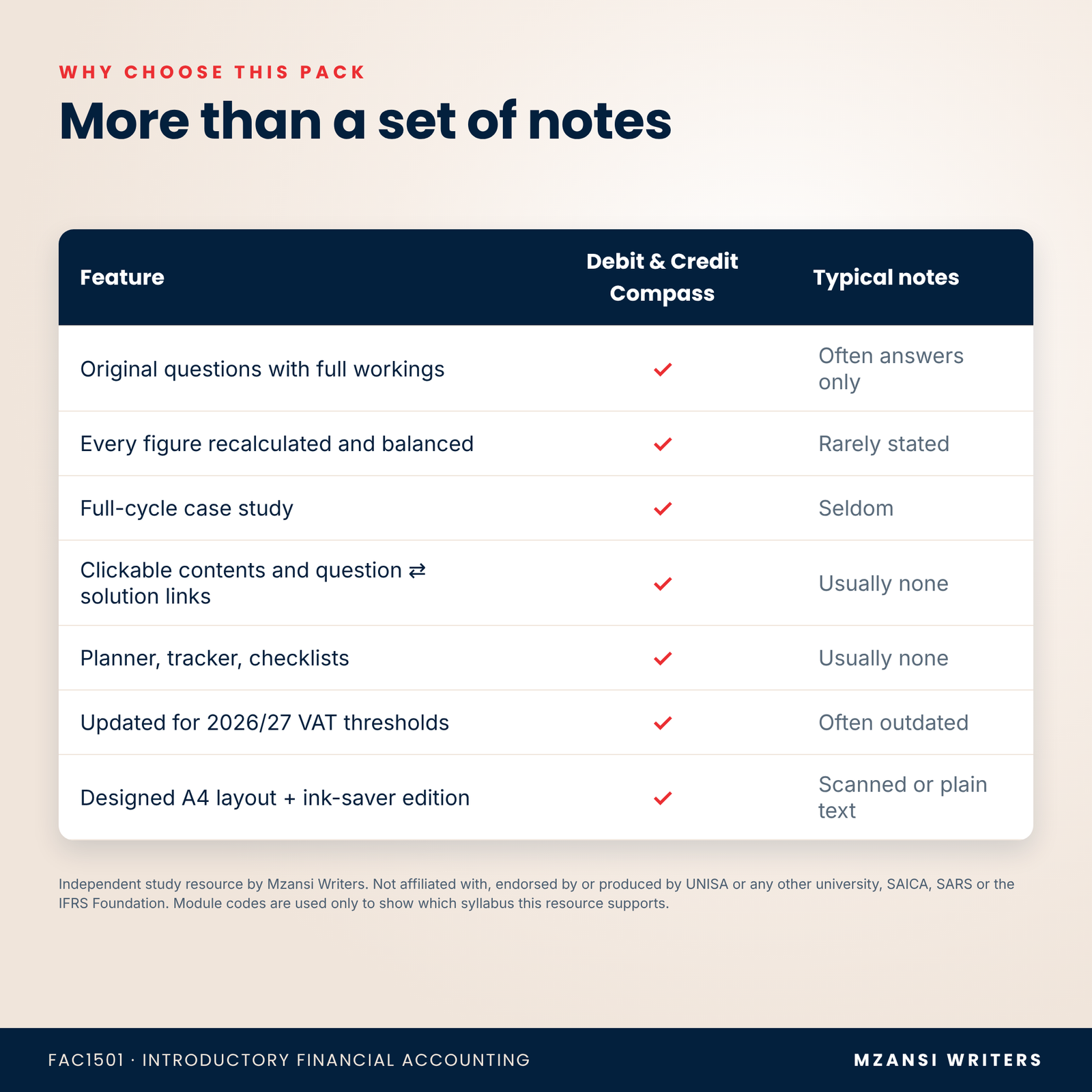
Why it is better than ordinary FAC1501 notes
- Worked, not just answered: every solution shows the method, the workings and the format examiners expect.
- Checked numbers: every example and answer was recalculated, so you are not learning from a wrong memo.
- Current tax figures: VAT at 15% with the compulsory registration threshold of R2,3 million and voluntary threshold of R120 000 from 1 April 2026, as published by SARS.
- Easy navigation: clickable contents, side tabs on every page, question-to-solution and back links, and PDF bookmarks.
- Exam focus: “Exam trap” boxes and self-checks in every unit target the mistakes that cost first-year students the most marks.
How it works
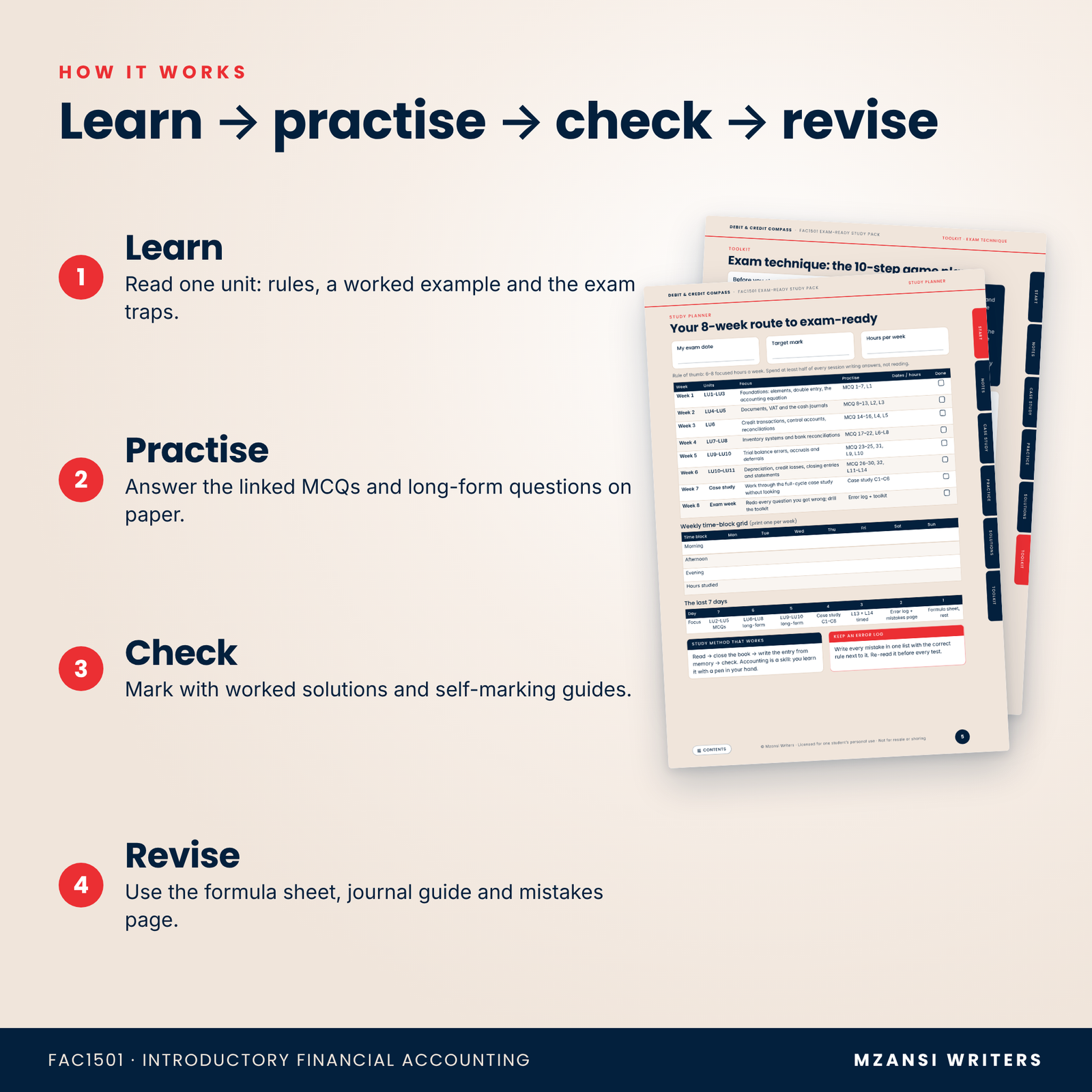
- Fill in the 8-week planner with your exam date.
- Study one learning unit at a time and tick the progress tracker.
- Answer the linked practice questions on paper, under time pressure.
- Mark yourself with the worked solutions and keep an error log.
- In the final week, revise from the formula sheet, journal-entry guide and mistakes page.
Use cases
- Preparing for FAC1501 assignments and quizzes during the semester
- Exam revision in the last four weeks before the exam
- Catching up on a topic you missed, such as bank reconciliations or credit losses
- Study groups (each member needs their own copy) and tutoring sessions
- Bridging into second-year financial accounting with solid foundations
File formats and software requirements
Two PDF files (A4) and one DOCX user guide. Open the PDFs in any PDF reader, such as Adobe Acrobat Reader, Microsoft Edge, Google Chrome, Apple Books or Preview, or Xodo, on a laptop, tablet or phone. The DOCX guide opens in Microsoft Word, LibreOffice Writer or Google Docs. No special software is needed.
Customisation
Annotate the PDF with highlights and notes in your reader or a tablet note-taking app, tick the checklists digitally, or print only the pages you need. The ink-saver edition keeps the same page numbers, so you can read on screen and print on paper side by side.
Digital download
This is a digital product. No physical item will be shipped. Your files are available to download immediately after payment from your Mzansi Writers account. Total download size is about 4,5 MB.
FAQ
Is this the official UNISA FAC1501 study guide?
No. It is an independent study resource that supports your official material. Always follow your tutorial letter for assessment formats.
Does it contain past exam papers or assignment answers?
No. All questions are original practice questions written by Mzansi Writers, with full workings.
Is the VAT content up to date?
Yes. It uses the 2026/27 figures published by SARS: 15% VAT, R2,3 million compulsory and R120 000 voluntary registration thresholds from 1 April 2026.
Can I use it if I study at UJ, UP or another university?
Yes. The topics form the core of first-year financial accounting across South Africa. Compare the contents with your module outline.
Can I print it?
Yes. Print any pages for personal use. Use the ink-saver edition to save ink.
Can I share it with friends?
No. The licence covers one student’s personal use. Each person needs their own copy.
Will it work on my phone?
Yes, although a tablet or laptop is best for the wider tables.
Licence and disclaimer
Personal use by one student only. You may not resell, share, upload or distribute the files in whole or in part.
Independent study resource by Mzansi Writers. Not affiliated with, endorsed by or produced by UNISA or any other university, SAICA, SARS or the IFRS Foundation. Module codes are used only to show which syllabus this resource supports.



Reviews
There are no reviews yet.