
Description
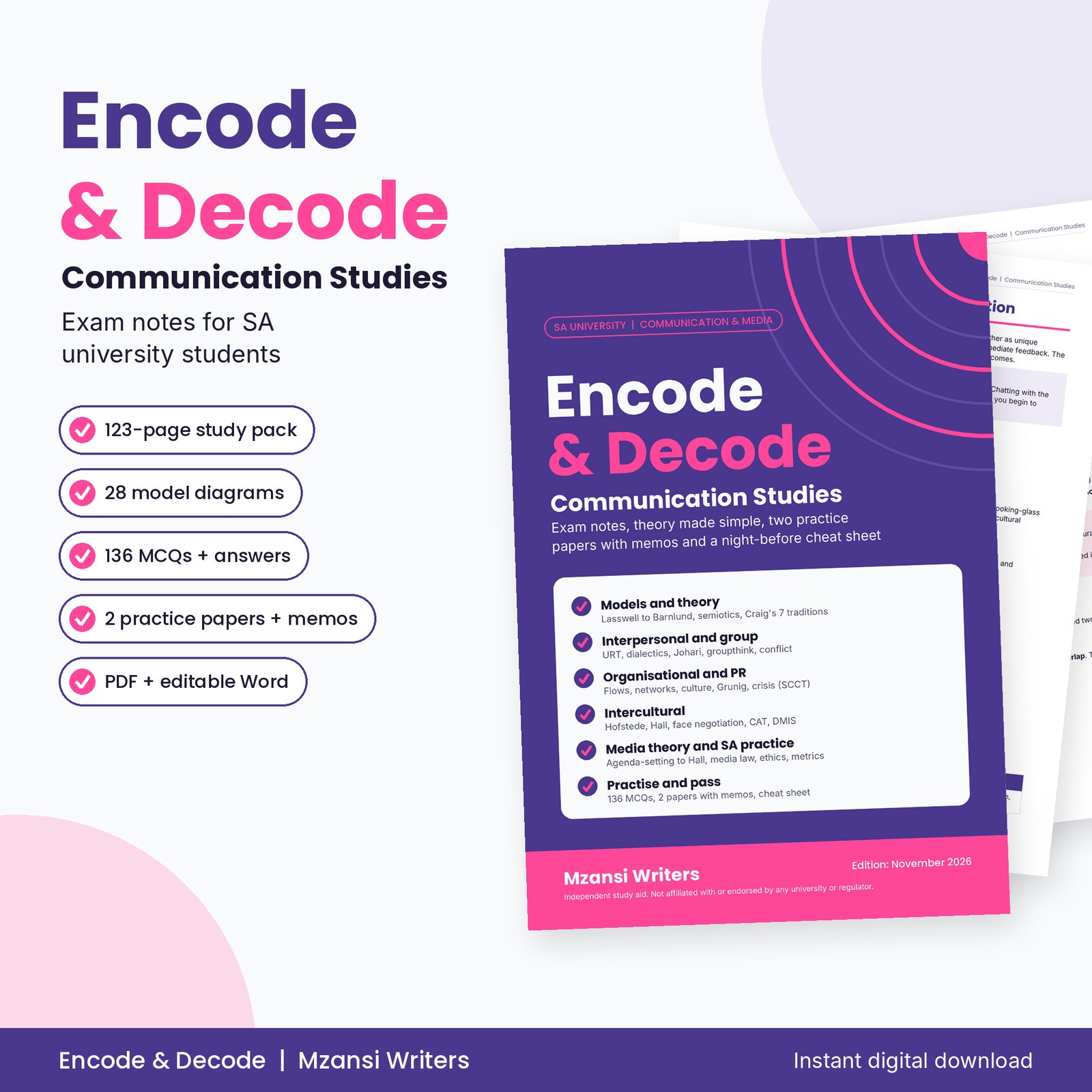
Encode & Decode gives you complete Communication Studies notes in one instant download. It covers communication models, theory, interpersonal, group, organisational, intercultural and media communication, with South African examples, two full practice papers and marking memos. Everything is original, written in plain South African English and checked in November 2026.
What these Communication Studies notes do for you
Communication exams look friendly until you are asked to compare Schramm with Shannon and Weaver, apply relational dialectics to a case study or critique cultivation theory for 20 marks. Encode & Decode is built around how marks are actually awarded. Each theory gives you the theorist, the year, the main idea, key concepts, an example, and a strength and a limitation. That is the formula that earns marks in essays and application questions.
You also get an exam game plan with command words, the TEA method (Theory, Evidence, Analysis) for case studies, an essay structure and a time plan, so you know exactly how to turn what you know into marks.
Who it is for
- First-year and second-year students in Communication Science, Communication Studies, Media Studies, Journalism, Public Relations and Strategic or Corporate Communication
- Students taking a communication module inside a BA, BCom, BSocSci, BEd, Nursing or Law degree or diploma
- Distance students who study mostly alone, and contact students who want organised revision notes
- Students repeating a module who want a fresh, structured way to revise
Main features
- Communication models made simple: Aristotle, Lasswell, Shannon and Weaver, Schramm, Osgood and Schramm, Berlo, Westley and MacLean, Newcomb, Dance, Barnlund, Jakobson, and semiotics (Saussure, Peirce, Barthes), with a comparison table
- Communication theory foundations: objective and interpretive approaches, Craig’s seven traditions, symbolic interactionism, CMM, critical theory, Afrocentric perspectives and Ubuntu
- Interpersonal communication: Johari window, perception, verbal and nonverbal codes, listening, uncertainty reduction, social penetration, social exchange, relational dialectics, expectancy violations, CPM, Knapp, Watzlawick, Gibb and conflict styles
- Groups and persuasion: Tuckman, group roles, leadership, groupthink, Aristotle’s rhetoric, ELM, social judgement, cognitive dissonance, Toulmin, fallacies and Monroe’s motivated sequence
- Organisational communication and PR: classical to critical approaches, Weick, Schein, flows, networks, media richness, Grunig and Hunt, stakeholder theory, King V, campaign planning and crisis communication (SCCT)
- Intercultural communication: Hofstede, Hall, value orientations, face negotiation, CAT, AUM, culture shock, Bennett’s DMIS, intercultural competence and South Africa’s twelve official languages
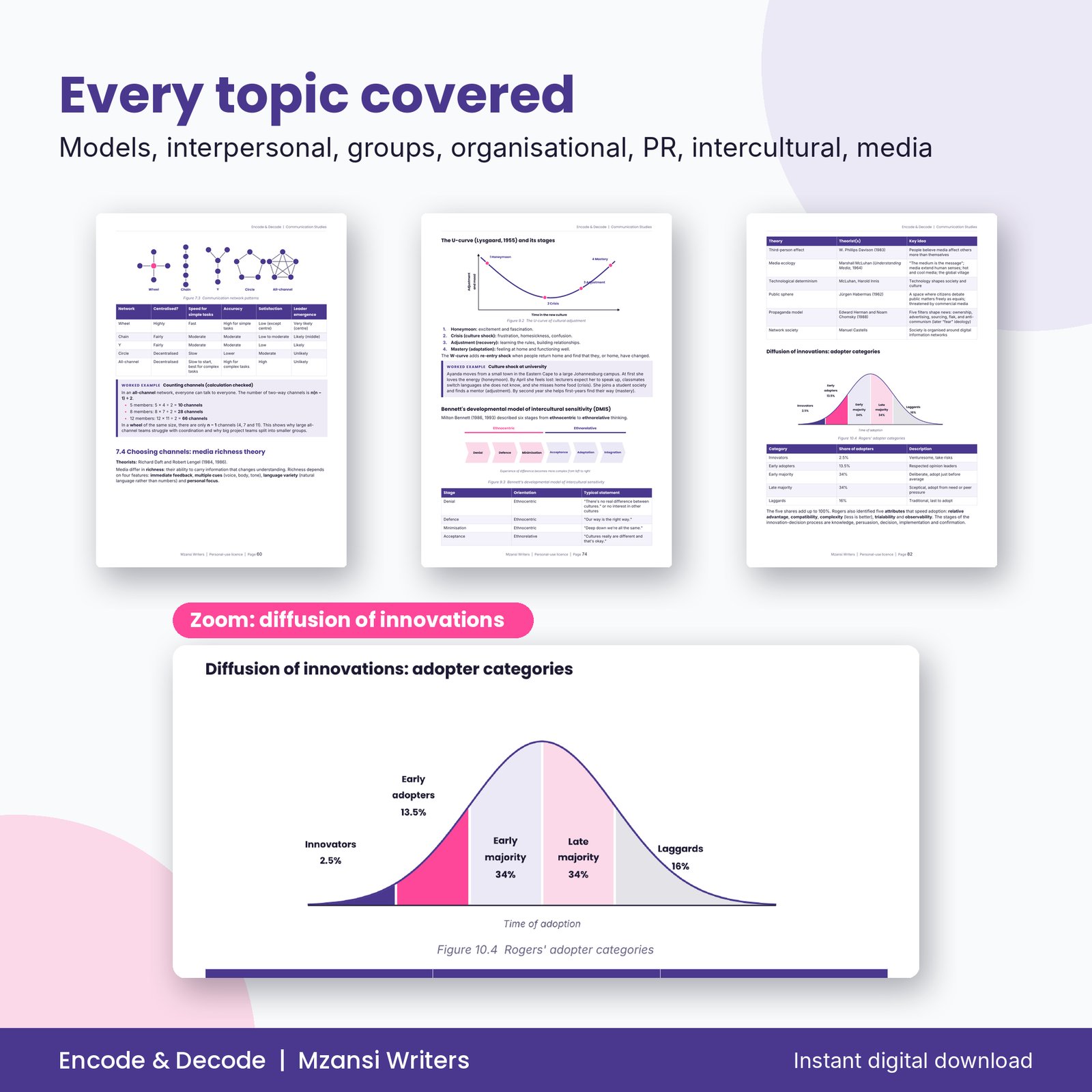
- Media theory and practice: agenda-setting, framing, cultivation, uses and gratifications, spiral of silence, two-step flow, Stuart Hall’s encoding and decoding, diffusion of innovations, normative theories, digital media, South African media law and ethics, news writing and media metrics
- Research methods: quantitative and qualitative designs, sampling, content analysis and coder reliability, research ethics
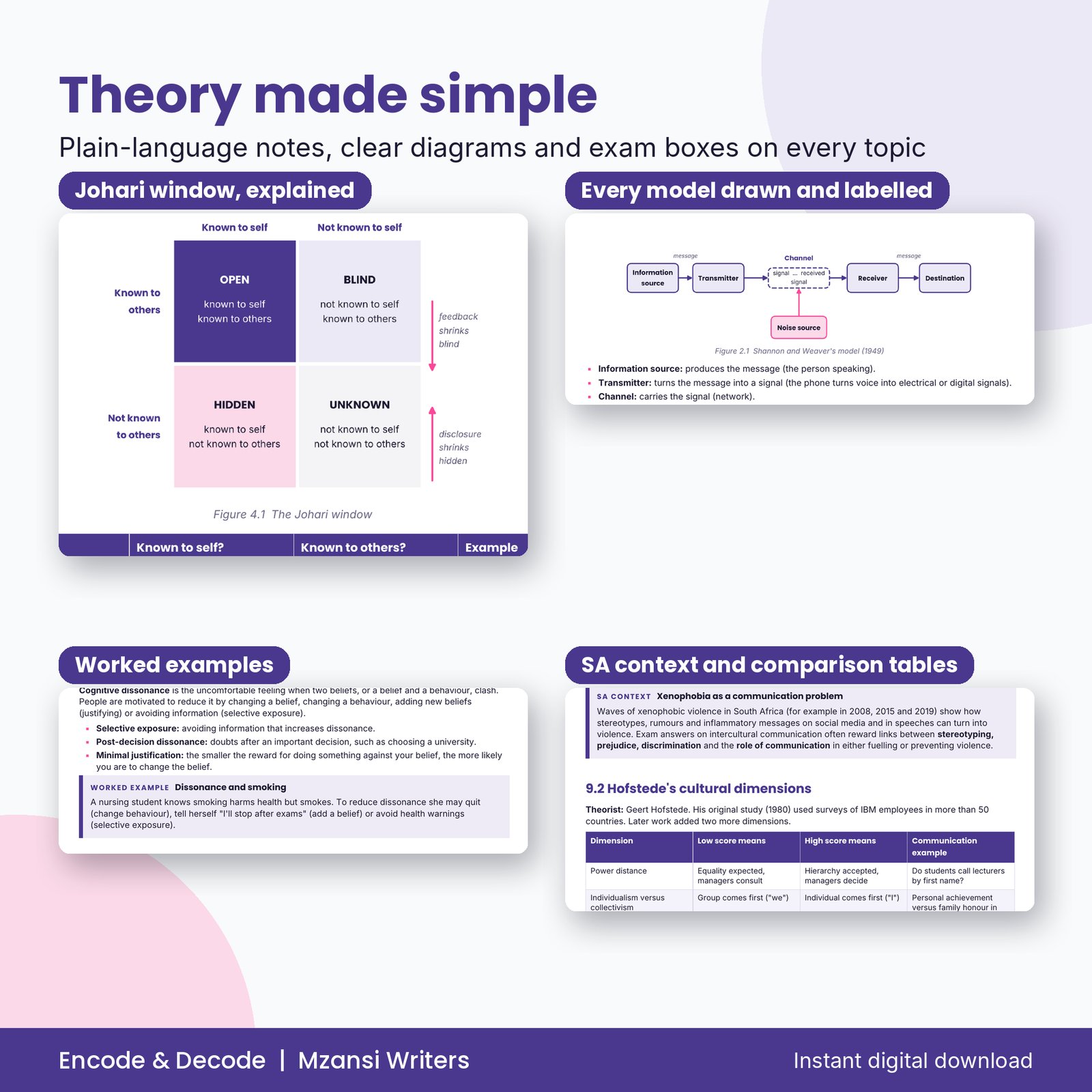
- 28 clear diagrams you can copy in the exam
- Exam tip, Memory aid, Avoid this, SA context and Worked example boxes throughout
What is included in your download
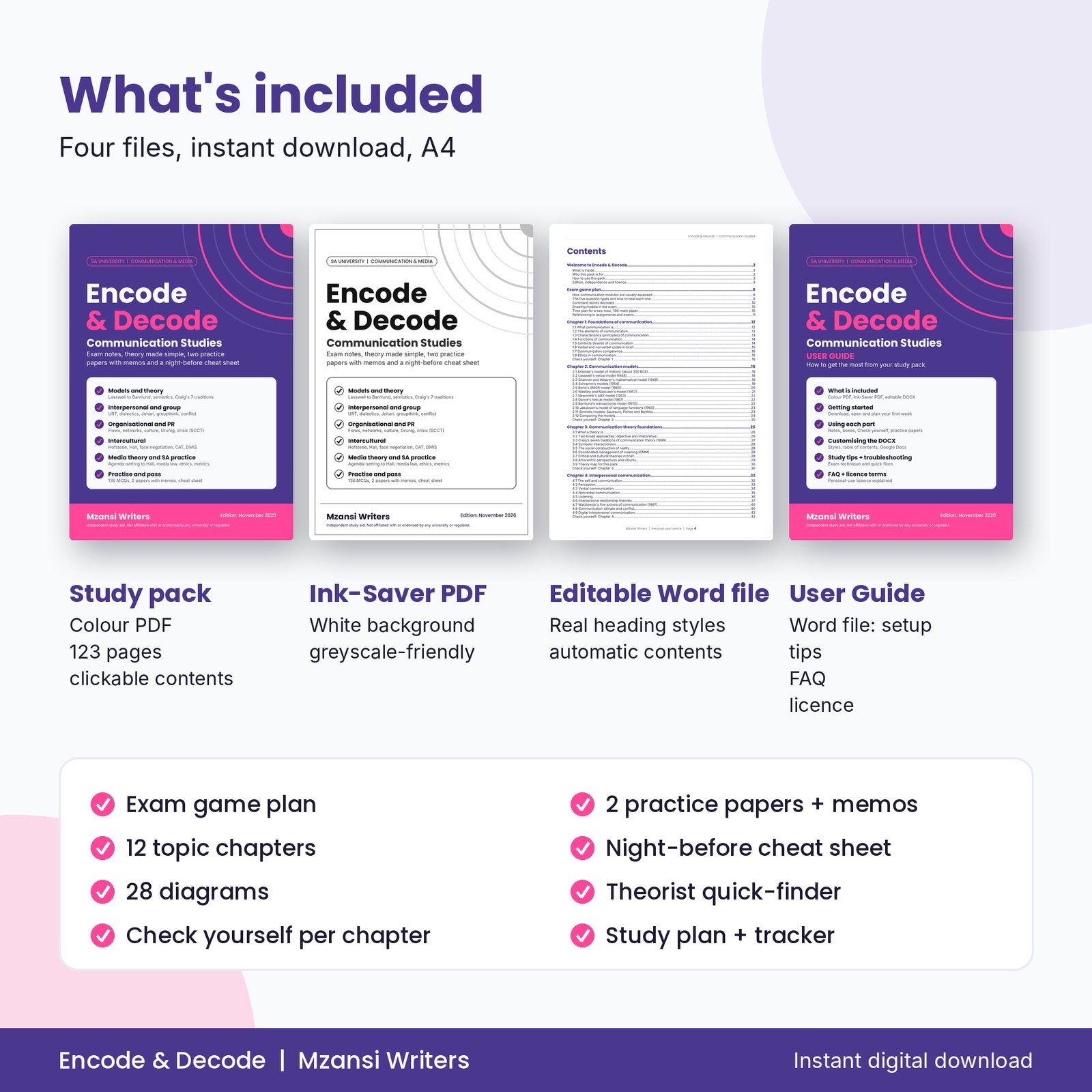
- Study pack, colour PDF (123 A4 pages) with a clickable table of contents and bookmarks
- Study pack, Ink-Saver PDF with a white background and greyscale-friendly diagrams for cheaper printing
- Study pack, editable Word (DOCX) file with real heading styles and an automatic table of contents
- User Guide (DOCX) covering setup, how to use each part, customising, study tips, troubleshooting and FAQs
Practice that matches the exam
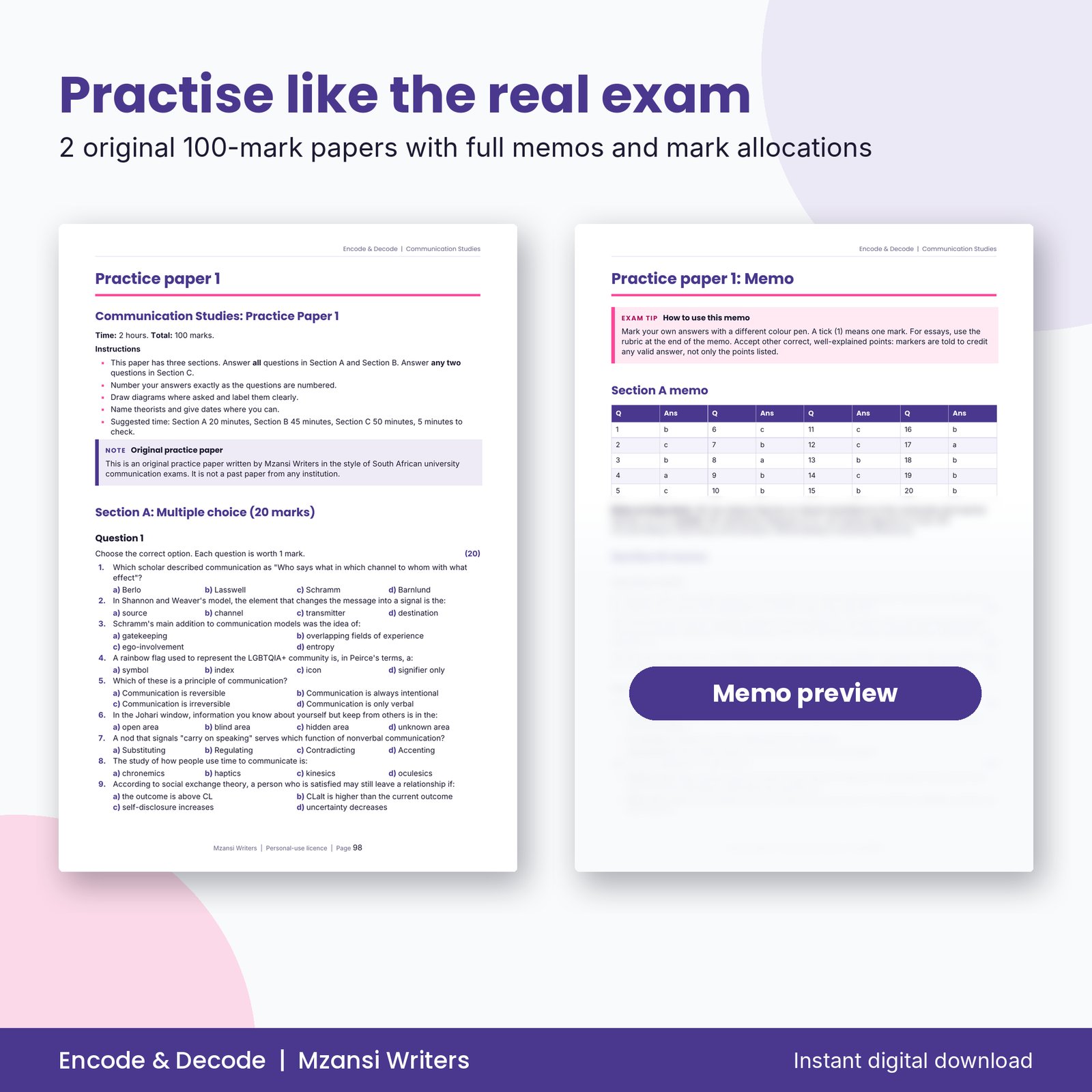
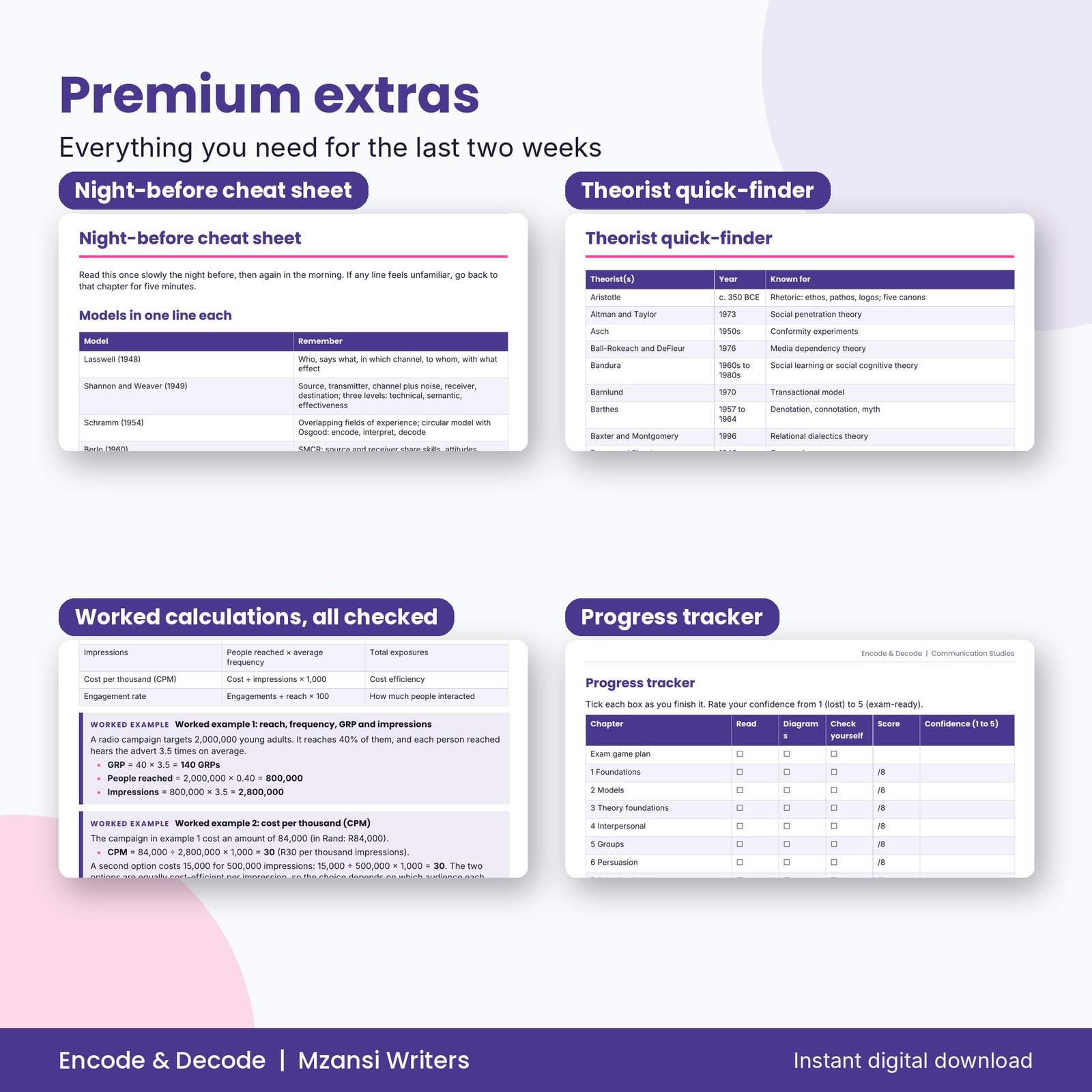
Every chapter ends with Check yourself questions: 8 multiple-choice questions and 3 or 4 written questions with answers and mark guides. Two original 100-mark practice papers follow the common university format of multiple choice, short and application questions, and essays. Each has a full memo with mark allocations and an essay rubric. All calculations, such as GRP, CPM, engagement rate, Holsti’s coefficient and Cohen’s kappa, were re-checked.
Revision tools
A night-before cheat sheet, a theorist quick-finder with more than 90 names and dates, a six-week study plan, a progress tracker and a glossary of more than 120 terms.
How it works
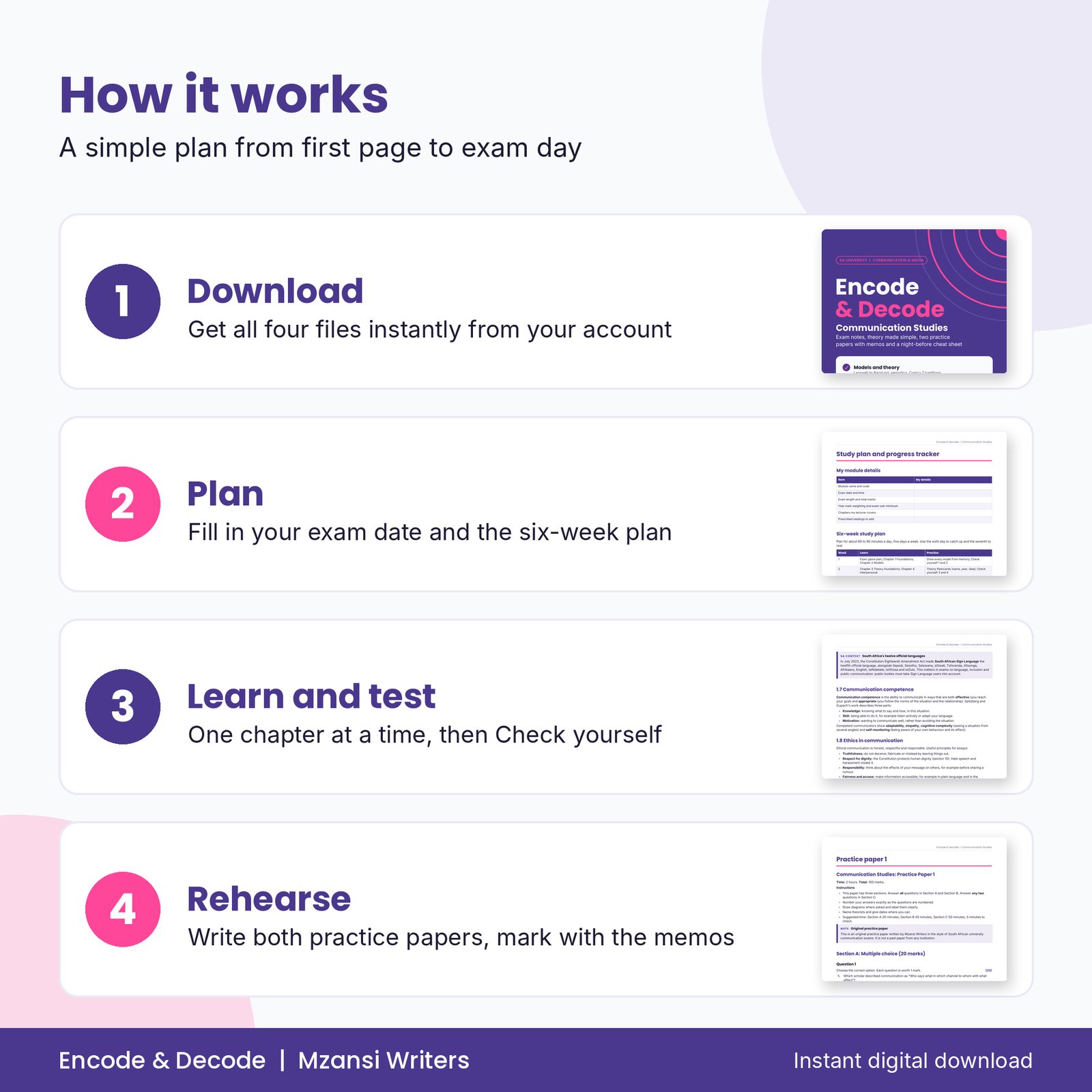
- Buy and download all four files instantly from your account.
- Compare the contents with your own module outline and tick the chapters you need.
- Fill in the study plan with your exam date.
- Work through one chapter at a time, then test yourself with Check yourself.
- Write both practice papers under timed conditions and mark them with the memos.
- Read the cheat sheet and theorist quick-finder the night before.
File formats and software needed
You get two PDF files and two DOCX files, all A4. The PDFs open in any PDF reader on a phone, tablet, laptop or desktop, such as Adobe Acrobat Reader, Microsoft Edge or Google Chrome. Fonts are embedded. To edit the DOCX files, use Microsoft Word, Google Docs or LibreOffice Writer.
Customise it
The Word file uses built-in Heading 1, 2 and 3 styles, so you can add your lecturer’s notes, remove chapters your module does not cover, change colours and update the table of contents in one click. The User Guide shows you how.
Digital download
This is a digital product. Nothing is posted. Your download links appear straight after payment and stay available under My Account, Downloads.
Real situations where it helps
- You are studying through distance learning and need the whole module organised in one place.
- Your exam is three weeks away and you need a plan that fits.
- You know the theories but lose marks because you do not apply them to the case study.
- You keep mixing up similar theories, such as agenda-setting and framing, or cultivation and uses and gratifications.
- You want practice papers with memos before the real exam.
Frequently asked questions
Does it match my university’s Communication module?
It covers the topics found in most South African undergraduate communication curricula, including first and second year. Module codes and prescribed books differ, so compare it with your own outline and add any extra readings.
Are the practice papers past exam papers?
No. All notes, questions, papers and memos are original material written by Mzansi Writers in the style of university exams.
Is the South African media law up to date?
Yes, as at November 2026, including the Press Code in force since 1 September 2022, POPIA, the Cybercrimes Act, King V and South African Sign Language as the twelfth official language.
Can I study on my phone?
Yes. The colour PDF has a clickable contents page and bookmarks that work in phone PDF readers.
Can I print it?
Yes, for your own use. The Ink-Saver PDF is designed for cheaper printing.
Can I use it for my assignments?
Use it to understand the work, then write assignments in your own words and follow your university’s rules on referencing, plagiarism and AI use.
Can I share it with my study group?
No. The licence covers one person. Tutors can contact us about a group licence.
Licence and independence
Personal-use licence: you may download, print and keep copies for your own study. You may not resell, share, upload or distribute the files. Mzansi Writers is an independent study aid publisher. Encode & Decode is not affiliated with, endorsed by or approved by any university, college, the Department of Higher Education and Training, the Press Council of South Africa, ICASA or any other organisation named. Names of institutions, laws and regulators are used only to describe the content. This study aid is not legal advice.


Reviews
There are no reviews yet.