

Description
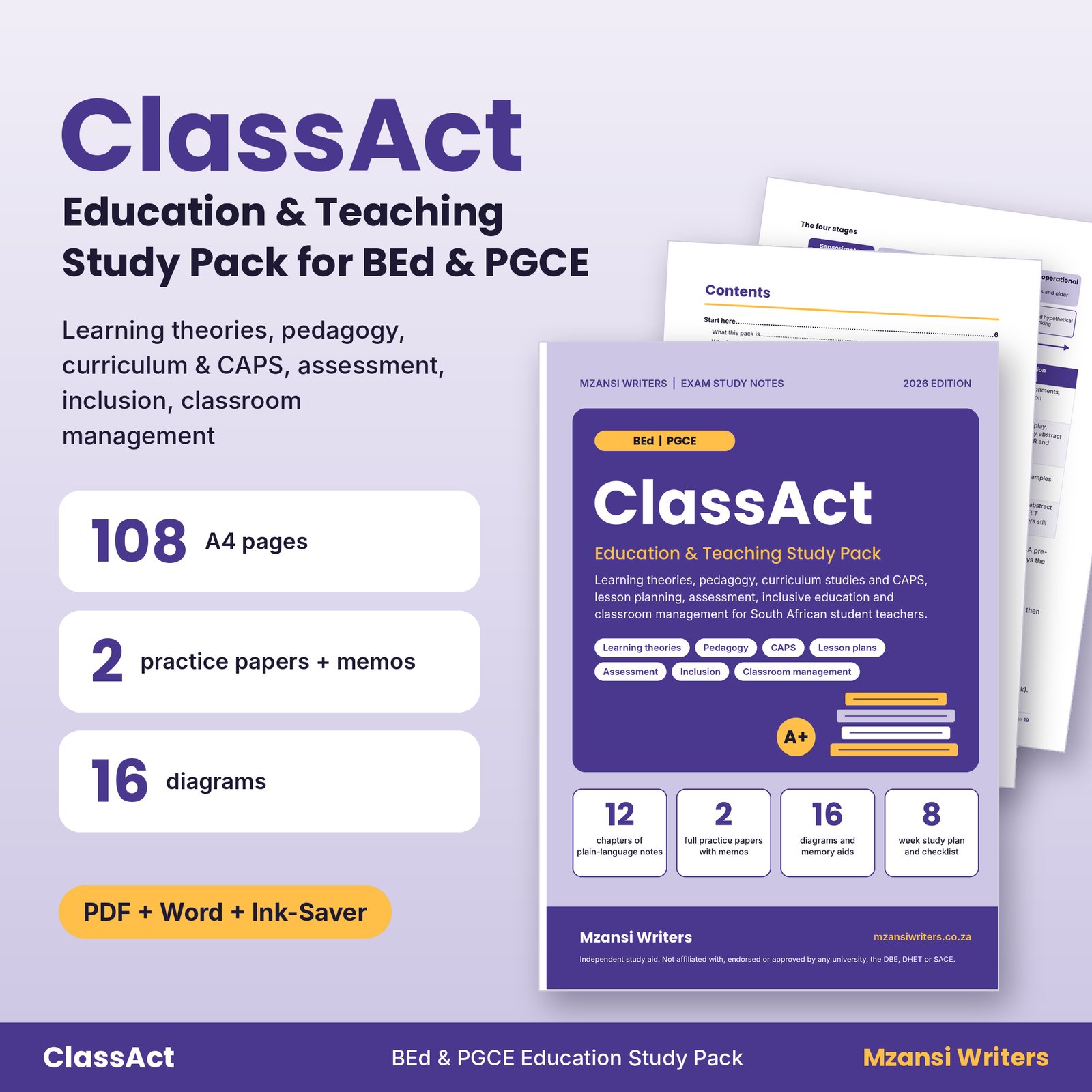
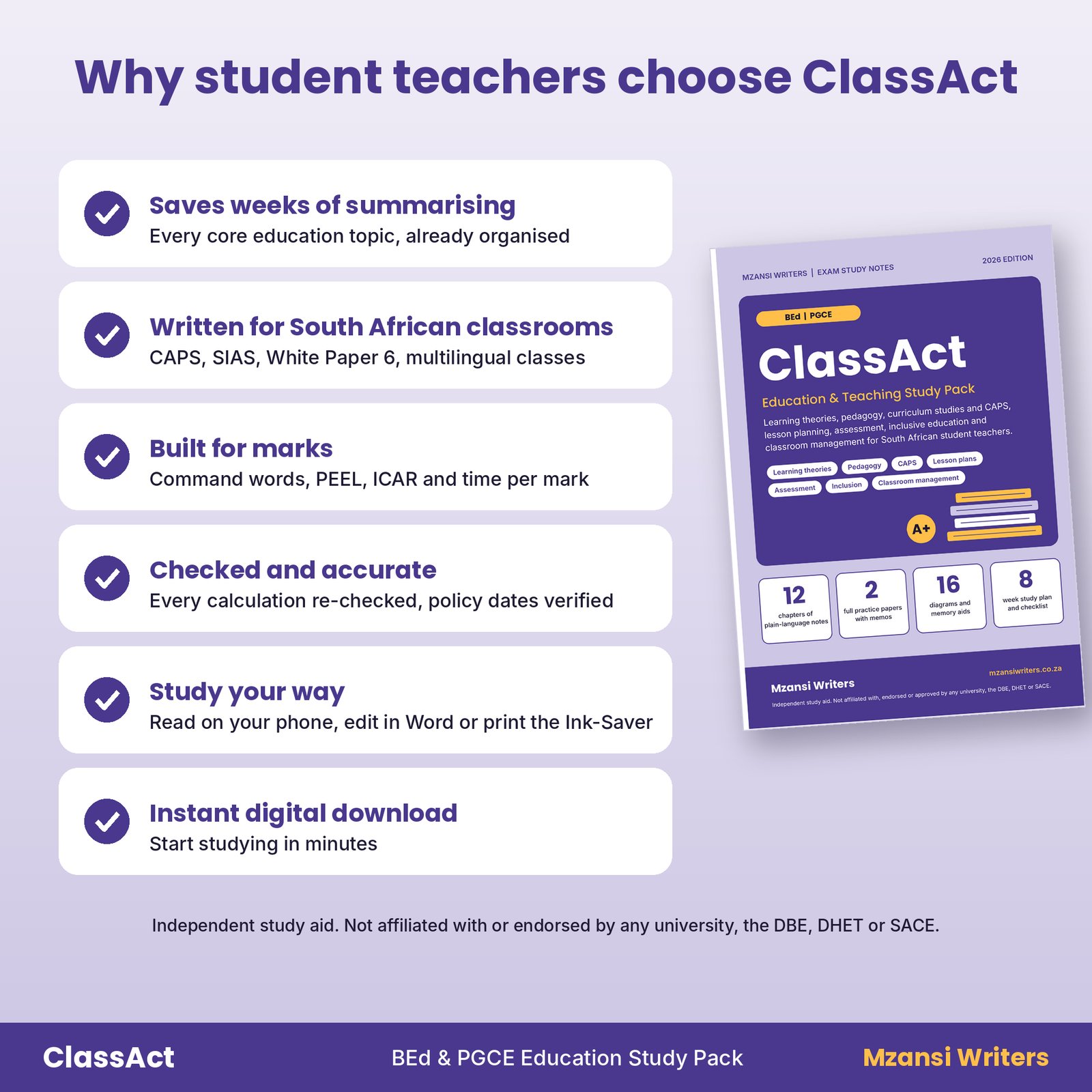
ClassAct is a set of BEd study notes and PGCE exam notes for South African student teachers. In 108 A4 pages it covers the education theory that shows up in almost every teacher education programme: learning theories, learner development, pedagogy, curriculum studies and CAPS, lesson planning, assessment, inclusive education and classroom management. Every topic is written in plain language and then applied to a real South African classroom, because that is where education exam marks are won.
What ClassAct BEd and PGCE study notes do for you
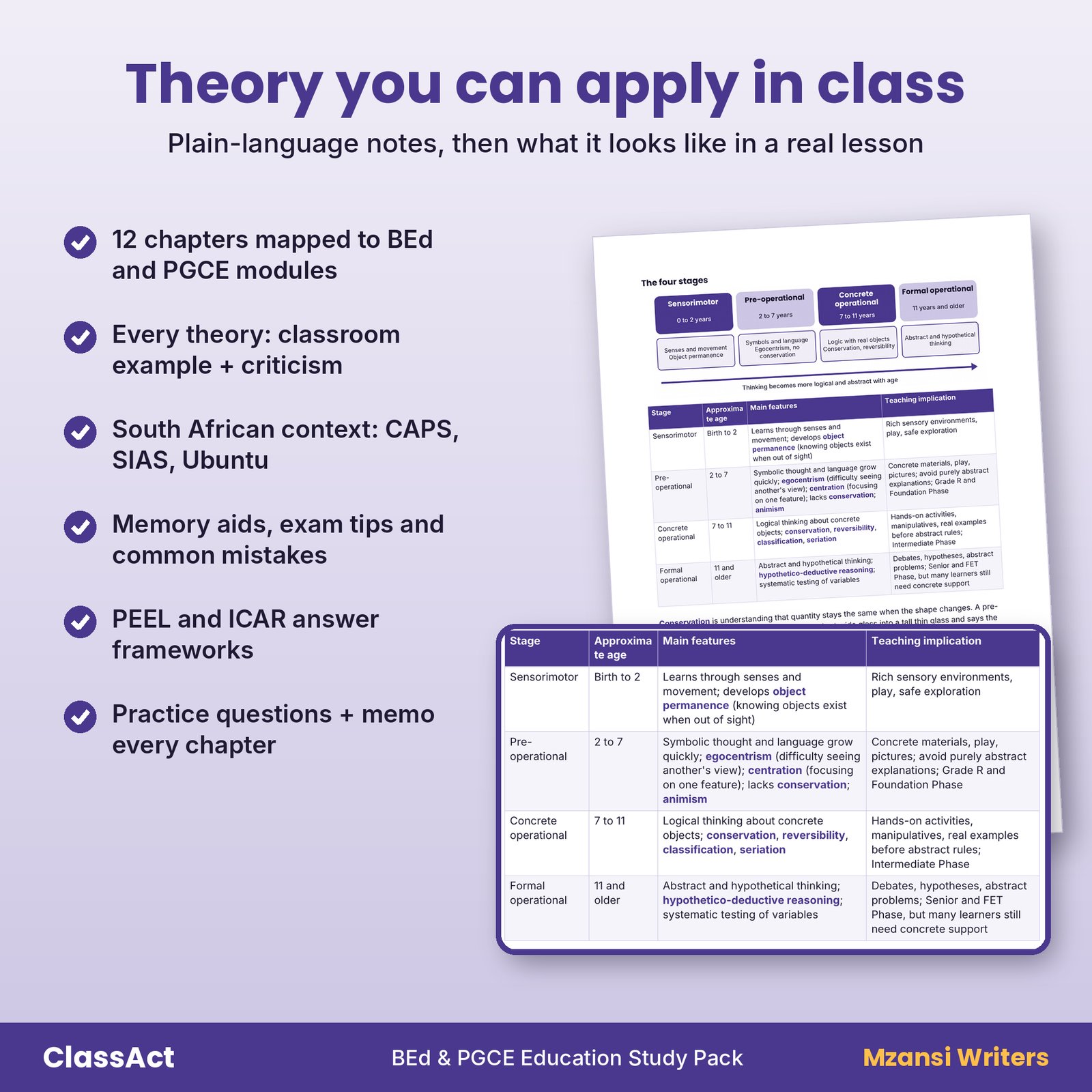
Education modules rarely reward a memorised definition on its own. Lecturers want you to explain a theory, show what it looks like in a lesson, and say where it falls short. ClassAct is built around that standard. Each theory comes with a classroom example and a criticism, and each chapter ends with practice questions and a memo so you can test yourself straight away.
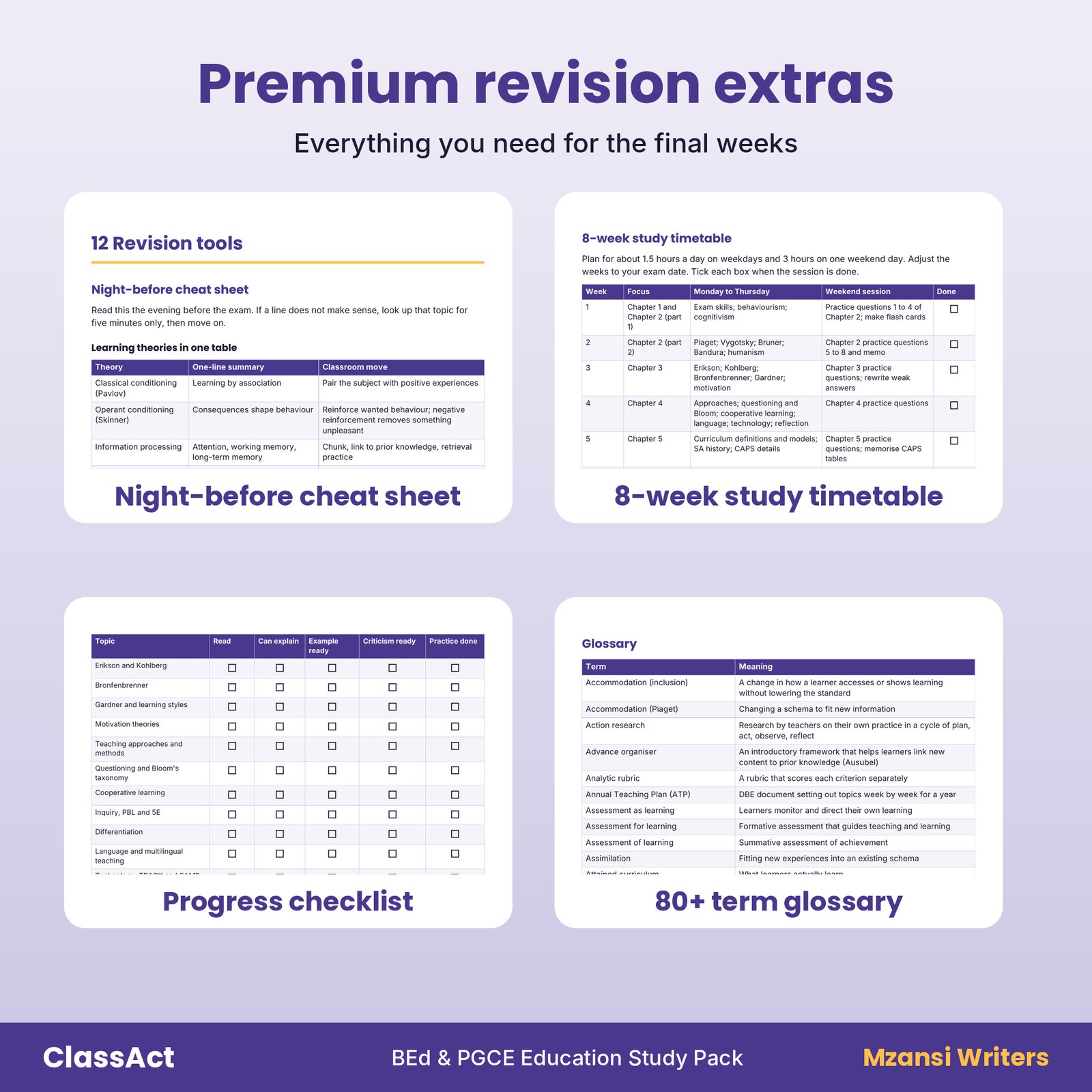
You also get two full 100-mark practice papers with mark-by-mark memos, a night-before cheat sheet, an 8-week study timetable, a progress checklist and an 80+ term glossary.
Who it is for
- BEd students in the Foundation, Intermediate, Senior and FET Phases
- PGCE students who need the education theory on top of their teaching subjects
- Diploma in Grade R Teaching students who want stronger theory notes
- Students repeating a module or writing a supplementary exam
- New teachers preparing for interviews or school-based assessments
Main benefits
- Saves weeks of summarising. The core education topics are already organised, explained and linked.
- Written for South African classrooms. CAPS, the National Protocol for Assessment, White Paper 6, SIAS, MRTEQ, multilingual classes and Ubuntu are woven through the notes.
- Built for marks. Chapter 1 teaches command words, the PEEL paragraph, the ICAR method for case studies and time per mark.
- Checked for accuracy. Every worked calculation was re-checked, and theorist dates and policy details were verified.
Features
Learning theories and learner development
Behaviourism (Pavlov, Thorndike, Skinner), cognitivism and cognitive load theory, Ausubel, Gagné, Piaget, Vygotsky and the ZPD, Bruner, Bandura, Maslow, Rogers, Kolb, connectivism, Ubuntu, Erikson, Kohlberg, Bronfenbrenner, Gardner, the learning styles myth, and motivation theories including self-determination, attribution and growth mindset.
Pedagogy and teaching methods
Teacher-centred and learner-centred approaches, explicit instruction and “I do, we do, you do”, Rosenshine’s principles, Bloom’s revised taxonomy and questioning, cooperative learning, inquiry and the 5E model, differentiation, BICS and CALP, translanguaging, TPACK, SAMR and reflective practice with Schön, Gibbs and Brookfield.
Curriculum studies and CAPS
Definitions and levels of curriculum, the hidden and null curriculum, Tyler, Taba, Wheeler, Stenhouse, Walker and Bernstein, the history from Bantu Education through C2005 and the RNCS to CAPS, the principles of the NCS, phases, subjects and weekly time allocations.
Lesson planning and assessment
ABCD and SMART objectives, backward design, two fully worked lesson plans (Grade 4 Mathematics and Grade 7 Natural Sciences), assessment of, for and as learning, SBA weightings, the seven-point rating scale, rubrics, validity and reliability, item analysis and eight worked calculations.
Inclusive education and classroom management
White Paper 6, barriers to learning, the SIAS process, UDL, curriculum differentiation, support strategies for specific barriers, Kounin, Canter, Glasser, Dreikurs, Ginott, positive behaviour support, restorative practice, routines and managing large classes.
What is included
- ClassAct Study Pack, colour PDF (108 A4 pages, clickable contents and bookmarks)
- ClassAct Study Pack, Ink-Saver PDF for printing in black and white
- ClassAct Study Pack, editable Word file (DOCX) with real heading styles and an automatic contents page
- ClassAct User Guide (DOCX)
Inside the pack: 12 chapters, 16 diagrams, more than 80 tables, memory aids, exam tips, common mistakes, practice questions with memos after every chapter, two full practice papers with memos, a cheat sheet, a study timetable, a progress checklist and a glossary.
How it works
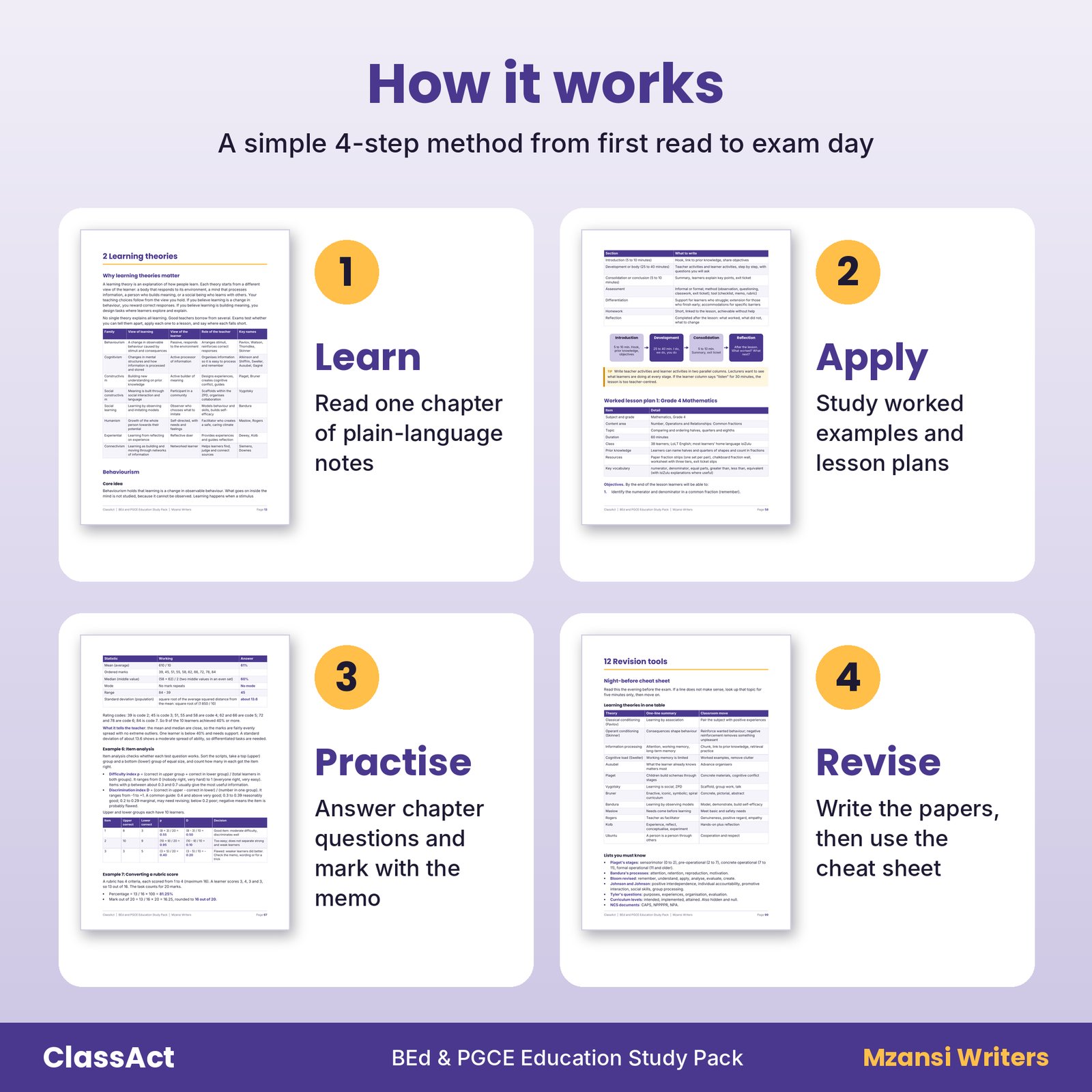
- Learn: start with Chapter 1 on exam skills, then read one chapter at a time.
- Apply: study the classroom examples, worked lesson plans and calculations.
- Practise: answer the chapter questions and mark yourself with the memo.
- Revise: write the two practice papers under timed conditions, then use the cheat sheet the night before.
File formats and software needed
You receive two PDF files and two DOCX files. The PDFs open in any PDF reader, including Adobe Acrobat Reader, your web browser or the PDF app on your phone. The DOCX files open in Microsoft Word, Google Docs or LibreOffice Writer. All files are A4.
Customisation
Use the Word file to add your own notes, highlight key points, remove chapters your module does not cover or rearrange content. All headings use built-in heading styles, so the contents page updates automatically after you edit.
Digital download
This is a digital product. Nothing is posted. After payment you can download all four files straight away from your order confirmation and from your account on mzansiwriters.co.za.
Use cases
- Preparing for a semester exam in Educational Psychology, Teaching Studies or Curriculum Studies
- Writing an assignment on Piaget and Vygotsky and needing clear, accurate explanations to start from
- Planning lessons for teaching practice and checking that objectives and assessment align
- Answering a case study on a learner who experiences barriers to learning
- Reflecting on teaching practice for your portfolio using Gibbs’ cycle
- Revising for a supplementary exam with limited time
Frequently asked questions
Does ClassAct match my university’s module?
It covers the topics found in most South African BEd and PGCE education modules. Universities name and group modules differently, so compare the contents page with your module outline.
Is it up to date with CAPS?
Yes. CAPS and related policies were checked as they stood in late 2026, with notes on areas the DBE is still revising.
Does it cover SACE and education law?
Only where it links to teaching. Our separate ChalkCode pack covers SACE, education law and teaching ethics in depth.
Can I print it?
Yes. Use the Ink-Saver PDF, which is designed to print clearly in black and white on A4.
Can I edit it?
Yes. The DOCX version is fully editable in Word, Google Docs or LibreOffice.
Can I reference it in my assignments?
No. Reference the original theorists and prescribed texts. The pack gives theorist dates to help you find them.
Can I share it with my study group?
No. The licence is for one buyer’s personal use. Each person needs their own copy.
Licence and independence
ClassAct is licensed for personal, non-commercial study by one buyer. You may print it for your own use, but you may not share, resell, upload or copy it for others. Mzansi Writers is an independent study aid publisher. This product is not affiliated with, endorsed by or approved by any university, college, the Department of Basic Education, the Department of Higher Education and Training or SACE. Names of institutions and policies are used only to describe the content.


Reviews
There are no reviews yet.