Description
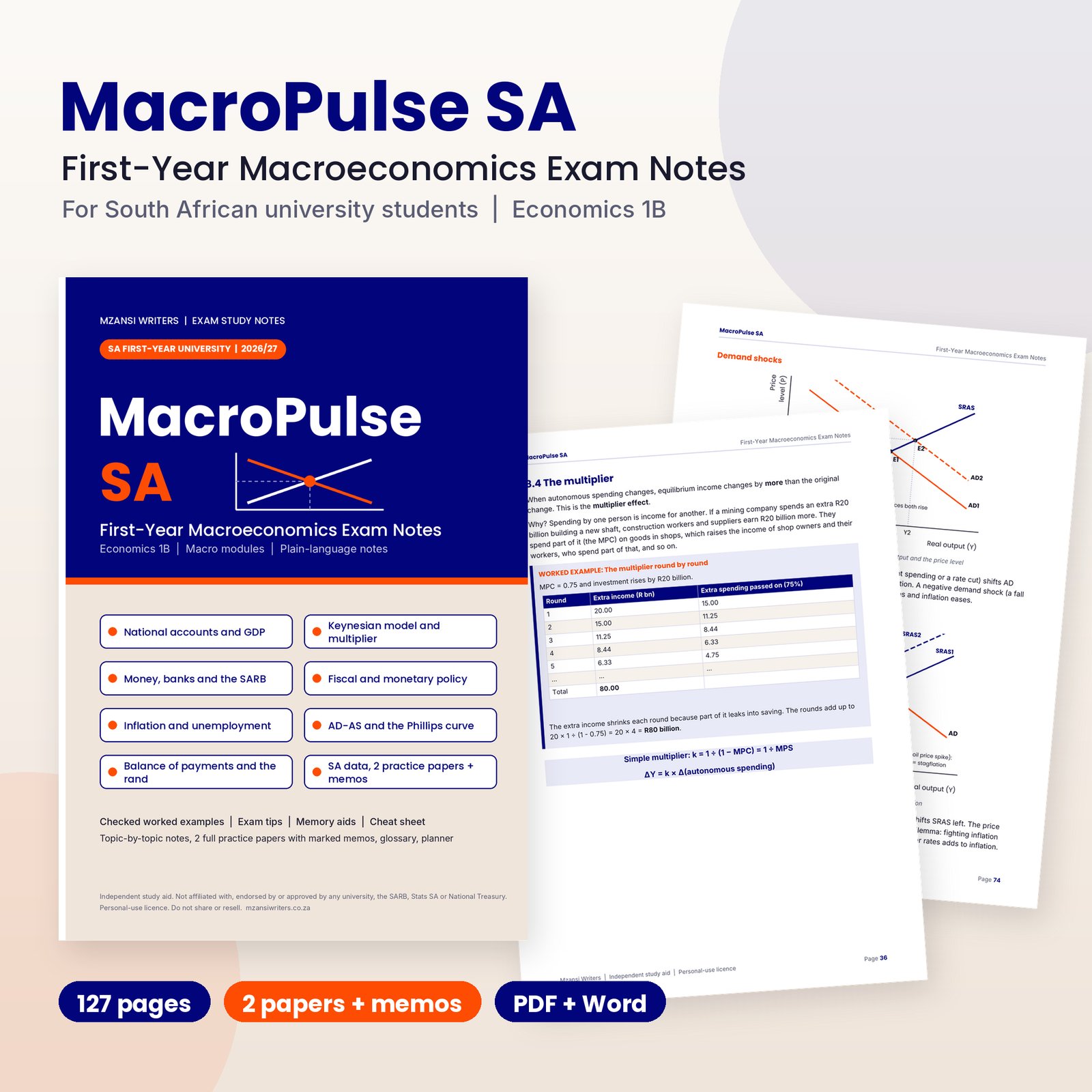
MacroPulse SA: macroeconomics study notes for first-year students
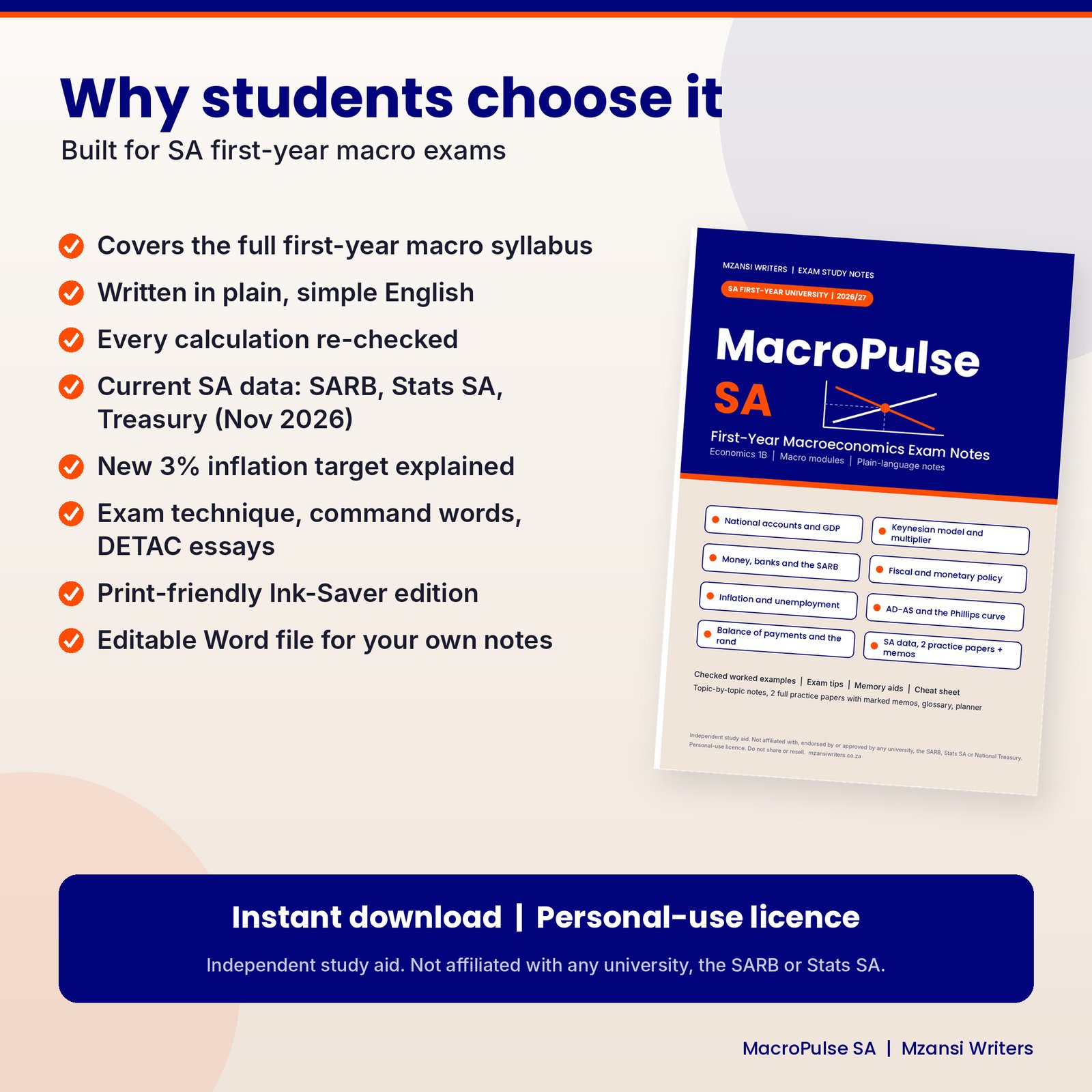
MacroPulse SA is a complete set of macroeconomics study notes written for first-year economics students at South African universities. If your module is called Economics 1B, Economics 102, Macroeconomics 1 or something similar, this pack takes you through every macro topic in the order lecturers teach it, with South African examples on every page.
The notes are written in plain, simple English. Each idea is explained, then shown in a labelled diagram or a worked example, then tested with practice questions. Every calculation in the pack has been recalculated and checked, so you can trust the method you are copying.
Who it is for
- First-year students in a macroeconomics module at any SA university, including distance-learning students
- Students repeating economics who want a clear, exam-focused summary
- Extended-programme students who need the maths explained step by step
- Anyone who finds the textbook too long and needs to know what actually gets examined
What you will learn
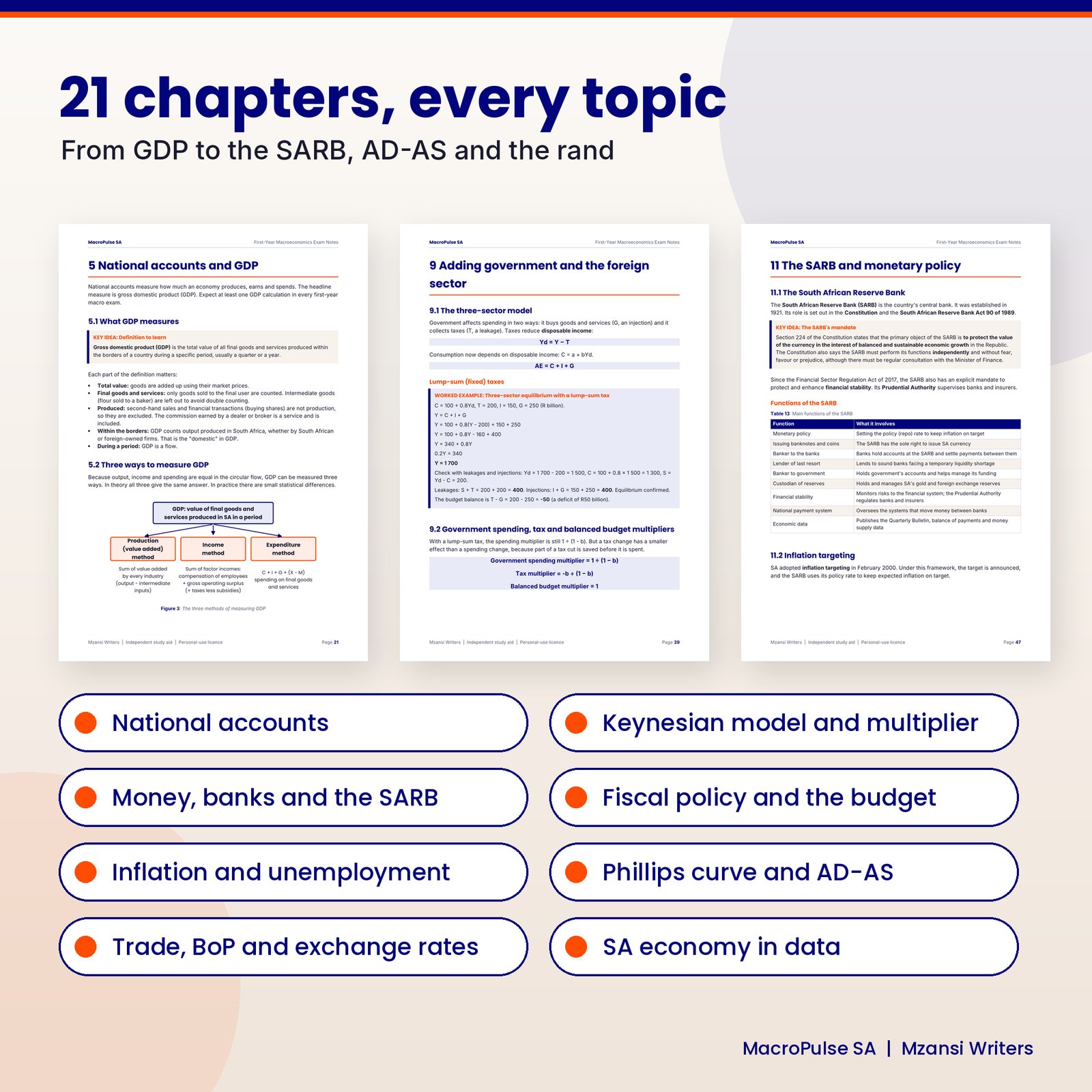
- National accounts: GDP by the production, income and expenditure methods, GDE, GNI, basic prices and factor cost, real versus nominal GDP and the deflator
- Growth and the business cycle: measuring growth, the rule of 70, SARB business cycle indicators
- The Keynesian model: consumption and saving functions, MPC and APC, the 45-degree diagram, equilibrium income, the multiplier, the paradox of thrift, three- and four-sector models, tax and balanced budget multipliers, recessionary and inflationary gaps
- Money and banking: functions of money, SA monetary aggregates (M1A to M3), how banks create money, the money multiplier
- The SARB and monetary policy: the constitutional mandate, the new 3% inflation target, the policy (repo) rate, the MPC, the transmission mechanism and its limits
- Money demand and the quantity theory: Keynes’s motives, the money market, MV = PY, real interest rates
- Fiscal policy: the SA budget cycle, taxes, deficits, the primary balance, debt-to-GDP, automatic stabilisers, crowding out and the Laffer curve
- Inflation and unemployment: CPI calculations, demand-pull and cost-push inflation, QLFS definitions, official and expanded unemployment, types and causes of unemployment in SA
- The Phillips curve and AD-AS: demand and supply shocks, stagflation and policy responses
- The open economy: comparative advantage, terms of trade, protectionism, the balance of payments, exchange rates, cross rates and purchasing power parity
- Extension: an introduction to IS-LM for modules that include it
Features
Clear notes with exam-ready diagrams
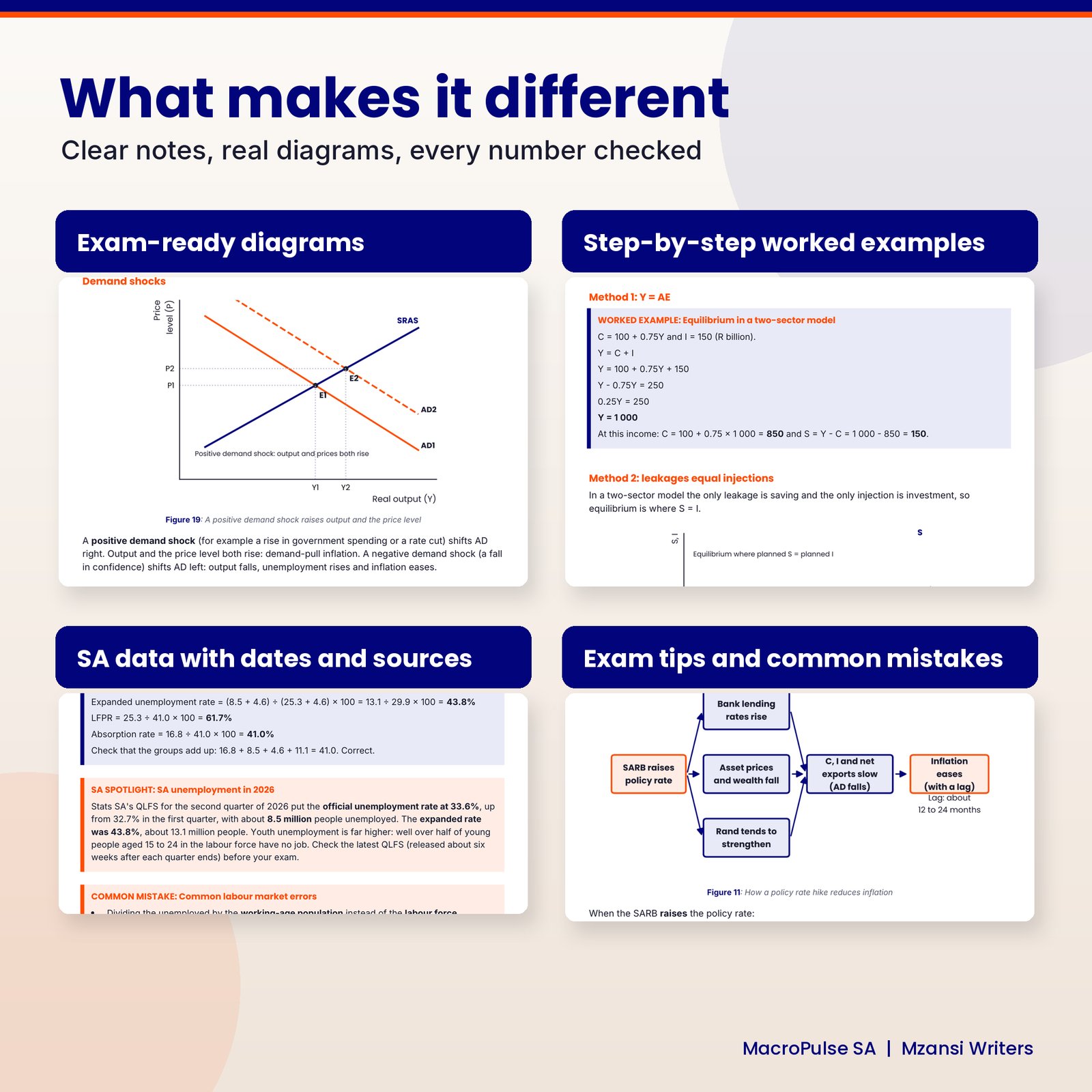
The pack includes 24 diagrams drawn the way examiners want to see them: labelled axes, labelled curves, old and new equilibrium points and arrows showing the shift. A diagram checklist tells you exactly what each one must show.
Worked examples you can follow
Every calculation type that appears in first-year papers is worked step by step: value added, GDP and GNI, real growth, equilibrium income, multipliers, expenditure gaps, deposit creation, the quantity theory, CPI baskets, real wages, labour market rates, AD-AS equations, the balance of payments and exchange rates.
South African context and current data
SA spotlight boxes use real, dated figures from the SARB, Stats SA and National Treasury, checked in November 2026. That includes the move to a 3% inflation target, the 2026 rate decisions, CPI inflation, the QLFS unemployment rates and the government debt ratio. A data chapter shows you where to find the latest numbers and how to use them in essays.
Exam technique built in
Chapter 1 explains how macro papers are set, what each command word asks for, how to approach MCQs, calculations and diagrams, and a simple essay structure (DETAC) that helps you cover every part of a long question.
Memory aids, tips and common mistakes
Colour-coded boxes flag exam tips, common mistakes, memory aids and key definitions, so you can scan a chapter in a few minutes before a test.
What is included
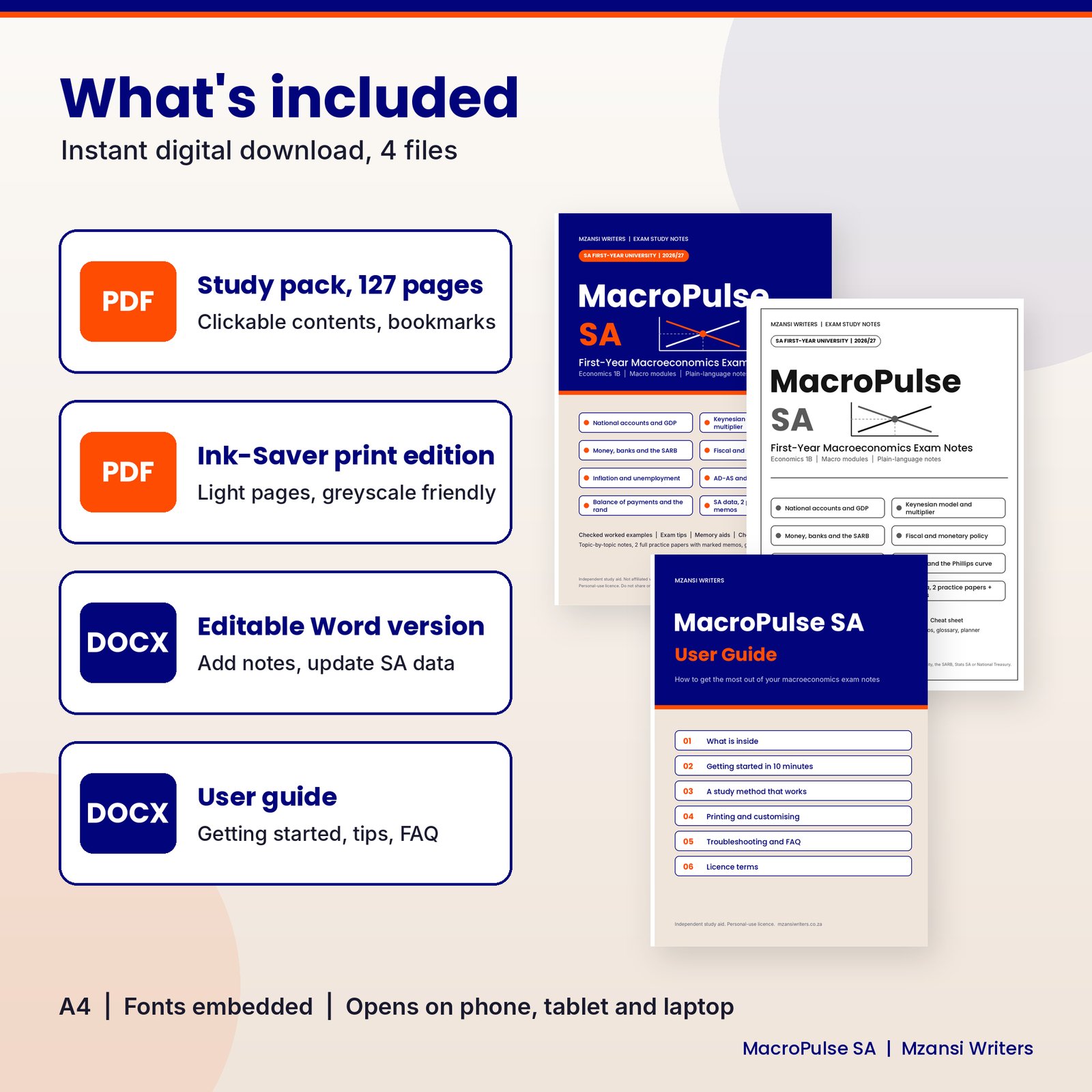
- Study pack PDF (127 A4 pages) with a clickable contents page and bookmarks
- Ink-Saver PDF for printing: light pages, greyscale-friendly diagrams
- Editable Word (DOCX) version with real heading styles and an automatic contents page
- User guide (DOCX) with a study method, printing tips, troubleshooting and FAQ
- 21 chapters, practice questions after every chapter, and answers at the back
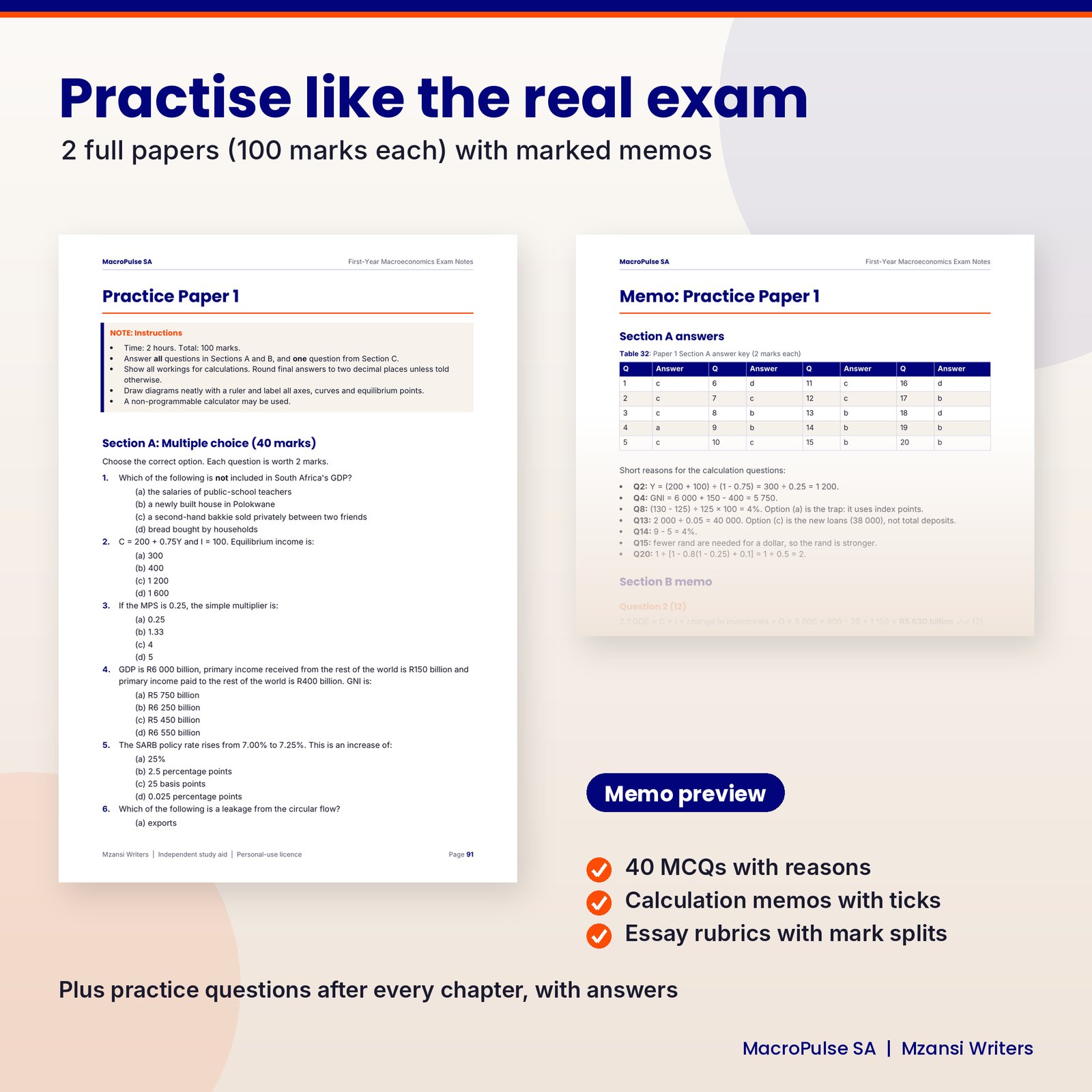
- 2 full practice papers (100 marks each) with marked memos and essay rubrics
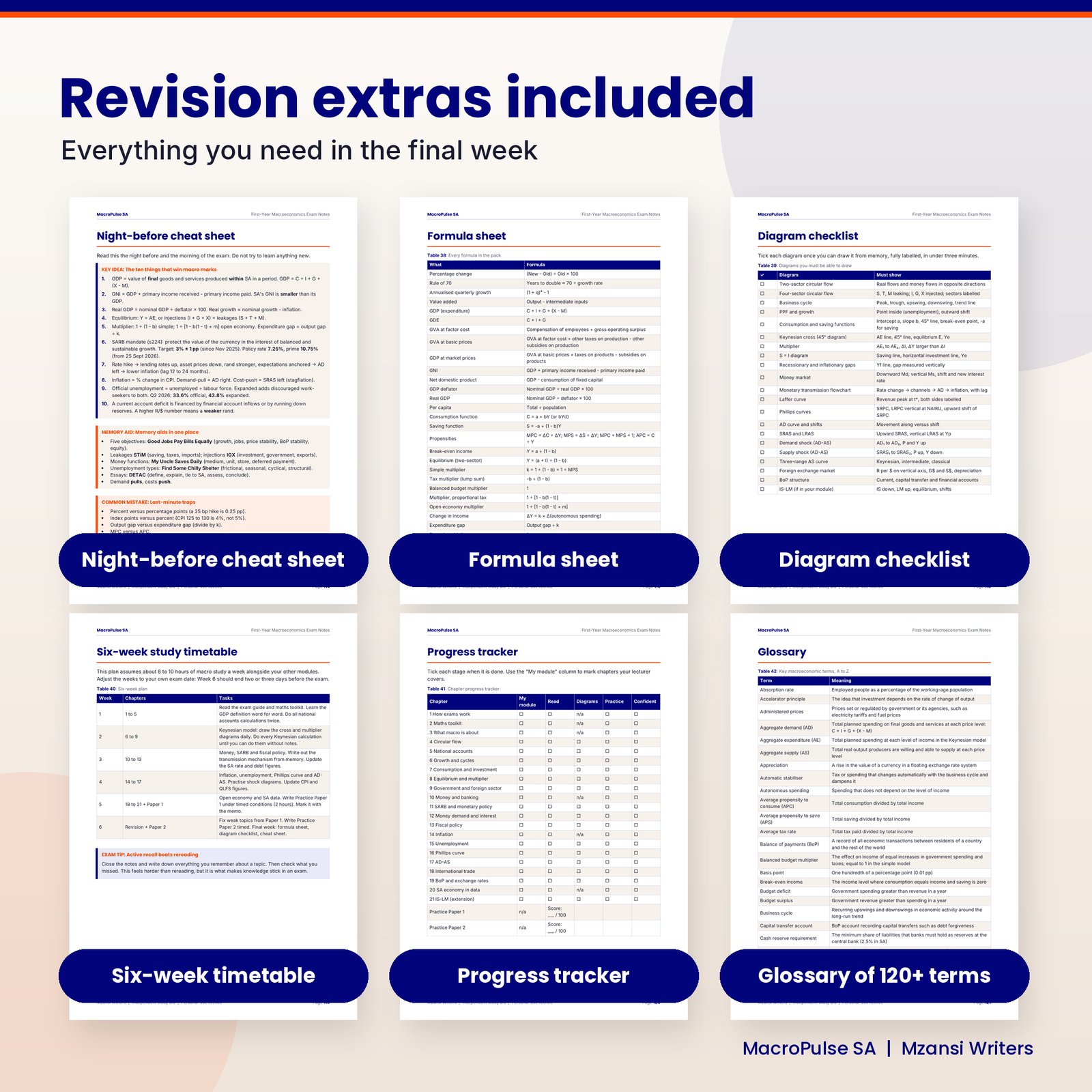
- Night-before cheat sheet, formula sheet, diagram checklist, six-week study timetable, progress tracker and a glossary of more than 120 terms
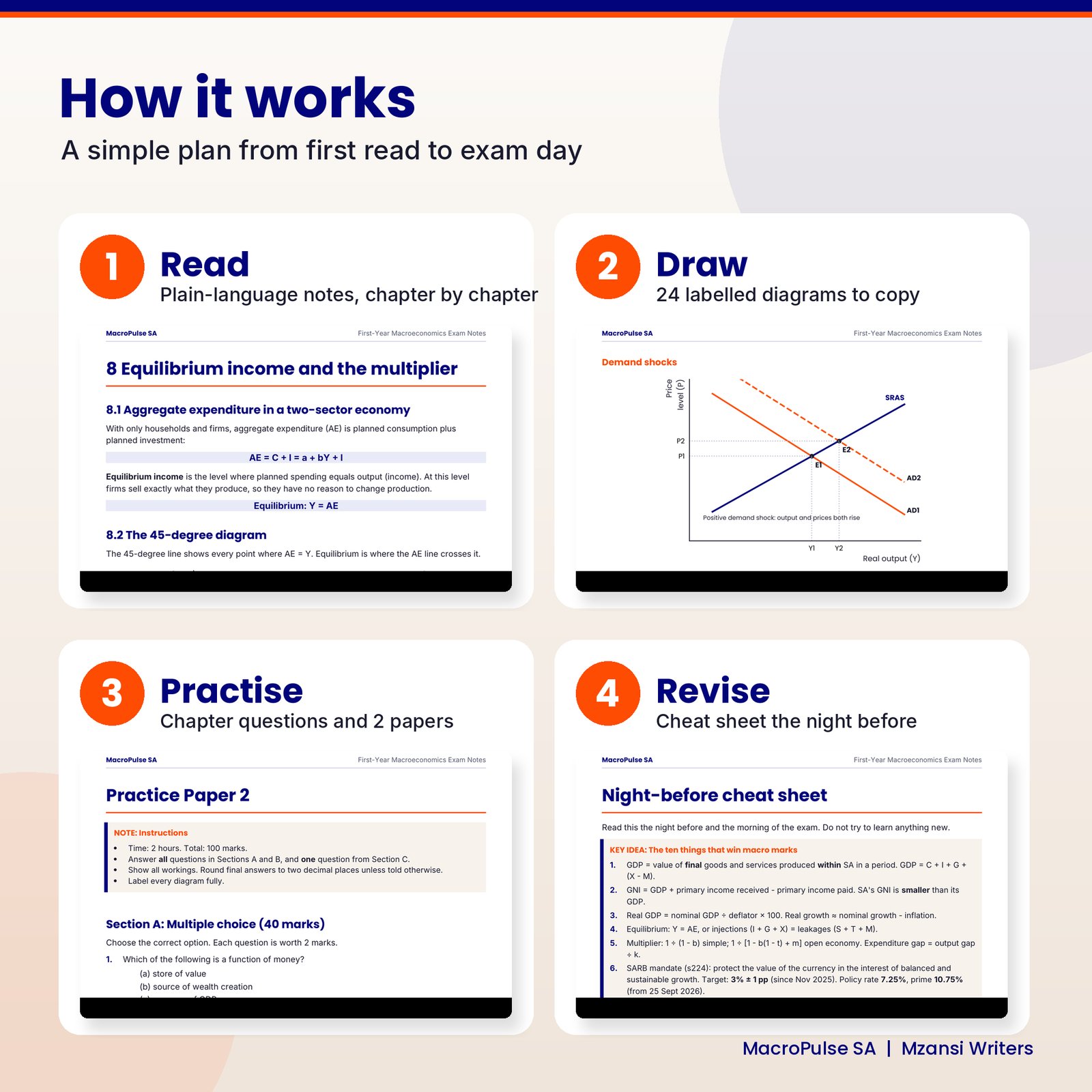
How it works
- Download your files straight after payment.
- Check your module outline and tick your chapters in the progress tracker.
- Read and draw: work through each chapter, redrawing every diagram.
- Practise: do the chapter questions, then write both practice papers under timed conditions and mark them with the memos.
- Revise: use the cheat sheet and formula sheet in the final days.
File formats and software
- PDF: opens in any PDF reader on Android, iPhone, tablets, Windows and Mac. Fonts are embedded.
- DOCX: opens in Microsoft Word, Google Docs or LibreOffice Writer. Use it to add your own notes or update the SA data table.
- Page size: A4. Print the Ink-Saver edition to save toner.
Digital download
This is a digital product. No physical item is posted. You can download the files from your account straight after checkout. Licence: personal use by the buyer only; do not share, upload or resell.
Use cases
- Preparing for semester tests and the final macroeconomics exam
- Catching up after missing lectures or falling behind on the textbook
- Practising calculations such as GDP, the multiplier and CPI before a test
- Planning essays on monetary policy, fiscal policy, inflation or unemployment in SA
- Last-week revision with the cheat sheet, formula sheet and diagram checklist
Frequently asked questions
Does this cover my university’s macro module?
It covers the topics found in first-year macroeconomics modules across SA universities. Outlines differ, so compare the contents page with your module guide. Chapter 21 (IS-LM) is an extension for modules that include it.
Is the SA data current?
Figures were checked against SARB, Stats SA and Treasury releases in November 2026 and every figure is dated. The pack shows you where to find updates before your exam.
Are the practice papers real past papers?
No. All questions and both papers are original, written in the style of first-year macro exams, with full memos.
Does it include microeconomics?
No, this pack is macroeconomics only. Mzansi Writers sells a separate microeconomics pack.
Can I print it?
Yes. Use the Ink-Saver PDF, which is designed for A4 printing in black and white.
Can I edit the notes?
Yes. The Word version can be edited in Word, Google Docs or LibreOffice.
Can I share it with my study group?
No. The licence covers one person. Each group member needs their own copy.
Important
MacroPulse SA is an independent study aid by Mzansi Writers. It is not affiliated with, endorsed by or approved by any university, UNISA, the South African Reserve Bank, Statistics South Africa, National Treasury, the Department of Higher Education and Training or any textbook publisher. Names are used only to describe the content you will be examined on. Use the notes alongside your prescribed material and your lecturer’s guidance.



Reviews
There are no reviews yet.