



Description
Biome to Bylaw is a complete set of Environmental Science exam notes for South African university students. In 128 A4 pages it takes you from ecology and biodiversity to climate change, water, pollution, sustainability and South African environmental law, with NEMA at the centre. You get clear notes, 22 diagrams, worked calculations, 109 chapter questions, two full practice papers and memos for everything.
Mzansi Writers is an independent study aid publisher. This product is not affiliated with, endorsed by or approved by any university, college, DHET, DFFE, SANBI or any other organisation named in it. Names are used only to describe the content.
Environmental Science exam notes built for South African modules
Most textbooks are written for overseas students. Biome to Bylaw uses South African biomes, laws, court cases and data, so your answers earn the “application” marks that lecturers look for. Every chapter is in plain English, with short paragraphs, key terms in bold and tables that compare concepts side by side.
Who it is for
- First-year and second-year students in Environmental Science, Environmental Management, Environmental Studies or Geography and Environmental Science
- BSc, BA, BCom and BEd students taking an environmental module
- Distance learners who want structured notes next to their study guide
- Students repeating a module who need a fresh, organised way to revise
What the study pack covers
- Part A: Exam success. How tests and exams are set, command words, essay structure (PEEL), calculation layout and how to read graphs.
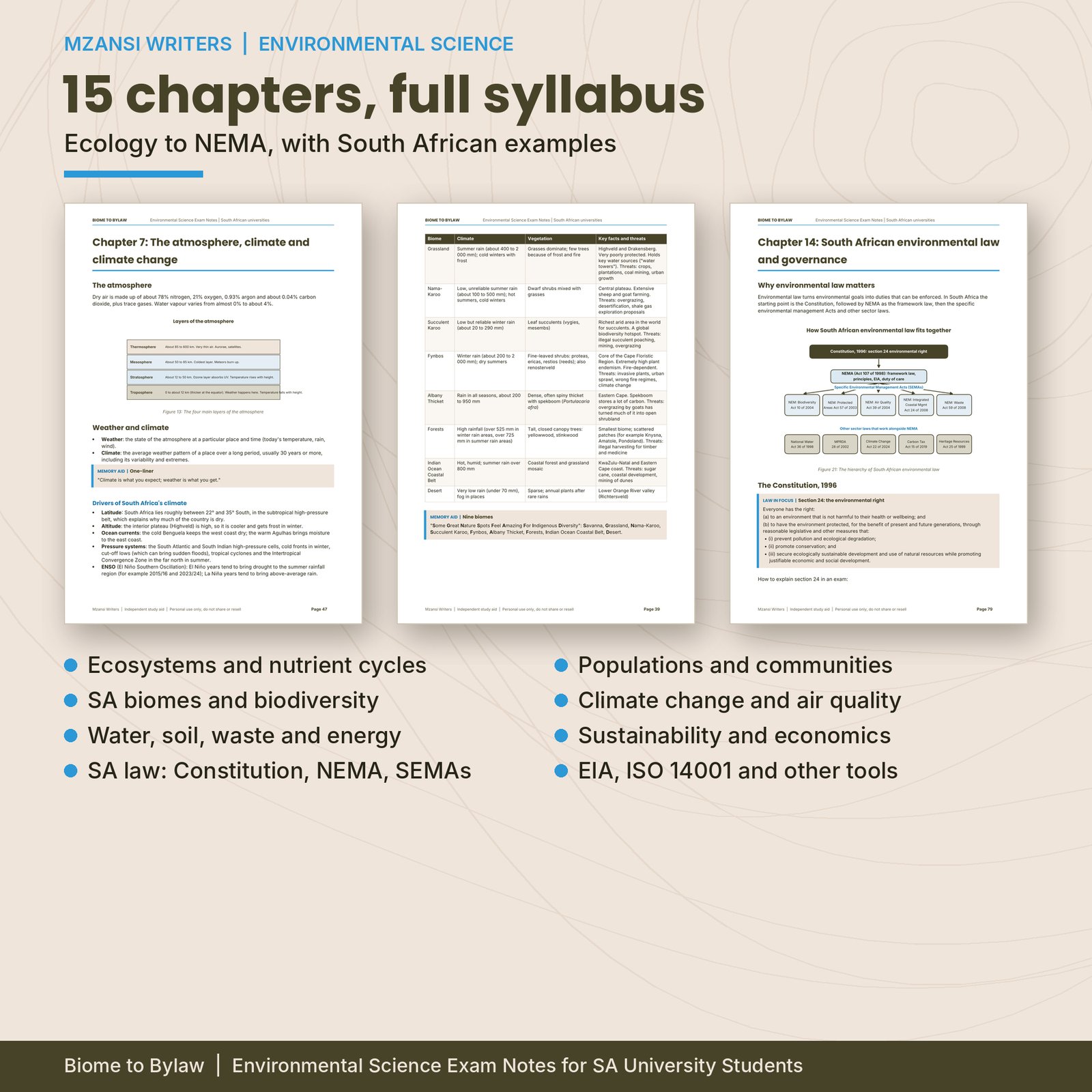
- Chapters 1 to 4: Ecology. Systems and the four spheres, IPAT and ecological footprints, energy flow and the 10% rule, carbon, nitrogen, phosphorus and water cycles, population growth models, mark-recapture, r and K selection, human population and the demographic transition, species interactions, diversity indices and succession.
- Chapters 5 and 6: Biomes and biodiversity. South Africa’s nine biomes, wetlands, estuaries, ocean currents, the three biodiversity hotspots, HIPPO threats, IUCN Red List categories, conservation strategies and case studies on rhino poaching and the African penguin.
- Chapters 7 and 8: Climate and air. The greenhouse effect, GWP and CO2-equivalent, evidence for climate change, impacts on South Africa, mitigation and adaptation, the Paris Agreement, the Carbon Tax Act and the Climate Change Act 22 of 2024, air pollutants, priority areas, temperature inversions, acid rain and the Deadly Air case.
- Chapters 9 to 12: Water, land, waste and energy. Water scarcity, Day Zero, water quality and BOD, eutrophication, acid mine drainage, the National Water Act and the Reserve, soil and land degradation, food security, mining, the waste hierarchy, landfills, EPR, the circular economy, coal, renewables, load-shedding and the just energy transition.
- Chapter 13: Sustainability. Brundtland, weak and strong sustainability, SDGs, planetary boundaries, externalities, environmental taxes, valuation methods and environmental justice.
- Chapter 14: South African environmental law. Section 24 of the Constitution, NEMA principles, environmental authorisation, section 24G, the section 28 duty of care, the five SEMAs, invasive species categories, international agreements and eight key court cases.
- Chapter 15: Management tools. The EIA process (Basic Assessment and Scoping and EIR), the mitigation hierarchy, EMPrs, ISO 14001, auditing, life cycle assessment, risk assessment and DPSIR.
Features
- 22 original diagrams, from the nitrogen cycle to the EIA flowchart
- Worked examples for every calculation type, each one rechecked
- Exam tips, common mistakes, memory aids, SA spotlights, law boxes and case studies
- 109 Check yourself questions with mark allocations
- Two full 100-mark practice papers in university format
- Full memos with mark allocations and essay marking guidelines
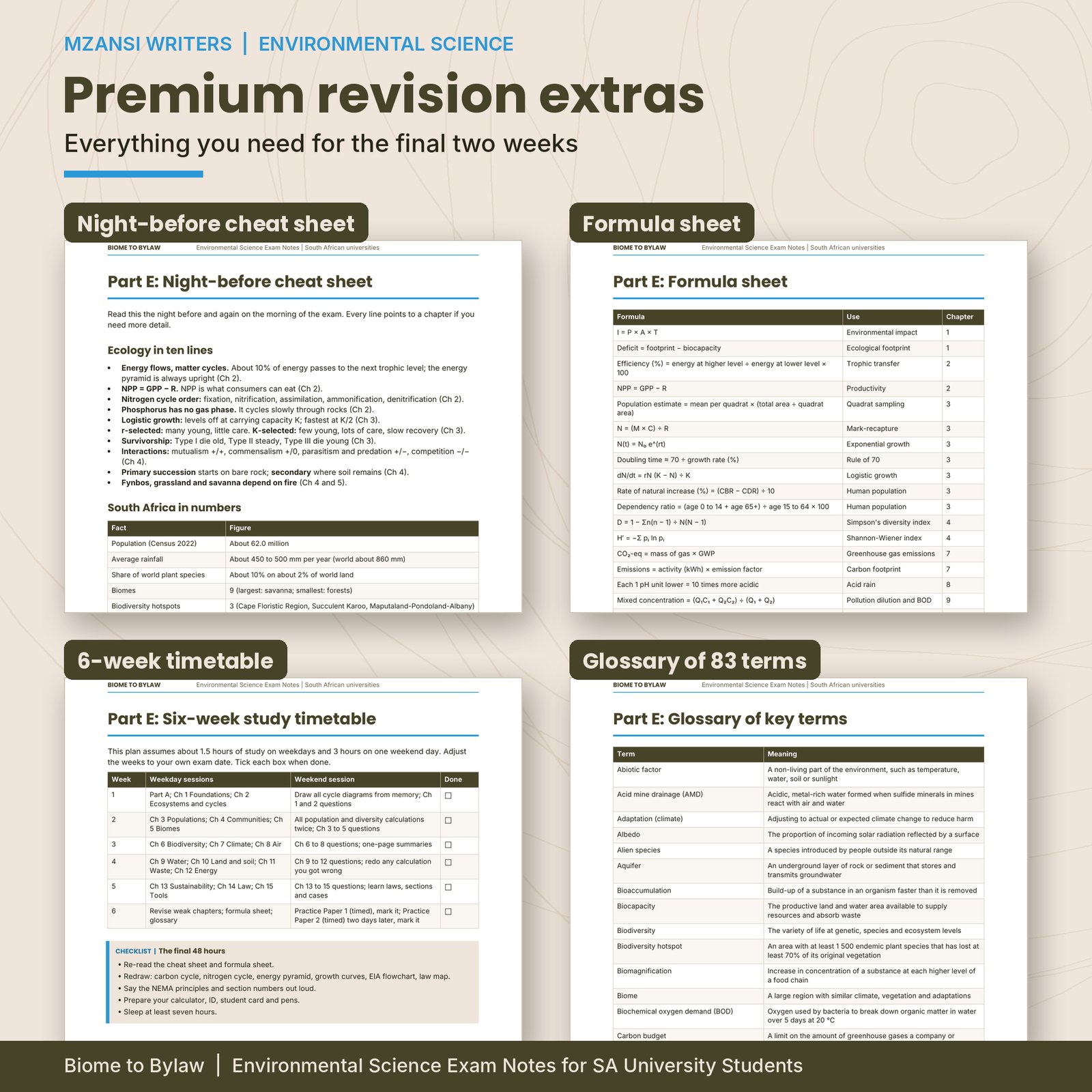
- Night-before cheat sheet, formula sheet, six-week study timetable, progress checklist and score tracker
- Glossary of 83 key terms
What’s included
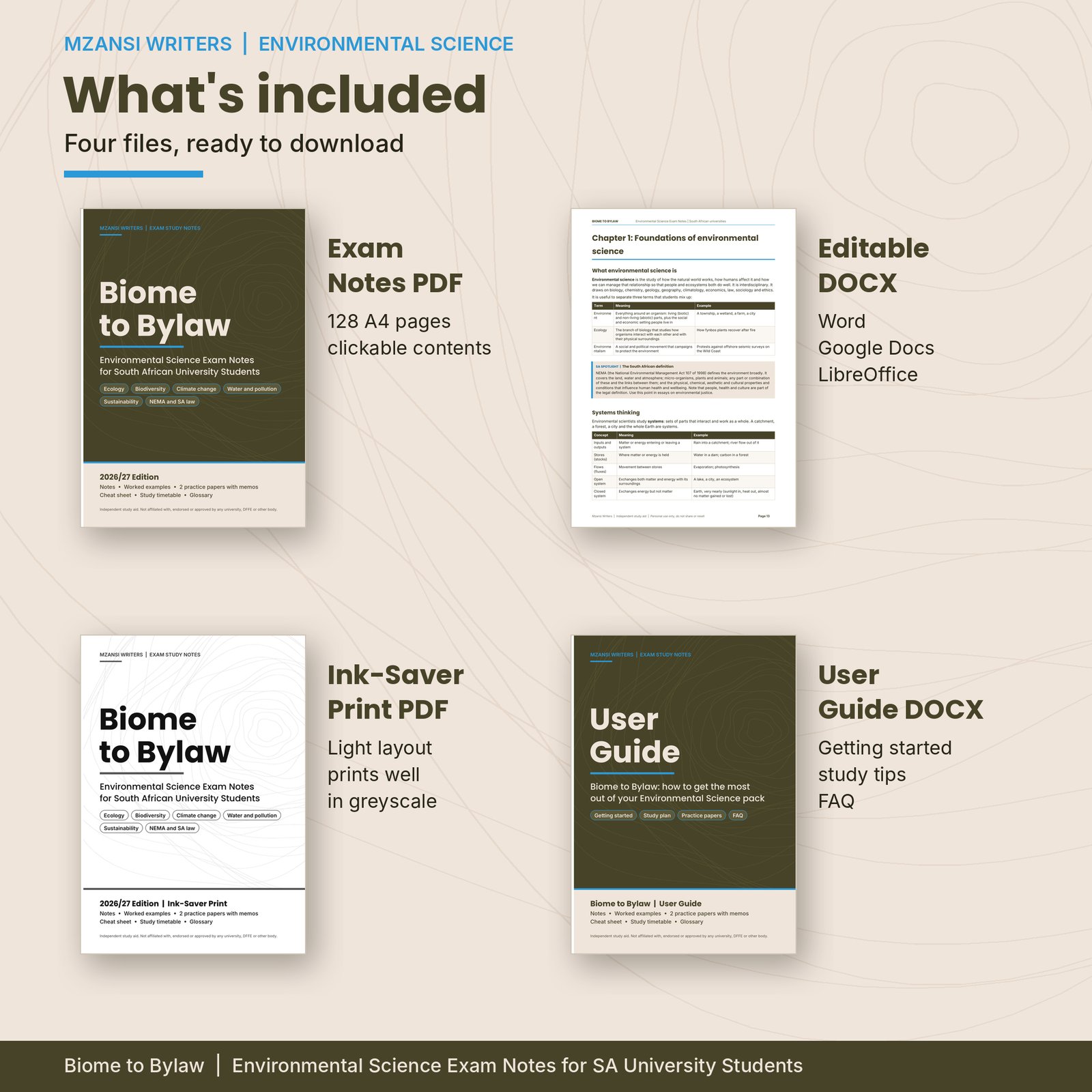
- Exam Notes PDF (128 A4 pages) with a clickable contents page and bookmarks
- Editable DOCX with real heading styles and an automatic table of contents
- Ink-Saver Print PDF, a light, greyscale-friendly edition for home printing
- User Guide DOCX with getting started steps, study tips, troubleshooting and FAQ
How it works
- Buy and download the files straight after checkout.
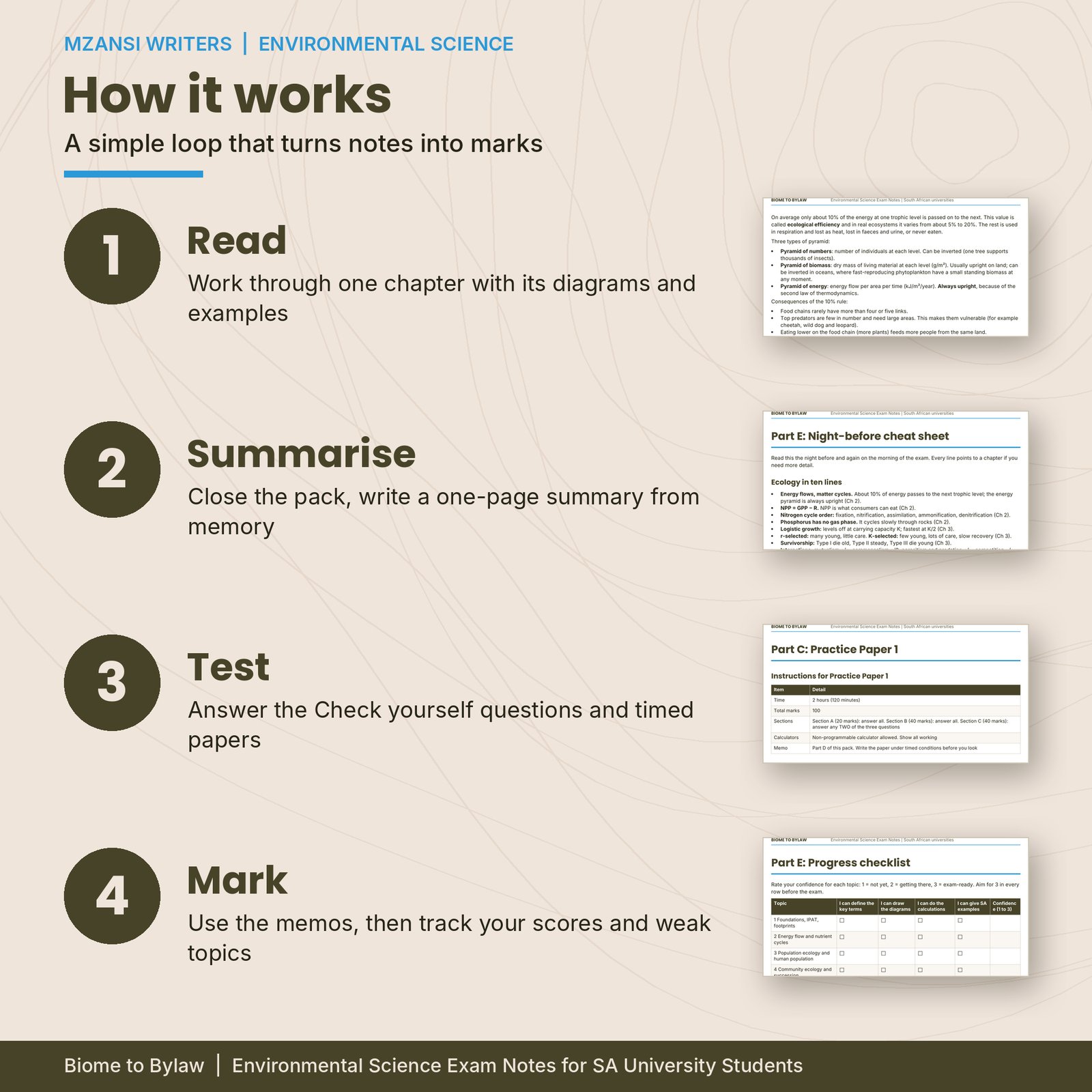
- Read Part A, then plan your weeks with the timetable.
- Work through one chapter at a time and write a one-page summary from memory.
- Answer the Check yourself questions and mark them with the memos.
- Write both practice papers under timed conditions and track your scores.
- Use the cheat sheet and formula sheet the night before.
File formats and software
PDF files open in any PDF reader on a phone, tablet or computer (Adobe Acrobat Reader, Edge, Chrome, Apple Books or Google Drive). The DOCX files open in Microsoft Word, Google Docs or LibreOffice. All PDFs are A4 with fonts embedded.
Customising
Use the editable DOCX to add your own notes, highlight key points or adjust figures to match your lecturer’s slides. Headings use built-in styles, so you can restyle the whole document in a few clicks and refresh the contents page after editing.
Digital download
This is a digital product. Nothing is posted. Your download links appear on the order confirmation page and in your account straight after payment.
Use cases
- Preparing for a semester test on ecology, populations or biodiversity
- Revising for a final exam that mixes short questions, calculations and essays
- Writing an assignment on climate change, water security or environmental justice
- Learning NEMA, the EIA process and key court cases for an environmental law section
- Catching up quickly after missing lectures
FAQ
Does it match my university’s module?
It covers the core content shared by most first-year and second-year Environmental Science modules in South Africa. Check your module outline to see which chapters your lecturer stresses.
Is the law up to date?
Yes, as of November 2026. It includes the Climate Change Act 22 of 2024 (in operation since 17 March 2025), the 2026 carbon tax rate and the 2022 NEMA amendments.
Are the practice papers real past papers?
No. They are original papers written in university exam format, with full memos.
Can I print it?
Yes, for your own use. The Ink-Saver Print PDF is designed for black and white printing.
Do I need Microsoft Word?
No. The PDFs open in any PDF reader, and the DOCX works in free Google Docs or LibreOffice.
Can I share it with my study group?
No. The licence is for one person’s personal use. Each person needs their own copy.
Licence
Personal use licence for one buyer. You may not share, upload, resell or copy any part of the product. All content is original work by Mzansi Writers. Trademarks and names of institutions belong to their owners and are used only to describe the subject.


Reviews
There are no reviews yet.