


Description
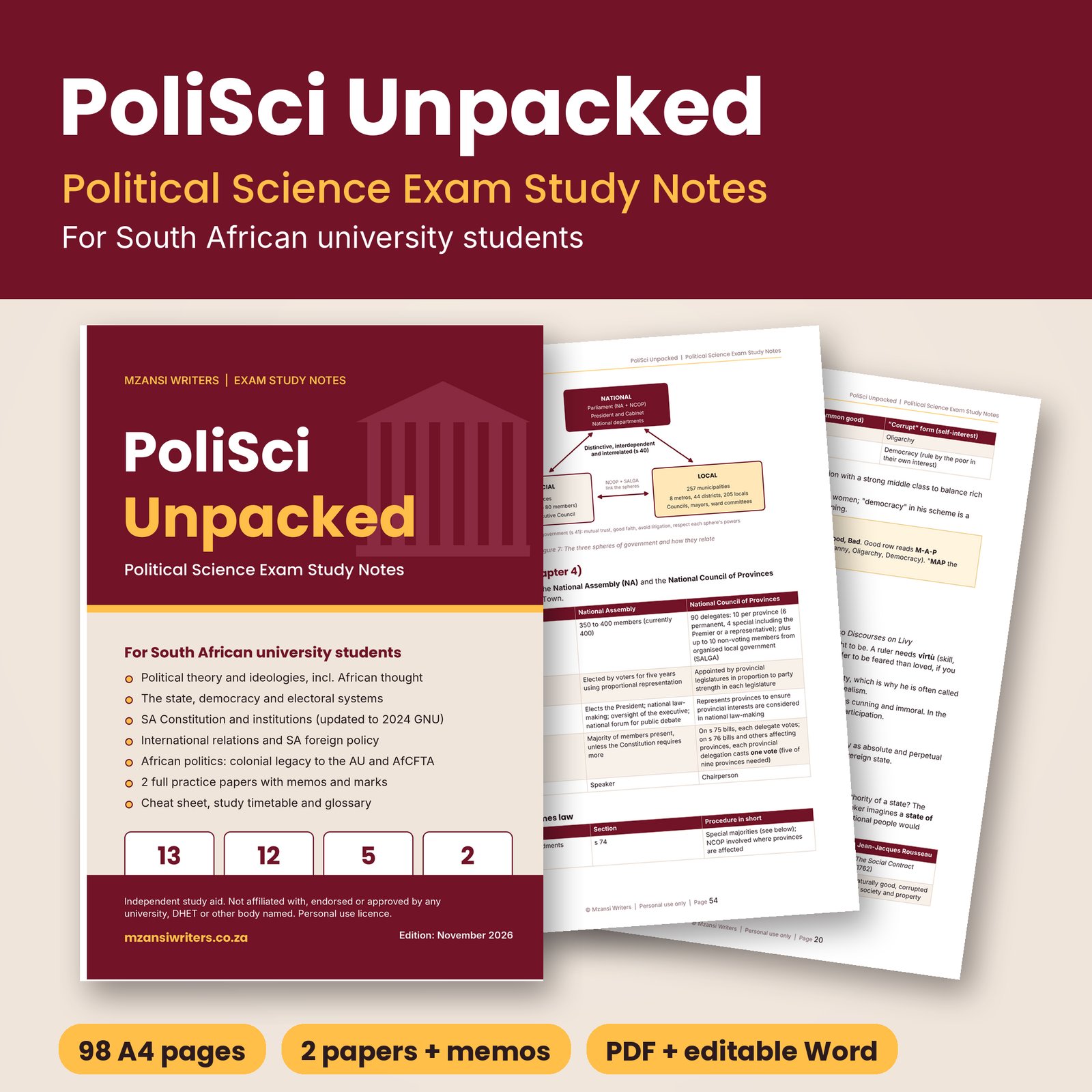
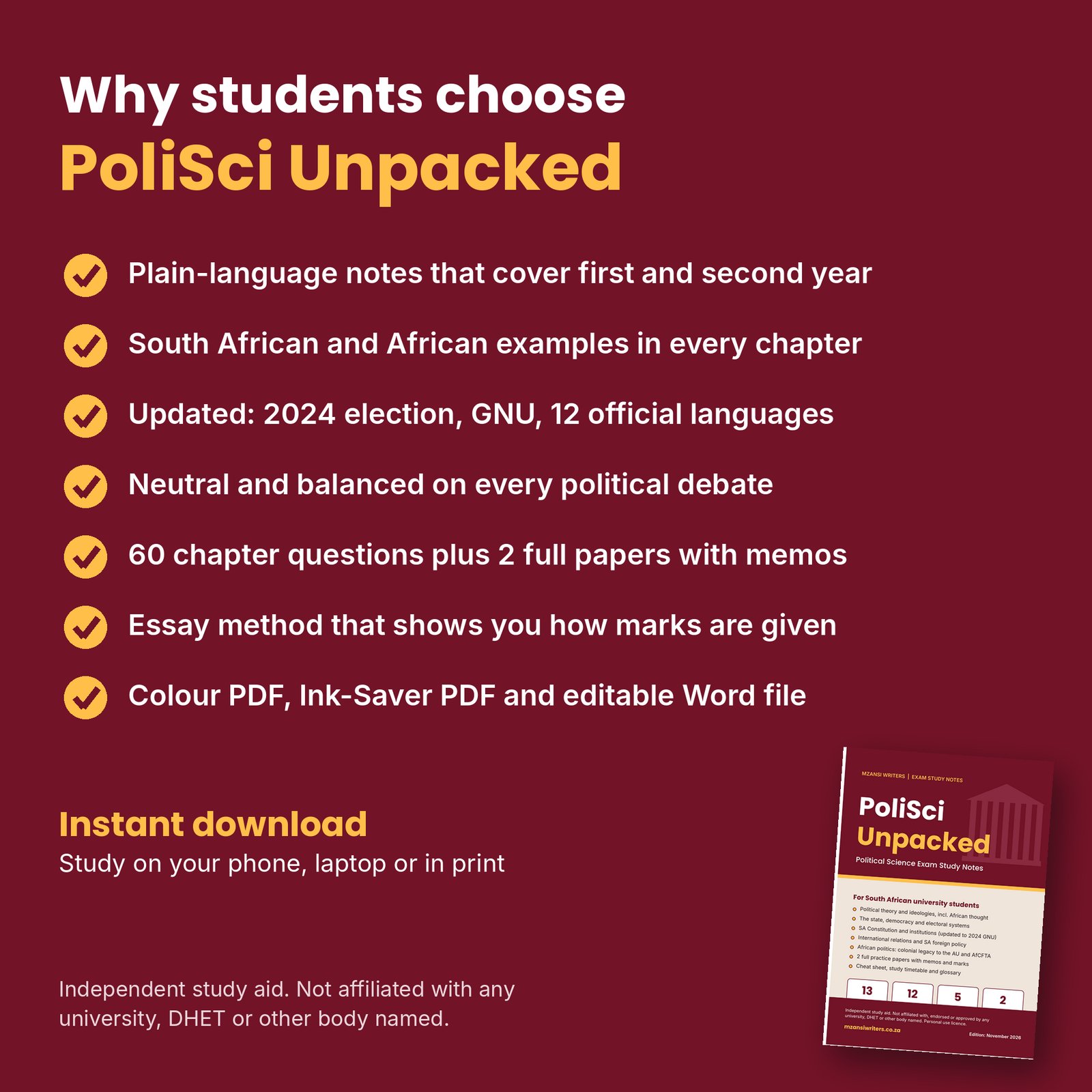
PoliSci Unpacked is a set of Political Science notes for South African university students who want to understand the work and write better exam answers. In 98 A4 pages it explains political theory, the state, democracy, the South African Constitution and its institutions, international relations and African politics in plain language, then gives you the practice you need to turn that knowledge into marks.
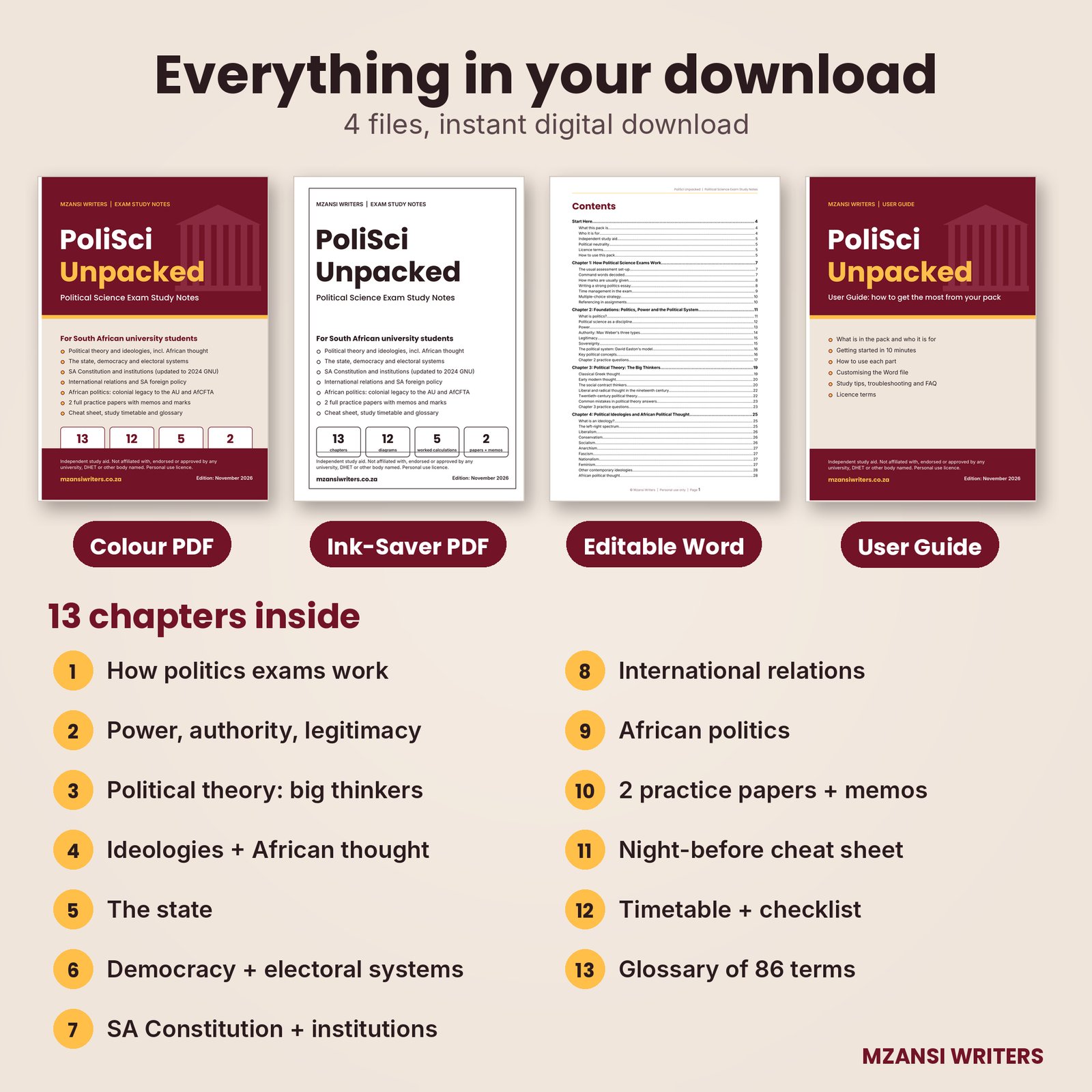
You get a colour PDF for reading on any device, an Ink-Saver PDF for printing, an editable Word version for your own notes, and a user guide.
What these Political Science notes do for you
Politics exams reward argument, not memorisation alone. Each chapter therefore does two jobs. First, it explains the concepts, thinkers and facts clearly, with tables that compare theories side by side. Second, it shows you how to use them in an exam answer, with tips on command words, essay structure and the evidence markers look for.
The notes are neutral and balanced. Where scholars or parties disagree, both sides are set out fairly, and election results and events are reported as facts with dates. You learn how to argue; your position stays your own.
Who it is for
- First-year students in introductory politics or political science modules
- Second-year students in South African politics, comparative politics, African politics or international relations
- Distance-learning students who need notes that work on their own
- Law, public administration, development studies, international studies and journalism students taking politics as a second major
- Third-year students who want the foundations back in place before a big exam
What is covered
Foundations and political theory
Definitions of politics, power (including Lukes’s three faces), Weber’s types of authority, legitimacy, sovereignty and Easton’s systems model. Then the big thinkers: Plato, Aristotle, Machiavelli, Hobbes, Locke, Rousseau, Montesquieu, Mill, Marx, Gramsci, Rawls and Nozick, each with the main idea, key concept and a criticism you can use.
Ideologies and African political thought
Liberalism, conservatism, socialism, anarchism, fascism, nationalism, feminism and populism, plus Pan-Africanism, Négritude, Nyerere’s Ujamaa, Fanon, Cabral, the Freedom Charter, Black Consciousness, ubuntu and decolonial thought.
The state, democracy and government
Theories of the state, the developmental state, unitary and federal systems, regime types and failed states. Models of democracy, Huntington’s waves, consolidation, executives, legislatures, parties, coalitions, civil society and voting behaviour. Electoral systems come with five worked calculations: FPTP, D’Hondt, Sainte-Laguë, largest remainder with a Droop quota, and the effective number of parties. Every figure was checked.
The South African Constitution and institutions
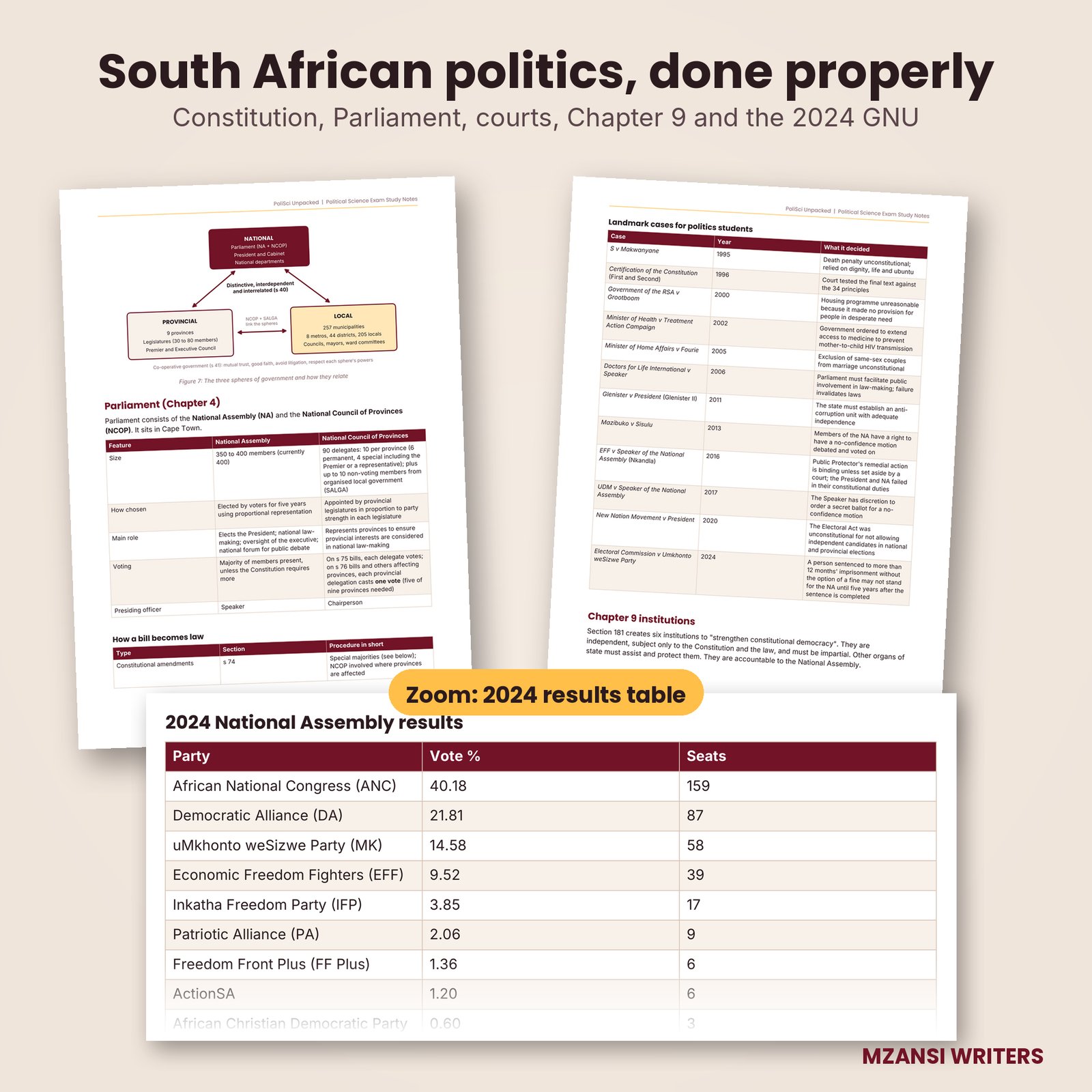
The road to 1996, the Bill of Rights and the s 36 limitation clause, Parliament and law-making, the President and no-confidence motions, provinces, local government, the courts and landmark cases, Chapter 9 institutions, the electoral reforms of 2023, the 2024 election results and the Government of National Unity.
International relations and African politics
Realism, liberalism, constructivism, Marxist, feminist and postcolonial approaches; the UN, Bretton Woods, BRICS and the G20; globalisation, security and South Africa’s foreign policy since 1994. African politics covers colonial rule, Mamdani’s bifurcated state, decolonisation, one-party states and coups, neo-patrimonialism, ethnicity, democratisation, the AU, SADC, AfCFTA and recent trends in the Sahel.
Features
- 13 chapters with real heading styles and a clickable table of contents
- 12 clear diagrams, from Easton’s model to the court hierarchy and the 2024 seat chart
- Memory aids, exam tips, common-mistake boxes and South African examples throughout
- 60 chapter practice questions with answer guides and mark splits
- 2 full 100-mark practice papers with memos, MCQ answer keys and essay rubrics
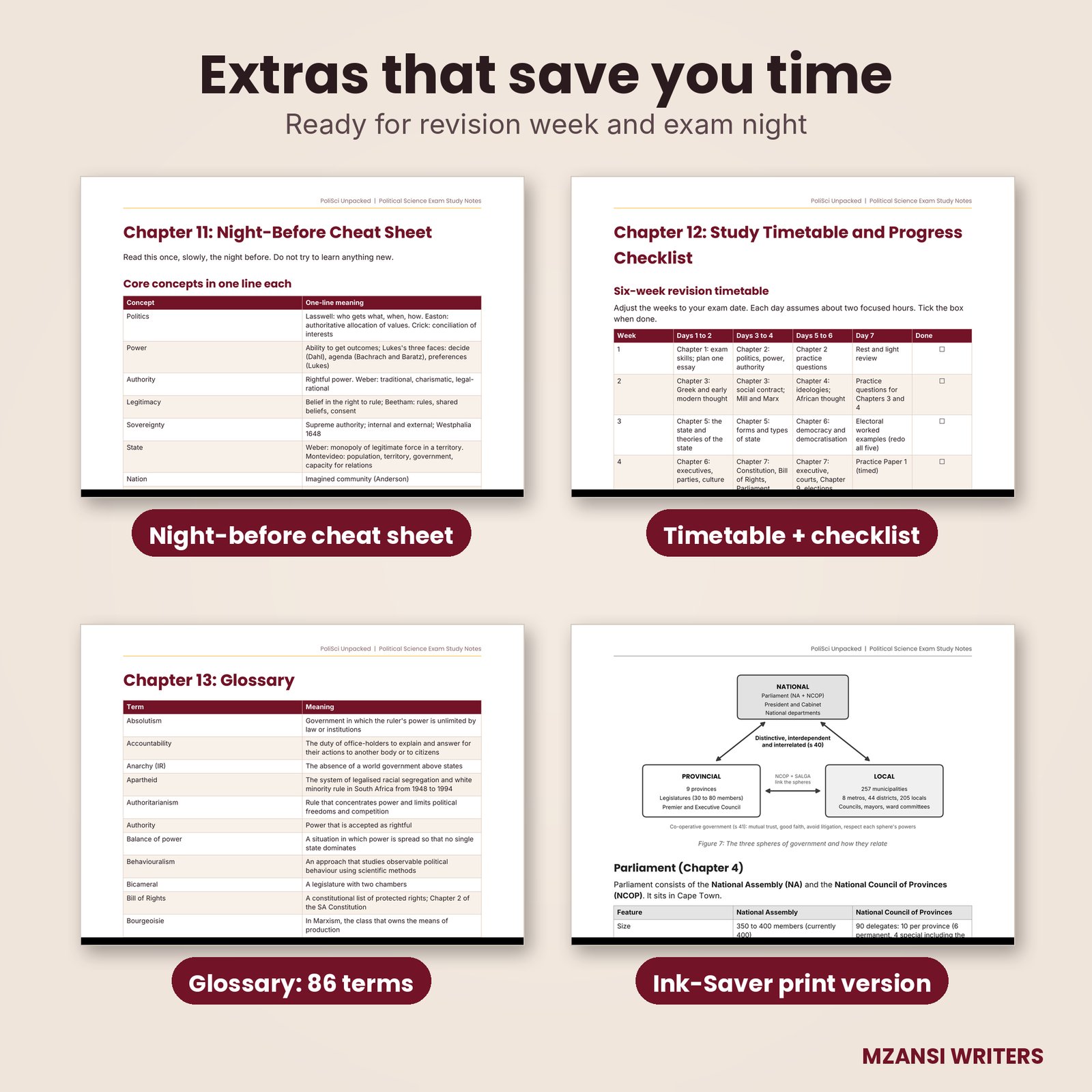
- A night-before cheat sheet, six-week and four-week timetables, a 38-topic progress checklist and a practice log
- A glossary of 86 key terms
What is included
- PoliSci Unpacked Political Science Exam Notes, colour PDF (98 pages, bookmarks and clickable contents)
- Ink-Saver PDF with light backgrounds and greyscale-friendly diagrams for printing
- Editable Word (DOCX) version
- User Guide (DOCX) with getting-started steps, customising tips, troubleshooting and FAQ
How it works
- Buy and download the files straight away from your account.
- Open the contents and tick the chapters that match your module outline.
- Read each chapter, then answer its practice questions and check the answer guide.
- Write the two practice papers under timed conditions and mark them with the memos.
- Use the cheat sheet the night before your exam.
File formats and software
PDF files open in any PDF reader, including Adobe Acrobat Reader, Microsoft Edge, Chrome and phone PDF apps. The DOCX files open in Microsoft Word, Google Docs or LibreOffice Writer. All files are A4.
Customisation
The Word version is fully editable. Add your lecturer’s examples under any heading, highlight key points, change the heading styles or delete chapters your module does not cover. Update the table of contents with one click after editing.
Digital download
This is a digital product. Nothing is posted. Your download links appear immediately after payment and are also available from your account on Mzansi Writers.
Use cases
- Preparing for a semester test or final exam in an introductory politics module
- Planning an essay on the state, democracy or the Constitution and needing a clear starting point
- Catching up after missing lectures
- Revising South African institutions and section numbers before an open-book online exam
- Getting ready for a second-year African politics or international relations module
Frequently asked questions
Does it match my university’s Political Science module?
It covers the topics found across most South African first-year and second-year politics modules. Use your module outline to choose the chapters you need.
Is it updated for the 2024 election?
Yes. It includes the 2024 National Assembly results, the Government of National Unity at formation, the 2023 electoral reforms and South Africa’s twelfth official language. Facts were checked in November 2026.
Is it politically biased?
No. Debates are presented from all sides and results are reported as facts. The pack teaches you how to build your own argument.
Can I print it?
Yes, for your own use. The Ink-Saver PDF is made for printing.
Can I use it on my phone?
Yes. The PDF opens in any phone PDF app, with bookmarks for quick navigation.
Can I copy it into my assignment?
No. It is a study aid. Write assignments in your own words and cite your prescribed sources.
Can I share it with my study group?
No. The licence is for one person’s personal use. Each member needs their own copy.
Licence and independence
Personal use licence for one person: no resale, sharing, uploading or copying for others. Mzansi Writers is an independent study aid. This product is not affiliated with, endorsed by or approved by any South African university, the Department of Higher Education and Training (DHET), the IEC, Parliament or any other institution named. Names are used only to describe the subject.


Reviews
There are no reviews yet.